
We know that quiet worry. That moment after a long day, when you hope the verses shared with your child have found a home in their heart—not just their short-term memory.
In our busy lives here in the West, between school, activities, and the ever-present glow of screens, creating a deep and lasting bond with the Quran can feel like an uphill climb. The desire is immense, but time and competing distractions are real.
This is where the power of Visual Quran learning enters the picture. It’s not about replacing tradition; it’s about enhancing it with how young minds are wired to learn today.
Children are naturally engaging with digital worlds. The key, as research suggests, is making mindful choices about that engagement—choosing tools that truly benefit their development. We believe that by embracing a science-backed, visual approach, we can transform this challenge into a joyful and effective journey.
Together, we can move beyond simple rote repetition. We can unlock a method that aligns with your child’s natural way of processing information, building a connection that is both meaningful and enduring.
Transform your child’s Quran routine today with the [Ayah & Tardeed Package] for just
Key Takeaways
- Many parents in the diaspora face the dual challenge of limited time and ensuring their children retain Islamic teachings.
- Modern Islamic education tools that leverage digital engagement can be part of a mindful, beneficial learning strategy.
- Visual learning methods are supported by science and align with how children naturally absorb information.
- This approach aims to complement traditional methods, making Quran memorization more engaging and effective.
- The goal is to build a deep, lasting personal connection with the Quran, not just short-term recall.
- Parents and educators can work as partners to navigate modern life while upholding core Islamic values.
The Quiet Struggle of the Diaspora Parent: Seeking Connection in a Busy World
Between soccer practice, math tutoring, and the ever-present glow of tablets, carving out meaningful time for Quranic connection can feel like an impossible mission. We understand this quiet struggle. In the hustle of American life, the desire to root our children in faith competes with a calendar packed with modern demands. The quest isn’t just for a time slot; it’s for a method that sticks and a connection that resonates deeply.
Between School, Activities, and Screen Time: Where Does Quran Fit?
The weekly schedule for many Muslim children in the USA is a masterpiece of logistics. School demands focus, extracurriculars build skills, and downtime often defaults to digital entertainment. Parenting dynamics are changing drastically; there’s an increasing reliance on screen time so we can focus on getting work done. This reality leads to a pivotal question: in this economy of attention, where does the Quran belong?
We often hope online Quran lessons will be the perfect fit—convenient and educational. Yet, the digital landscape is fraught with pitfalls. Many parents share the experience of downloading apps only to discover inappropriate ads, non-Islamic content, or games where a child plays for weeks and learns nothing. This isn’t the engagement we seek.
The Modern Time Crunch: A Typical Week’s Challenge
| Activity | Weekly Hours | Mental Energy Required | Space for Quran? |
|---|---|---|---|
| School & Homework | 35-45 | High | Competes directly |
| Extracurriculars (Sports, Music) | 5-10 | Medium-High | Evenings & weekends |
| Screen Time (Entertainment) | 15-20 | Low (Passive) | Prime opportunity for redirection |
| Family & Downtime | 10-15 | Variable | Potential for integration |
| Quran Study (Ideal) | 2-5 | Focused but Joyful | Needs dedicated, protected slot |
Finding balance requires intentional design, not just finding more time.
The Frustration of Forgotten Lessons: Why Rote Memorization Falters
Perhaps the deeper ache is watching hard work evaporate. Your child masters a Surah, recites it perfectly for a week, and then… it’s gone. This frustration is a common signal. Traditional Quran memorization through pure repetition (rote learning) often fails to create durable neural pathways.
The brain prioritizes information with context, pattern, and meaning. When verses are memorized as isolated sounds without visual or conceptual anchors, they reside in short-term memory. Without consistent, meaningful reinforcement, they fade. This isn’t a reflection of your child’s effort or ability; it’s a limitation of the method itself. We need an approach that builds memory palaces the mind wants to keep.
More Than Just Recitation: The Deep Desire for Meaningful Connection
Ultimately, our goal transcends perfect pronunciation. We yearn for our children to build a heartfelt, lifelong relationship with the Words of Allah. This is the deep desire we share: meaningful connection over mechanical recitation.
Many available digital tools and generic online Quran lessons miss this mark entirely. They focus on drill-and-test mechanics, neglecting the soul of the engagement. True Islamic education for Muslim children in the USA must bridge the gap between the screen and the heart. It must inspire wonder, provide context, and make the divine message feel personally relevant. Your aspiration is valid, and the right method should honor it completely.
The Cognitive Science Behind Visual Quran Learning
At the heart of effective Quran learning for children lies a simple, scientific principle: we remember what we see. For parents seeking genuine connection and retention, understanding this brain-based truth is the key. We transition from identifying the challenge to embracing a solution rooted in how young minds are wired to learn.
This isn’t about adding more flashy graphics. It’s about aligning sacred education with the natural architecture of the human brain. Let’s explore the compelling science that makes visual learning a game-changer for .
How the Human Brain Prioritizes and Stores Visual Information
The human brain is a visual processor first. Scientists estimate that a staggering 90% of the information transmitted to our brain is visual, and we process images 60,000 times faster than text. When a child sees a picture of a mosque alongside the word “مسجد,” two powerful memory systems—the visual cortex and the language center—light up simultaneously.
This dual-coding creates a robust mental “anchor.” The image provides context and meaning that plain text or sound alone often lacks. This is why a child can quickly point to a picture of an apple but might struggle to spell the word. The visual memory is simply more immediate and durable.
This principle is harnessed masterfully in the best . Consider a simple matching game: a child refuses to write a letter ten times on paper but will happily click the correct answer fifty times in a digital activity. The learning goal—recognition through repetition—is identical. The experience, however, is transformed from a chore into engaging play.
Furthermore, immediate feedback solidifies these connections. When a child matches ‘ to a mosque and hears “Correct! That’s masjid!” the brain receives a positive reinforcement signal. This loop of action and instant confirmation makes the knowledge “stick” in a way that delayed correction cannot.
Sequential Visual Memorization: The Method Behind the Magic
Knowing the brain prefers visuals is one thing. Systematically applying it to Quranic mastery is another. This is where our core methodology, Sequential Visual Memorization, comes in. It’s a structured approach that pairs each verse, or even each phrase, with a consistent and meaningful visual cue.
The process is deliberate. A specific image is permanently linked to a specific segment of Quranic text. As the child progresses, they aren’t just memorizing sounds; they are following a visual storyboard. The sequence of images provides a scaffold for recall, turning abstract verses into a concrete, memorable journey.
This method transforms repetition from a monotonous task into an exploratory one. The child’s brain actively seeks the familiar visual anchor, making recall faster and more accurate. It bridges the gap between short-term memorization and long-term retention, building a library of visual-verse pairs in the mind.
We apply these engaging, game-like principles—where repetition feels like play and feedback is instant—but with a sacred intention. The goal is not just to play a game, but to internalize the Quran through the brain’s most powerful pathway.
| Learning Aspect | Traditional Rote Method | Visual Sequential Method |
|---|---|---|
| Primary Engagement | Auditory & textual repetition; can feel like a chore. | Visual and interactive; leverages the brain’s preferred input. |
| Memory Anchor | Sound and text sequence alone. | Dual-coded: sound/text + a consistent, meaningful image. |
| Feedback Loop | Often delayed; correction happens after mistakes are made. | Immediate and positive; reinforces correct connections instantly. |
| Child’s Experience | Can be associated with pressure and frustration. | Feels more like discovery and mastery, sustaining motivation. |
By grounding our approach in cognitive science, we move beyond guesswork. We offer a reliable, effective pathway that respects both the sanctity of the Quran and the natural way children learn. This fusion of modern understanding and traditional reverence creates the ideal موارد تعليمية إسلامية for today’s family.
Why Visual Learning is a Non-Negotiable for Muslim Kids in the USA
When we consider the linguistic, motivational, and identity-based hurdles, visual learning emerges as a non-negotiable pillar for nurturing faith in our children abroad. For families in the diaspora, traditional methods often clash with the realities of modern American life. We need an approach that doesn’t just add another task, but seamlessly integrates profound Islamic learning into our daily rhythm.
Overcoming the Arabic Language Barrier with Universal Visuals
For a child whose first language is English, Arabic presents a triple challenge: a new alphabet, right-to-left reading direction, and unfamiliar phonetic sounds. This can quickly lead to frustration and disengagement. Visual learning bypasses this initial wall of text.
By associating verses with colors, shapes, and sequential images, meaning is grasped intuitively. The child connects with the message of the Quran before mastering the script. This aligns perfectly with a profound teaching of our Prophet ﷺ.
“Make things easy and do not make them difficult, cheer the people up and do not repel them.”
High-quality وسائل تعليمية للقرآن الكريم (educational tools for the Quran) embody this mercy. They transform اللغة العربية للأطفال (Arabic for children) from a daunting subject into a joyful discovery, building a positive foundation for all future مصادر تعلم اللغة العربية (Arabic learning resources).
Cultivating Intrinsic Motivation and Reducing Parent-Child Conflict
The dynamic in many homes shifts from a shared spiritual journey to a nightly battle over recitation. Visual learning changes this script. When lessons are engaging and game-like, curiosity drives the process.
Children begin to explore independently, reducing the need for constant parental enforcement. This shift is transformative. It replaces tension with shared accomplishment and turns Quran time from a source of conflict into a bonding activity. For time-pressed parents, this intrinsic motivation is a true lifeline.
Building a Positive, Modern Islamic Identity Through Engaging Media
Our children are immersed in a media-saturated world. If Islamic education feels archaic or poorly produced compared to their other content, a subconscious disconnect forms. We risk them viewing their faith as irrelevant to their modern lives.
By delivering Quranic learning through sleek, interactive, and visually stunning formats, we send a powerful message: Islam is dynamic, beautiful, and meant for them. This counters negative external narratives and builds a confident, positive Islamic identity. They become connected believers, proud of their heritage.
| Aspect of Learning | Traditional Rote Memorization | Visual Learning Approach |
|---|---|---|
| Primary Engagement | Auditory & Repetition | Visual, Spatial, & Interactive |
| Arabic Comprehension | Script-First, Meaning Later | Meaning-First, Intuitive Connection |
| Source of Motivation | Often External (Parent/Teacher) | Internal Curiosity & Reward Systems |
| Parental Role | Enforcer & Constant Supervisor | Guide & Supportive Partner |
| Identity Connection | Can Feel Like a Separate Chore | Integrated, Modern, and Relevant |
The evidence is clear. For our children’s connection to the Quran to not only survive but thrive in the West, a visual framework is essential. It addresses the core challenges head-on and turns them into opportunities for deeper, more joyful learning.
Introducing Ayah & Tardeed: Your Complete Juz Amma Mastery System
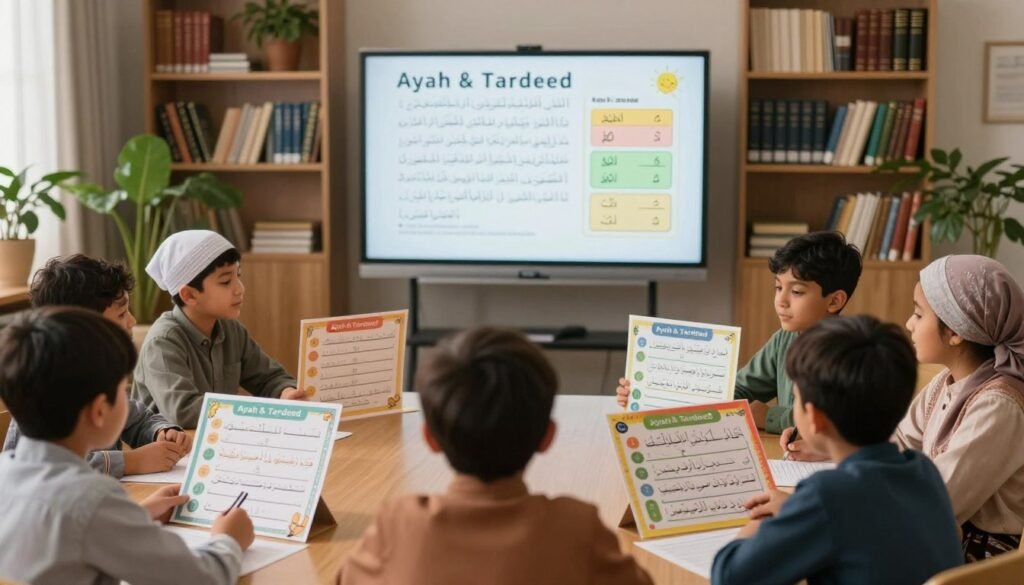
Let us introduce the cornerstone of your child’s visual Quran journey: the Ayah & Tardeed Juz Amma Mastery System. We understand that searching for effective Islamic educational apps can feel overwhelming. Many tools offer pieces of the puzzle—a game here, a recitation there—but lack a cohesive path to genuine mastery. Our program is different. It is the engineered solution that applies the cognitive science we’ve discussed into a single, seamless framework for your home.
This system is built on a fundamental goal of Islamic upbringing: to cultivate a steadfast belief rooted in understanding. As noted in contemporary Islamic education, a key aim is to foster faith “steeped in critical thinking.” Ayah & Tardeed is designed to meet this goal by making the Quran’s final section, Juz Amma, accessible, memorable, and deeply meaningful for young minds growing up in the West.
Not Just Another App: A Philosophy of Structured, Lifetime Learning
Ayah & Tardeed transcends the label of an app. It is a comprehensive educational philosophy made practical. We move beyond random exposure to a deliberate, sequential mastery of each surah. The program’s architecture is built on the principle of sequential visual memorization, turning complex Quran memorization techniques into an intuitive, child-friendly process.
Every lesson is a building block. Children don’t just hear and repeat; they see, connect, and internalize. This structured approach ensures that learning is cumulative, leading to confident recall and a fluent recital that lasts. It transforms daily Quran recitation practice from a chore into a series of clear, achievable victories.
What Lifetime Access Unlocks for Your Family
The most significant investment we offer isn’t just in the content—it’s in time and continuity. Unlike subscription models that create recurring decisions and costs, Ayah & Tardeed provides lifetime access to the entire Juz Amma mastery system. This decision is intentional and reflects our long-term partnership with your family.
Lifetime access means:
- A Growing Family Resource: The program is available for your second, third, or fourth child without ever paying again. It scales with your family’s needs.
- Learning at Any Stage: Whether your child is 5 and starting with recognition or 12 and refining fluency, the same system adapts to their developmental stage.
- Peace of Mind & Simplified Planning: Remove the annual “should we renew?” question. This one-time investment secures a key part of your children’s Islamic education permanently.
We see this not as a simple purchase, but as an investment in your family’s spiritual capital. It’s a tangible tool that supports the profound, lifelong work of nurturing connected, thinking believers.
Engineered for Real Family Life: Key Features of the Program
Imagine a Quran learning resource that respects your time, your child’s pace, and the technology you already use. We built the Ayah & Tardeed system not as a rigid curriculum, but as a flexible framework that bends to fit the rhythm of your home. Our features are designed to remove friction, foster independence, and make consistent progress inevitable—even on your busiest days.
Self-Paced Progression: Respecting Your Child’s Unique Learning Speed
Every child absorbs information at their own rhythm. Our program honors this by eliminating all pressure to “keep up.” Lessons are mastery-based; your child moves forward only when they are truly ready. This approach builds deep confidence and ensures that knowledge sticks, transforming memorization from a race into a personal journey of achievement.
There are no bells or timers rushing them. This method is a cornerstone of effective مواد دراسية للقرآن الكريم, allowing for genuine comprehension rather than temporary recall. Your child owns their learning timeline, which cultivates a positive, lasting relationship with the Quran.
Minimal-to-No Supervision Needed: A True Time-Saver for Parents
We understand that your attention is pulled in a dozen directions. That’s why the system is engineered for independent engagement. Clear visual and audio instructions guide your child through each step. You can have peace of mind knowing they are practicing meaningfully while you handle other tasks.
One parent shared, “Your child can practice independently while you make dinner.” This independence is powered by intuitive parent dashboards. As one of our essential مصادر تعليمية إسلامية, these dashboards let you see progress at a glance—what was reviewed, mastered, or needs more attention—without having to sit through every session.
Device Flexibility: Learn on Tablets, Laptops, or Smartboards
Learning shouldn’t be confined to one room or one device. Our platform is fully responsive, working seamlessly on the screens your family uses every day. Whether it’s a tablet during afternoon quiet time, a laptop at the kitchen counter, or a smartboard for a family huddle, the experience remains consistent and engaging.
This flexibility means Quran learning can happen anywhere: during travel, in waiting rooms, or as a calming pre-bed ritual. It integrates sacred study into the modern digital landscape, making it one of the most practical الموارد الرقمية الإسلامية available. The barrier between “screen time” and “Quran time” gracefully dissolves.
Together, these features—self-paced learning, independent practice, and multi-device access—work in harmony. They transform what can feel like a daily chore into a smooth, integrated, and even joyful part of your family’s routine. The result is not just memorization, but a sustainable habit of connection.
Your Action Plan: 5 Practical Steps to Implement Visual Learning at Home
Let’s move from insight to implementation with a clear, five-step blueprint designed for the rhythm of a modern Muslim family’s life. This practical دليل دراسة القرآن transforms theory into daily action, empowering you to build a sustainable and joyful learning environment.
Step 1: Designate a “Quran Visual Zone” for Focused Learning
The first action is physical. Choose a specific, consistent spot in your home—a corner of a room, a dedicated desk, or a comfortable chair. This becomes your child’s “Quran Visual Zone.”
Its purpose is to signal to the brain that it’s time for focused, visual engagement with the Quran. Minimize clutter and distractions like loud toys or competing screens. You can make it inviting with a prayer rug, good lighting, and easy access to the learning device.
This simple act of creating a dedicated space elevates the activity. It frames your دروس إسلامية تفاعلية as a special and respected part of the day, reducing the mental effort needed to transition into learning mode.
Step 2: Craft a Sustainable 15-Minute Daily Ritual
Forget marathon sessions that lead to burnout. The golden rule for new habits is consistency over intensity. We champion starting with a non-negotiable, manageable 15-minute daily practice.
Why does this work? Fifteen minutes is short enough to fit into the busiest schedule yet long enough for meaningful repetition. As the data shows, 15 minutes daily creates stronger neural pathways than 2 hours crammed on the weekend.
Anchor this ritual to an existing part of your routine—right after breakfast, before bedtime stories, or as an afternoon reset. This consistency is the engine of mastery, turning new تقنيات قراءة القرآن into automatic skills.
Step 3: Leverage Visual Rewards to Sustain Motivation
Visual learning isn’t just about the input; it’s also about visually celebrating the output. Children thrive on seeing their progress. Integrate simple visual reward systems that provide immediate, positive reinforcement.
These tools combat the “forgotten lesson” frustration by making advancement tangible. They tap into intrinsic motivation, making your child want to return to their Visual Zone each day. Consider these three powerful types of visual motivators:
| Reward Type | How It Works | Example for Quran Learning |
|---|---|---|
| Progress Trackers | Offers a clear visual map of what’s been accomplished and what’s next. | A wall chart where your child adds a sticker for each verse mastered or a digital progress bar within the program. |
| Achievement Badges | Celebrates specific milestones and skill acquisitions. | Earning a “Perfect Tajweed” badge for a surah or a “Consistency Champion” badge for a full week of practice. |
| Real-Life Connection Rewards | Ties screen-based success to a meaningful offline experience. | After completing a lesson on nature in the Quran, the reward is a family hike to observe Allah’s creation. |
Step 4: Bridge the Gap Between Screen and Heart
This is the most crucial step. The ultimate goal of any tool is to connect your child to the Quran’s meaning and to their faith. After a visual lesson, take 5 minutes to bridge that digital experience to real life and the heart.
This is where تقنيات قراءة القرآن find their deeper purpose. If the lesson involved vocabulary about food, cook a simple meal together using those Arabic words. If it was about the story of a prophet, ask, “What would you have done in that situation?”
These micro-conversations are powerful. They transform the screen from a passive teacher into a springboard for discussion, reflection, and family bonding. It ensures the technology serves as a bridge to a deeper connection, never a replacement for it.
By following these four steps—creating the space, committing to the ritual, using visual motivation, and prioritizing heart connection—you implement a complete دليل دراسة القرآن. You move from hoping your child learns to actively guiding them through a proven, engaging, and spiritually enriching process.
Answering Your Top Concerns About Visual Islamic Education Tools
Before committing to any educational resource, savvy parents rightly seek clarity on suitability, authenticity, and ease of use. We believe informed choices build confident learning journeys. Let’s address your most pressing questions about visual تطبيقات إسلامية للأطفال with the empathy and evidence you deserve.
Adopting a new method can feel like a leap of faith. Our goal is to turn that uncertainty into confidence by providing transparent, practical answers grounded in both educational science and our Islamic values.
Age Appropriateness: Is My 5-Year-Old Ready? What About My Teen?
Visual learning is remarkably adaptable. Research and experience show that children can engage with structured visual cues as early as age four. For a young child, the focus isn’t on reading Arabic text but on building a positive, familiar relationship with Quranic sounds and patterns through engaging imagery.
For teenagers, the same visual framework supports a deeper, more analytical engagement. Teens can use the visual sequences to understand verse structure, aid in memorization review, and connect themes—transforming the tool from a simple aid to a study companion.
The key is a program designed to grow with your child. The table below outlines how visual strategies differ by developmental stage:
| Age Group | Primary Learning Focus | Visual Strategy in the Program | Parental Role |
|---|---|---|---|
| 4-7 years | Audio recognition, positive association, simple word-picture linking. | Bright, clear imagery tied to short audio clips. Game-like progression. | Facilitate short, joyful sessions. Celebrate engagement. |
| 8-12 years | Memorization (Hifz), understanding basic meanings, building a daily habit. | Sequential image stories for ayat, color-coded Tajweed hints. | Monitor progress, provide gentle encouragement, discuss meanings. |
| 13+ years | Deepening memorization, understanding context (Tafsir), applying Tajweed rules. | Advanced visual maps for surah structure, comparative thematic visuals. | Transition to a learning partner; engage in discussions prompted by the visuals. |
Ensuring Audio Fidelity and Tajweed Within a Visual Framework
A stunning visual is useless if the pronunciation it’s linked to is incorrect. This is non-negotiable. As one expert plainly states, “Kids copy what they hear, so the model needs to be perfect.”
Our philosophy is simple: the visual component supports and reinforces the audio, never replaces it. Every word and verse in our system is recited by certified, native Arabic Qaris whose recitation meets the highest standards of Tajweed.
The visual sequences act as a memory anchor for the correct sound. When a child sees a specific image, they recall the precise pronunciation linked to it. This method effectively embeds high-quality دروس التجويد عبر الإنترنت into the core learning experience, ensuring proper articulation (Makharij) and rules (Ahkam) are learned from the very first encounter.
How the Program Supports Parents with Limited Islamic Backgrounds
Perhaps you didn’t grow up studying Quran formally, or your own Arabic is rusty. This doesn’t disqualify you from guiding your child; it simply means you need the right partner. Our program is engineered to be that partner—a complete, self-guiding system.
You are not required to be the teacher. The program provides the structured curriculum, the correct pronunciation, and the engaging method. Your role shifts to that of an encouraging facilitator and a fellow learner. The visual framework gives you a common language to connect with your child’s progress.
Key features designed for your support:
- Clear Progress Dashboards: See exactly what your child has mastered and where they are headed, without needing deep Islamic knowledge to interpret the results.
- Integrated Parent Notes: Simple explanations of verses and concepts are provided, allowing you to have meaningful conversations.
- Community Access: Connect with other parents on the same journey, sharing tips and encouragement.
This approach empowers you to say, “Let’s learn this together,” turning a potential point of anxiety into a bond-strengthening, shared spiritual journey. It demystifies دروس التجويد عبر الإنترنت and makes authentic Islamic education accessible to every committed family.
Embracing a New Era in Islamic Education for Our Children
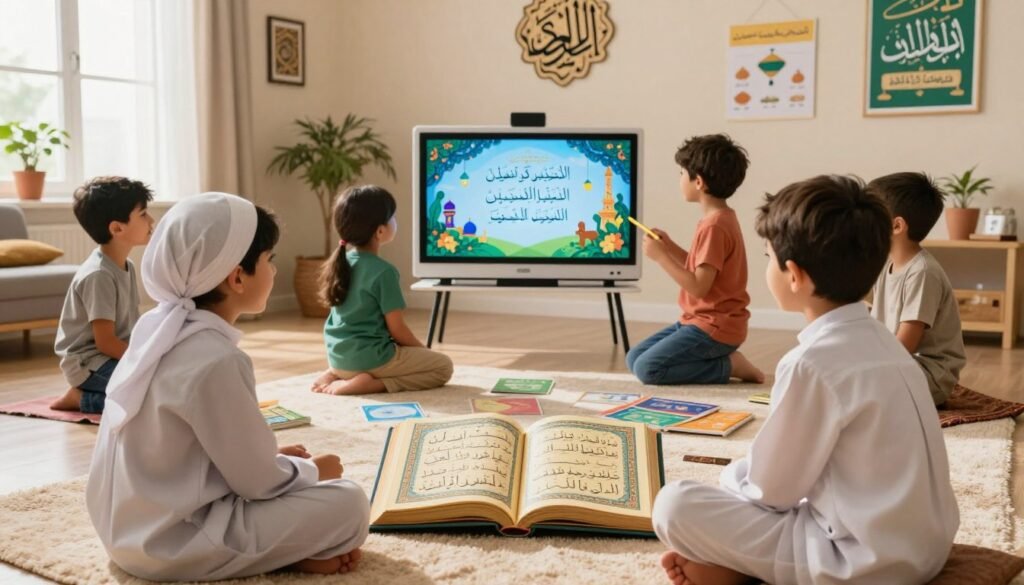
For Muslim families in America, the future of faith formation lies in transforming Quran study from a required task into a source of daily inspiration. We are not just teaching verses; we are nurturing a relationship. This shift marks a new era—one where Islamic education tools are designed not to burden, but to illuminate, creating a natural bridge between our children’s modern lives and timeless faith.
Moving from Obligation to Inspiration in Quran Study
The traditional model often framed Quran learning as a duty—a box to be checked. While discipline is valuable, an approach rooted solely in obligation can drain joy and create resistance. Our new paradigm seeks to spark intrinsic motivation. We aim to make the Quran’s language and lessons feel accessible, even exciting.
When the process feels engaging, a profound change occurs. A child’s mindset shifts from “I have to” to “I get to.” This is the heart of visual Quran learning. Colorful, sequential visuals and interactive modules turn abstract Arabic text into a tangible, memorable story. The data from our community reflects this transformation perfectly:
“When learning the language of the Qur’an feels like play, children build: Confidence to recite with understanding, Connection to their faith, Curiosity that lasts a lifetime.”
This quote captures the essence of the shift. It’s about creating an environment where curiosity is the driver, not compliance. The goal is to plant seeds of love for the Quran that will grow with them, long after the lesson ends.
The Long-Term Impact: Confident Reciters and Connected Believers
What does this inspired approach yield over years? The outcomes extend far beyond memorizing Juz Amma. We are cultivating young adults who carry the Quran with confidence and connection.
A confident reciter understands what they are saying. They can follow along in prayer with meaning, and they feel secure in their identity. A connected believer feels a personal bond with the scripture; it becomes a source of guidance and comfort, not just a recitation exercise. This long-term impact is the true measure of success for Muslim kids in the USA.
The contrast between the old paradigm and this new, visual-based approach is clear in the outcomes it fosters:
| Aspect of Learning | Traditional / Obligation-Based Model | Modern / Inspiration-Based Visual Model |
|---|---|---|
| Primary Driver | External pressure & parental authority | Intrinsic curiosity & joyful engagement |
| Relationship with Arabic | Seen as a barrier; a difficult code to crack | Seen as a key to understanding; unlocked through visuals |
| Long-Term Skill | Rote memorization (can fade without practice) | Visual-spatial memorization & conceptual understanding (more durable) |
| Faith Identity | Can feel separate from “American” life | Integrated; faith is engaging and relevant to modern context |
| Parent-Child Dynamic | Potential for conflict over practice | Collaborative; shared discovery and celebration |
As the table shows, the shift is comprehensive. It builds not just knowledge, but a resilient and positive Islamic identity that can thrive anywhere.
Why This Approach is the Future for Diaspora Communities
In diaspora settings, sustaining faith across generations requires intentional, innovative strategy. We cannot rely solely on methods designed for homogenous, majority-Muslim societies. Our children are navigating a complex cultural landscape.
Evidence-based, engaging Islamic education tools are not a passing trend; they are a necessary evolution. They speak the digital language of the next generation while preserving sacred content. They provide consistency where community access might be limited. Most importantly, they make faith compelling in a world full of competing distractions.
By adopting visual Quran learning methodologies, we are doing more than teaching—we are future-proofing our children’s connection to Islam. We are equipping them to be confident ambassadors of their faith, rooted in understanding and love. This is how we ensure the Quran remains a living, guiding light in their hearts, wherever in the world they may be.
Conclusion: Begin Your Family’s Transformative Journey Today
We have walked together from recognizing a quiet struggle to embracing a solution built on solid cognitive science. The path to meaningful Quran memorization for our children in the West is clear.
The method of التعلم المرئي للقرآن directly addresses language barriers and fosters a deep, personal connection. It transforms daily practice from a potential conflict into a source of joy and identity-building.
Our commitment is to walk alongside you with practical, effective أدوات التعليم الإسلامي. The Ayah & Tardeed system is engineered for your real life—minimizing supervision and maximizing your child’s intrinsic motivation.
The first step is a simple, intentional choice. Visit our program page to unlock lifetime access for your family. Your child’s journey toward becoming a confident, connected reciter starts with this decision.
This is more than a learning tool; it is an investment in your child’s lifelong relationship with the Quran. Their future as a grounded, faithful believer begins today.