
What if your child could connect with the Quran’s profound message in just minutes a day, even amidst your family’s busy schedule?
We understand the daily reality for Muslim parents in the West. Juggling work, school runs, and household duties leaves little time for the spiritual nurturing we deeply desire. Helping our children memorize Quranic verses can feel like another daunting task on the list—fraught with worries about time and lasting retention.
This challenge is especially poignant with the opening of Juz Amma. Surah An-Naba, “The Great Tiding,” begins with powerful questions in its first three ayat: “About what are they asking one another? About the Great Tiding…” (Quran 78:1-3). These verses are the grand overture to the final section of the Quran, focusing our hearts on the reality of the Resurrection.
But what if there was a method that transformed this task from a struggle into an engaging, joyful, and deeply effective practice? We believe there is. In this guide, we introduce Sequential Visual Memorization—a proven technique rooted in both cognitive science and Islamic tradition.
This approach moves beyond simple repetition. It helps children visualize and internalize the meaning and flow of these foundational passages. We’ll walk you through a practical, step-by-step process designed for modern life. Our goal is to help your child not only recite the words but also build a genuine, lasting connection with their meaning.
Let’s turn this common challenge into a remarkable opportunity for spiritual growth and family bonding.
Key Takeaways
- Understand why the first three verses of Surah An-Naba are a crucial and meaningful starting point for young learners.
- Discover a science-backed memorization technique that boosts retention and makes learning stick.
- Learn how to integrate short, effective Quranic practice seamlessly into a busy family routine.
- Gain practical strategies to move beyond rote memorization and foster a real emotional connection to the verses.
- See how blending visual learning with Islamic understanding creates a powerful and engaging experience for children.
- Access a clear, step-by-step framework designed specifically for parents in the diaspora.
The Modern Muslim Parent’s Memorization Struggle
In the quiet moments after a long day, many Muslim parents in the West find themselves wrestling with a silent worry: how to pass on the profound beauty of the Quran to their children in a world of constant distraction.
We share this journey. The aspiration for our children to connect with the Divine Word is heartfelt. Yet, the reality of balancing school, extracurriculars, and digital noise often leaves little room for the deep, reflective study the Quran deserves.
This challenge feels particularly acute with surahs like Surah An-Naba. Its opening verses pose profound questions about creation and the Hereafter. They aren’t merely lines to recite Quran; they are invitations to ponder and understand.
Surah An-Naba addresses core disputes about the Hereafter, requiring genuine reflection—a task amplified in our fast-paced environments where time for deep religious education is limited.
How do we facilitate this level of engagement when our own schedules are stretched thin? The traditional “repeat after me” model we may have experienced often falls short with today’s children. It can lead to:
- Surface-level memorization without lasting retention.
- Frustration and disengagement from both parent and child.
- A missed opportunity to build a meaningful, lifelong connection with the verses.
The struggle is real. We see it in the desire to help a child recite Quran beautifully, coupled with the anxiety that the words might not stick. We feel the pressure of preserving Islamic identity while navigating a culture with competing values.
This is the modern Muslim parent’s dilemma. We want our children to memorize Surah An-Naba and other verses with love and comprehension, not as a chore. We seek methods that fit our contemporary lives and resonate with our tech-savvy kids.
Recognizing this shared experience is the first step. It’s why we move beyond one-size-fits-all approaches. Together, we can build a memorization practice that is effective, engaging, and seamlessly integrated into your family’s unique rhythm.
Why “Just Repeat After Me” Doesn’t Work Anymore
If you’ve ever watched your child’s eyes glaze over during a ‘repeat after me’ Quran session, you’ve witnessed the gap between traditional methods and modern learning needs. This approach, while well-intentioned, often reduces the profound act of islamic memorization to a mechanical task. For verses like the opening of Surah An-Naba, which ask deep questions about the “Great Tiding,” this disconnect is especially critical.
The classic method relies on passive auditory input. A child hears a line and is asked to parrot it back. In a world saturated with interactive games and compelling stories, this passive model struggles to hold attention. More importantly, it often sidelines the meaning of the words. To truly memorize verses for a lifetime, a child needs to connect with their message, not just their sound.
Cognitive science supports this observation. Studies show that information learned through sheer, passive repetition is stored in short-term memory. It’s easily forgotten because the brain isn’t deeply engaged. Lasting memory formation requires active processing—creating associations, visualizing concepts, and understanding sequence. Our goal in islamic memorization should be to move beyond the surface.
This is directly relevant to Surah An-Naba. The first three verses prompt contemplation (tafakkur) and evidence-based understanding. Asking “About what are they asking one another?” invites curiosity. Rote repetition alone cannot foster this essential reflection. We miss the divine invitation to ponder if we focus only on vocal mimicry.
Modern children are wired for engagement. They learn best when multiple senses and cognitive pathways are involved. To help them memorize verses effectively, we must upgrade our toolkit. Methods that incorporate visual anchors, story, and logical sequence don’t just make learning more enjoyable—they align with how the brain naturally encodes information for the long term.
We honor tradition not by clinging to outdated techniques, but by pursuing the original goal with the best tools available: creating a generation that holds the Quran in their hearts and minds. The next step is understanding the science that makes this possible.
The Cognitive Science Behind Lasting Memory
At the heart of successful Quran recitation retention lies the brain’s natural preference for visual and sequential information. Modern cognitive science gives us a clear blueprint. It shows why some memorization techniques fade quickly while others create lifelong recall.
Our brains are not simple recording devices. They are meaning-making machines. Information attached to a picture, a story, or a logical flow gets a VIP pass into long-term storage. This process is called visual encoding.
When your child sees or imagines a vivid scene for a Quranic phrase, powerful things happen. The hippocampus—the brain’s memory center—lights up. The prefrontal cortex, which handles organization, also engages. This dual activation creates a strong, resilient memory trace.
Let’s apply this to Surah An-Naba. The first three verses ask profound questions about a momentous news. A rote repetition approach treats these as abstract words. A cognitive approach turns them into a visual story. The child might picture people questioning each other, with the “momentous news” as a glowing scroll. This link between word, image, and meaning is the secret.
Not all learning methods are equal. The table below contrasts common approaches based on cognitive science principles.
| Encoding Method | How It Works for Quran Memorization | Impact on Long-Term Retention |
|---|---|---|
| Rote Repetition | Repeating sounds until they stick through auditory loop. Relies heavily on short-term memory. | Often fragile. Prone to quick forgetting without constant review. High cognitive load. |
| Visual-Spatial Association | Linking each word or phrase to a specific mental image or location in a familiar “memory palace”. | Exceptionally strong. Creates multiple neural pathways for recall. Deepens understanding. |
| Storytelling & Narrative Linking | Weaving verses into a coherent story that mirrors their thematic sequence and meaning. | High retention. Uses the brain’s innate love for narrative, making recall natural and ordered. |
| Multi-Sensory Integration | Combining listening (recitation), visualization, and tactile tracing or writing of verses. | Most robust. Engages multiple brain regions, creating a rich, interconnected memory web. |
This science directly informs our approach. The method of sequential visual memorization taps directly into the brain’s wiring. We don’t just want your child to recite. We want them to see and sequence the revelation in their mind’s eye.
For verses 1-3 of Surah An-Naba, this means building a three-part mental movie. Each “hook”—the questioning, the turning away, the great news—has its own image. These images are then placed in order. This transforms the Quran recitation from a string of sounds into a memorable journey.
We bridge this cutting-edge science with timeless Islamic pedagogy. The goal is not just neurological efficiency. It is heart-centered understanding. By knowing the “why” behind memory, we empower you with confidence. You become a supportive guide in your child’s sacred journey, armed with techniques that are both spiritually enriching and scientifically sound.
Understanding these principles turns a daunting task into an engaging discovery. It shows that effective memorization techniques are not about more hours, but about smarter, more brain-friendly connections.
Introducing Sequential Visual Memorization: A Game-Changer
We’ve moved beyond rote repetition to a method that transforms Arabic verses into a flowing mental movie. This is Sequential Visual Memorization—a science-backed framework that finally makes surah an naba memorization engaging, logical, and lasting for your child.
Why does this method work so powerfully for Surah An-Naba verses 1-3? The answer lies in the Surah’s own divine design. These opening verses present a perfect logical sequence: a profound question, a momentous announcement, and then a human reaction. Our approach mirrors this natural flow, turning the Quran’s rhetorical structure into the ultimate memory aid.
Instead of isolated words, we guide children to build a visual storyboard. Here’s how it works for surah naba 1-3:
- Verse 1 (The Question): Imagine a group of people leaning in, whispering to one another—”What are they asking one another about?” This creates a scene of curiosity.
- Verse 2 (The Announcement): Visualize a grand, luminous bulletin board appearing in the sky, declaring “About the Great Tiding.” The image is one of awe and importance.
- Verse 3 (The Dispute): Picture two distinct groups on the ground, one in agreement and the other in clear disagreement, representing “They are in disagreement.”
This process does more than aid recall. It builds comprehension by linking meaning to imagery. Abstract text becomes a series of tangible mental images that a child can “walk through.” This active creation forges stronger neural pathways than passive listening ever could.
We bridge modern cognitive science with deep respect for the Quran. This method honors the text by using its inherent structure as the guide for learning. It’s a game-changer because it aligns with how young minds actually work—thriving on story, sequence, and visual hooks.
For you and your child, this transforms the task of memorizing Surah An-Naba from a daunting challenge into a creative discovery. We are not just teaching verses; we are opening a door to a more connected and joyful Quranic journey. Let’s explore how to bring this transformative practice into your home.
Your Structured Support System: Ayah & Tardeed Juz Amma Mastery Package
What if you had a complete, science-backed toolkit designed specifically for mastering Juz Amma, starting with Surah An-Naba? We created the Ayah & Tardeed Juz Amma Mastery Package to be exactly that—a structured support system for families navigating the beautiful challenge of Quranic memorization.
This comprehensive package moves beyond isolated lessons. It provides a cohesive framework that applies the Sequential Visual Memorization method directly to your child’s journey. The modules for Surah An-Naba verses 1-3 serve as the foundational launchpad, building confidence and technique before progressing through the entire Juz.
Inside, you and your child will find a multi-sensory learning environment engineered for retention:
- Visual Memory Aids: Custom illustrations and mind maps that transform abstract concepts into memorable hooks.
- Professional Audio Recitations: Clear, paced recordings for immersive listening and perfect pronunciation practice.
- Interactive Exercises: Engaging activities that reinforce connections and make review an active process, not passive repetition.
The package grants lifetime access, a feature we consider essential. It allows you to adapt the pace to your child’s unique learning rhythm, ensuring progress without pressure. You can revisit modules before a test, during Ramadan, or simply to strengthen the bond with the Quran—anytime.
We’ve woven Islamic understanding throughout. The resources highlight the virtues and themes of Surah An-Naba, providing context that transforms memorization into meaningful connection. This approach nurtures not just recall, but also a deeper appreciation for the Divine message.
Ultimately, the Ayah & Tardeed package is a partnership. It significantly reduces the planning burden on you, the parent, by delivering a proven, step-by-step path. You gain more than a digital product; you join a community of parents achieving tangible results. Together, we are making the goal to learn Surah An-Naba verses 1-3 and beyond a shared, successful family experience.
Building Connection Before Memorization: Understanding Verses 1-3
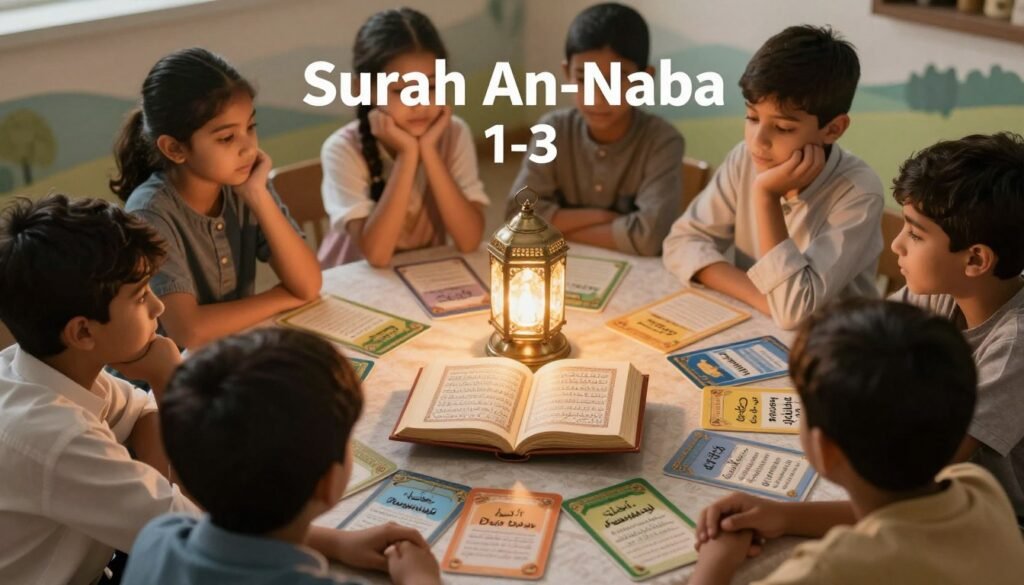
Before your child utters a single word of Surah An-Naba, we must first build a bridge of understanding. Memorization rooted in meaning lasts a lifetime. This foundational step transforms Arabic sounds into a message that resonates in their heart.
Verses 1-3 introduce a powerful conversation. They ask, “About what are they asking one another? About the Great Tiding… That over which they are in disagreement.” The “Great Tiding” (An-Naba al-Adheem) is the Day of Judgment—a core pillar of Islamic faith. In our modern context, children encounter doubt and curiosity daily. Explaining this connects ancient revelation to their contemporary world.
Here is how you can build this connection with your child. Use simple, relatable terms. Sit together and explore these ideas:
- Frame it as a mystery: “What is this huge news everyone is talking about and arguing over?”
- Link to their experiences: Discuss how people today might dispute big ideas, just like in the Quran.
- Use the resources in our Ayah & Tardeed Package to provide historical context from the Prophet’s time, making the verses tangible.
This dialogue is more than a lesson; it’s faith-building. When children grasp the “why,” the surah an naba verse 1-3 practice becomes an act of discovery, not duty. Their surah an naba verse 1-3 recitation will carry weight because they know what they are declaring.
We encourage you to make this a shared exploration. Ask open-ended questions. Let their curiosity guide the conversation. This understanding phase is the bedrock for all subsequent memorization. It ensures that when they move to active surah an naba verse 1-3 practice, they are engaging with a message, not just memorizing sounds. This approach aligns with cognitive science—meaningful information is stored more efficiently and recalled more easily.
By investing time in understanding first, you lay the groundwork for a deeper, more resilient connection to the Quran. This transforms the entire surah an naba verse 1-3 recitation journey from a chore into a cherished part of their identity.
Creating the Ideal Home Environment for Quranic Focus
The journey of memorizing Surah An-Naba verses 1-3 thrives in an environment crafted for auditory immersion and visual calm. We often focus on the how of memorization, but the where is equally powerful. Islamic tradition teaches us that reflection, or tafakkur, on the Quran’s signs requires a peaceful setting. For our children, this means transforming part of your home into a supportive sanctuary that signals Quranic learning is a valued, peaceful part of family life.
Begin by designating a consistent, distraction-free zone. This doesn’t require a separate room. A cozy corner with a comfortable prayer mat, soft lighting, and perhaps Islamic art creates a visual cue for the mind to shift into focus mode. This dedicated space becomes the physical anchor for your child’s memorization practice.
Here is where audio becomes your silent partner. The consistent, beautiful sound of surah an naba verses 1-3 audio recitations builds neural pathways through listening. Play these recordings during quiet times—before bed, during a calm afternoon, or in the car. This passive immersion reinforces correct pronunciation, melody (tajweed), and meaning, making the active memorization session later feel familiar and easier.
Routine is the engine of habit. We recommend a consistent, short daily practice—even just 10 focused minutes—over sporadic, longer sessions. This regularity builds discipline and tells your child’s brain that Quran time is non-negotiable and expected.
Involvement from the whole family multiplies the impact. When parents model engagement by listening to the Quran or discussing its meanings, children see it as a natural part of life, not a chore. Consider these practical steps:
- Create a Visual Aid Station: Hang posters with the Arabic text and translation of verses 1-3 in your designated space.
- Establish “Quran Quiet Time”: A 15-minute period where the home minimizes noise, and everyone engages in a related activity.
- Listen Together: Make playing the surah an naba verses 1-3 audio a shared experience, followed by a simple question about what you heard.
By intentionally layering space, sound, and schedule, you create an ecosystem that supports focus. This environment doesn’t just minimize distractions; it actively invites connection with the Quran. The result is a child who approaches memorization not with resistance, but with a sense of calm readiness, leading to deeper retention and a more meaningful experience.
Your Action Plan: How to Memorize Surah An Naba Verses 1-3
Memorization becomes manageable when we break it down. This three-phase plan provides the scaffolding your child needs. We move from passive hearing to active recall, using methods grounded in both cognitive science and traditional Islamic learning. Let’s walk this path together, step by step.
Phase 1: Foundation Through Listening
Before a single word is spoken, the ear must learn. This phase builds a solid auditory foundation. It’s about creating a familiar soundscape for the Surah An-Naba verse 1-3 translation and its Arabic recitation.
Start with clear, melodious audio. Play a recitation from a trusted Qari on repeat during calm moments—car rides, before bed, or quiet play. The goal isn’t immediate repetition, but attentive listening.
Here are practical tips for parents:
- Use High-Quality Audio: Select a recitation with clear Tajweed and a pace your child can follow.
- Listen with Purpose: Ask simple questions like, “Did you hear the rise and fall in the sheikh’s voice?” This builds active engagement.
- Connect Sound to Meaning: Briefly discuss the surah an naba verse 1-3 translation. Knowing they ask “About what?” makes the Arabic phrase more meaningful.
- Keep it Short: Focus on just these three verses. Cognitive science confirms that breaking material into manageable parts dramatically improves retention.
Phase 2: Crafting the Visual Memory Hooks
The human brain remembers pictures far better than abstract words. This phase transforms the verses into a series of vivid, mental images. It’s a powerful surah an naba memorization tip that makes learning stick.
Break each ayah into its key phrases. For “‘Amma yatasā’alūn” (About what are they asking one another?), imagine a group of people leaning in, whispering curiously. Let your child draw this scene or describe it in detail.
Practical tips for creating visual hooks:
- Chunk the Text: Work on one small phrase at a time. Don’t overwhelm with the full verse.
- Make it Personal and Vivid: Use bright colors, funny characters, or familiar settings in your mental pictures.
- Employ Multi-Sensory Tools: Use physical flashcards with drawings or a digital app where they can arrange images in order.
- Link Images Sequentially: Ensure each picture leads logically to the next, creating a storyboard for the verses.
Phase 3: The Sequential Practice Cycle
Now, we weave listening and visualization into fluent recall. This phase is about practice, repetition, and gradual independence. It turns separate pieces into a cohesive whole.
Begin by reciting the first verse while looking at its visual hook. Then, add the second. Practice this short sequence until it flows. The key is sequential practice—always building in the correct order.
Implement this cycle with these strategies:
- Start Slow and Accurate: Speed is the enemy of accuracy initially. Focus on perfect pronunciation.
- The “Add-One” Method: Master the first phrase, then add the next, always starting from the beginning.
- Fade the Prompts: Gradually stop showing the drawings or listening to the audio. Encourage recall from memory first.
- Daily, Short Sessions: Ten focused minutes daily are far better than one hour weekly. Consistency builds the neural pathway.
- Incorporate Review: Always start a new session by quickly reviewing what was learned the day before. This solidifies the memory.
This structured action plan transforms the goal of memorizing Surah An-Naba from a wish into a weekly routine. Each phase builds upon the last, creating confidence and lasting results. You are not just teaching words; you are building a connection.
From Words to Worship: Incorporating Basic Tajweed

Memorizing the words of Surah An-Naba is a beautiful achievement, but true mastery blossoms when we learn to recite them with reverence and precision. This is where Tajweed—the set of rules for Quranic pronunciation—becomes essential. In Islam, proper recitation preserves the divine purity of the Quran’s message. For your child’s surah an naba 78:1-3 memorization journey, introducing basic Tajweed early transforms a simple task into a profound act of connection.
Think of it this way: correctly pronouncing Allah’s words is a form of worship in itself. By focusing on Tajweed, you elevate the goal from mere repetition to honoring the Quran’s divine precision. This shift turns practice into ‘ibadah, teaching your child to approach the verses with deep respect.
For the first three verses of Surah An-Naba, we focus on three foundational rules. First is the clear articulation of each Arabic letter from its proper point in the throat or mouth. Second is observing the elongation (madd) where required, giving certain letters their full, resonant length. Third is learning appropriate pauses (waqf), which helps with understanding and breath control.
Common Tajweed Focus Points for Surah An-Naba 1-3
| Tajweed Rule | What to Practice | Why It Matters |
|---|---|---|
| Clear Articulation | Pronouncing each letter from its correct origin (e.g., the ‘Ayn ع in “عَمَّ”). | Ensures every word is distinct and preserves the original meaning revealed. |
| Proper Elongation (Madd) | Holding vowel sounds for their designated count (like in “يَتَسَاءَلُونَ”). | Adds beauty to recitation and is a mandatory rule for specific letters. |
| Thoughtful Pauses (Waqf) | Stopping briefly at the end of verses or natural phrase breaks. | Allows for reflection on the meaning and maintains a flowing, respectful pace. |
Demystifying these rules is easier with the right tools. Our Ayah & Tardeed Juz Amma Mastery Package includes slow-motion audio recitations of these verses. Your child can listen and repeat at a manageable pace, catching every subtle sound. We also provide visual Tajweed charts that color-code rules, making them interactive and easy to remember.
The best practice is a shared one. Sit with your child and use these resources together. Follow this simple cycle: Listen to the audio, Point to the rule on the chart, and Recite together. Correct mistakes gently—focus on one rule at a time—and always praise their effort. This supportive environment removes pressure and builds confidence.
By integrating Tajweed into your routine, you do more than help your child learn surah an naba ayat 1-3. You equip them to recite with accuracy and a heart full of devotion. This combination of correct pronunciation and spiritual intent is the ultimate goal. It ensures their surah an naba 78:1-3 memorization is living, meaningful, and deeply connected to Allah.
Ensuring It Sticks: The Retention and Review Strategy
Cognitive science and Islamic tradition agree on a fundamental truth: true learning isn’t about a one-time effort, but a consistent practice of return. The beautiful achievement of memorizing Surah An-Naba verses 1-3 is just the beginning. Our shared goal is to transition those verses from short-term memory into permanent, easily accessible knowledge.
Modern research highlights two powerful techniques for this: spaced repetition and active recall. Spaced repetition involves reviewing information at strategically increasing intervals. This method directly combats the natural forgetting curve, reinforcing the neural pathways where the memorization lives.
This isn’t a new concept to our faith—it’s the essence of dhikr (remembrance). The act of daily recitation aligns perfectly with this science. We help you build a simple, effective review schedule for your child’s Surah An-Naba first three verses memorize journey.
| Review Approach | Method | Long-Term Outcome |
|---|---|---|
| Cramming & One-Time Practice | Intense, focused repetition in a single session. | Rapid forgetting; verses feel unfamiliar after a week. |
| Strategic Spaced Repetition | Brief reviews after 1 day, 3 days, 1 week, then bi-weekly. | Strong, durable memory; verses are recalled effortlessly. |
| Passive Listening | Hearing the verses played in the background. | Familiarity without the ability for independent recall. |
| Active Recall with Visual Hooks | Using flashcards with your child’s custom drawings to prompt recitation. | Deep, contextual memory that connects meaning to sound. |
Your action plan for retention is straightforward. After your child masters the verses, initiate reviews:
- Day 1: A quick 5-minute recall session.
- Day 3: Another brief practice, focusing on any stumbling points.
- Day 7: A full, confident recitation.
- Thereafter: Integrate into weekly family Quran time.
The key is to weave the verses seamlessly into daily life. This transforms practice from a task into a natural part of your child’s identity. Here are simple integration ideas:
- Recite together right after Fajr or before bedtime prayers.
- Make it a “car ride surah” on the way to school.
- Start your family meal by having your child lead these three verses.
To supercharge this process, we champion family “Quran Circles.” Gather for ten minutes where everyone, parents included, recites what they know. This creates a supportive, communal review environment that removes pressure and builds joy. It shows your child that this knowledge is a living, shared family treasure.
Our Ayah & Tardeed Juz Amma Mastery Package is designed to support you here. We provide structured review calendars and ready-to-use flashcard templates that automate the scheduling. This allows you to focus on the nurturing and connection, not the planning logistics. Our tools help ensure the effort to memorize Surah An-Naba 1-3 blossoms into a lifetime of retained and cherished recitation.
Ultimately, this strategy is about helping your child truly internalize the verses. By pairing the divine wisdom of consistent remembrance with the proven science of memory, we build a foundation that lasts. The first three verses of Surah An-Naba become more than words; they become a permanent part of your child’s spiritual heart.
Navigating Common Hurdles and Keeping Motivation Alive
When motivation wanes and distractions multiply, parents need practical tools to keep their child’s Quranic journey on track. We understand that the path to how to memorize Surah An-Naba verses 1-3 is not always smooth. Every family encounters similar challenges. The good news is that these hurdles are predictable—and surmountable.
Common obstacles in Quran memorization typically fall into three categories:
- Waning Motivation: The initial excitement fades when progress feels slow.
- Daily Distractions: Modern life is full of competing sounds and screens.
- Frustration with Progress: A difficult verse can make a child feel stuck.
To reignite that essential spark, connect the task to its profound purpose. Share the deep spiritual weight of Surah An-Naba. It is narrated that this Surah had such a powerful impact on Prophet Muhammad (peace be upon him) that it was among the revelations that turned his hair grey.
“It was only the opening chapters of Surah Hud, Al-Waqi’ah, Al-Mursalat, ‘Amma Yatasa’aloon [An-Naba], and Idhash-Shamsu Kuwwirat that have turned my hair grey.”
This story isn’t about fear; it’s about awe. It shows children they are engaging with words of immense power and beauty. This intrinsic connection is the ultimate motivator.
For daily encouragement, a simple reward system works wonders. A sticker chart for each mastered verse provides clear, visual progress. However, we always balance this with conversations about the eternal reward. Remind your child that the angels surround them and Allah showers His mercy upon the one who recites the Quran.
When distractions arise, shorten the session. Aim for five to ten minutes of pure focus rather than a long, strained period. If focus drifts, gently guide it back without criticism. The goal is consistent, positive exposure.
If frustration sets in, pause. Take a break, do a different activity, and return with a fresh mindset. Celebrate what has been learned already. Say, “You’ve already mastered the first two words so well! Let’s just look at the next one together.” This positive reinforcement builds resilience.
Remember, you are not navigating this alone. Our Ayah & Tardeed Juz Amma Mastery Package includes community tips and structured resources designed for these exact moments. Perseverance is the key. Every small effort in learning how to memorize Surah An-Naba verses 1-3 is a cherished step toward Allah’s pleasure.
We are in this sacred journey together, transforming small, daily practices into a lifetime of connection with the Quran.
Conclusion: Your Child’s Quranic Journey Starts Here
The path to helping your child memorize Surah An-Naba verses 1-3 is now clear. We have moved beyond the frustration of simple repetition to a method built for lasting retention. The structured approach, combining cognitive science with Islamic reverence, turns a challenge into a joyful achievement.
Memorizing these opening verses is an investment in your child’s spiritual core. In the Western diaspora, Surah An-Naba offers transformative benefits for faith and character. These surah an naba verses 1-3 memorization tips are not just about words; they are about nurturing a heart connected to the Quran.
Our Sequential Visual Memorization technique, supported by the Ayah & Tardeed Juz Amma Mastery Package, provides the reliable system modern parents need. You gain more than a lesson plan; you gain a partner in building a home environment where Quranic focus flourishes.
We invite you to take this proven step. Explore our package today and join a community dedicated to meaningful Islamic education. Start their Quranic journey by implementing these strategies in your daily routine.
Every verse your child learns becomes a personal light, guiding them closer to Allah. Their blessed journey with the Quran begins with this commitment—and we are here to walk it with you.
Do you prefer reading in Arabic? Check out our article on visual learning here.