
What if your child could not only recite but truly connect with the Quran’s profound messages, starting with its very first Juz?
For Muslim parents in the West, this desire is deeply personal. We strive to nurture faith in a busy world, often feeling pressed for time and searching for methods that stick. The journey often begins with Juz Amma, and within it, Surah An-Naba presents a beautiful and foundational starting point.
This guide is designed to transform the goal to memorize Surah An Naba verses 3-5 from a daunting task into a joyful, shared achievement. We move beyond generic advice to offer a clear, step-by-step pathway.
Our approach is rooted in both timeless Islamic tradition and modern cognitive science, creating a practical blueprint for success in your modern context.
Key Takeaways
- Juz Amma is the traditional and ideal starting point for children’s Quranic memorization, with Surah An-Naba containing core, foundational themes.
- Memorizing these specific verses is an achievable and meaningful first milestone that builds confidence and connection.
- Effective learning blends respect for Islamic tradition with insights from modern educational science for faster, longer-lasting retention.
- The method is designed with the realities of busy diaspora family life in mind, focusing on quality, short sessions over lengthy drills.
- This process aims to foster a genuine love and understanding of the Quran, not just rote repetition.
- Following a structured, step-by-step guide removes guesswork and provides a clear path forward for both parent and child.
- The ultimate goal is to transform memorization into a positive, joyful, and bonding family experience.
The Quiet Struggle in Our Homes: When Quran Time Feels Like a Battle
For many parents in the diaspora, the aspiration to connect our children with the Quran quietly collides with the reality of modern family life. We envision a serene moment of learning, but what often unfolds feels more like a negotiation—or even a battle.
The well-intentioned session begins. The mushaf is open. Yet, within minutes, we’re managing distraction, pleading for focus, or wiping away tears of frustration. This scene is heartbreakingly familiar. The core challenges are universal: child resistance, verses memorized one day only to be forgotten the next, and schedules constantly hijacked by school projects and extracurriculars.
We feel the clock ticking. Between the fast pace of Western life and our deep desire to instill a divine connection, the pressure mounts. This isn’t just about memorization; it’s about anchoring faith in a busy world. The guilt whispers: “Are we doing enough? Is this even working?”
Let’s be clear. This quiet struggle is not a measure of your dedication or your child’s capability. When a child learns a verse on Tuesday but cannot recall it on Wednesday, it’s rarely a lack of effort. More often, it’s a sign that the traditional method of repetition alone isn’t aligning with how their brain learns and retains information in today’s environment.
Other factors deepen the challenge. Many of us lack immediate access to qualified, engaging teachers who can bridge the gap between classical instruction and contemporary childhood. We’re left piecing together well-meaning but inconsistent quran memorization tips from various sources, leading to a fragmented approach that confuses more than it clarifies.
The result? Quran time, which should be a source of spiritual serenity, becomes a point of stress. The child associates these moments with struggle, and the parent feels isolated in the effort. This friction is the very problem we must address head-on.
We see you in this struggle. We understand the quiet sigh after a difficult session. This friction point—where intention meets daily reality—is precisely where our work together begins. Recognizing this battle is the first, crucial step toward transforming it. From here, we can move beyond generic advice to strategies designed for your child’s mind and your family’s life.
Ayah Tardeed Method
Sequential Quran Memorization
Memorize Surah An-Naba verses 3-5 using the Ayah Tardeed sequential memorization method.
View from the Classroom: Why Common Memorization Methods Fall Short Today
Educational research now shows a significant gap between conventional Quranic memorization techniques and how young brains actually learn best. We deeply respect the legacy of these methods. Their intention—to instill the divine words with reverence and precision—is noble. Yet, in our classrooms and homes, we see a consistent pattern. The standard approach often struggles to meet the needs of children growing up in a fast-paced, visually-stimulating world.
The classic steps are familiar: Listen First, Break into Verses, Recite Aloud with Feedback, Repeat, Connect, and Review. On paper, this logic is sound. In practice, however, several critical cracks appear, especially for families managing busy diaspora schedules.
| Common Method Step | Intended Benefit | Why It Falls Short Today |
|---|---|---|
| Listen First & Recite Aloud | Builds accurate auditory memory and pronunciation (makharij). | Without immediate, expert feedback, children can internalize subtle errors. Unlearning these mistakes later is incredibly difficult. |
| Break into Verses & Repeat | Manages cognitive load by focusing on small segments. | Sheer auditory repetition can become monotonous. It fails to engage the brain’s powerful visual and spatial centers, leading to fragile retention. |
| Rigid Schedule (1, 2, 3-month plans) | Provides structure and a clear path to completion. | Assumes a consistent, high-intensity time commitment. A single missed day can derail the plan, creating feelings of failure and discouragement. |
| Review | Strengthens long-term memory through repetition. | Without a method to make review active and engaging, it feels like a chore. This drains motivation over time. |
The issue with rigid timelines is particularly poignant. A 30-day plan for a surah sounds efficient. But life with children is rarely linear. An unexpected school project, a family visit, or simply a tired child can interrupt the flow. When the plan has no flexibility, that interruption feels like a personal shortcoming rather than a normal part of learning. This can extinguish the joy of connecting with the Quran.
Furthermore, these traditional memorization techniques for Quran memorization rely heavily on the auditory pathway. Modern learning science tells us this is only one part of the puzzle. Our brains are wired to remember images, locations, and stories far more easily than isolated sounds. By not tapping into this visual-spatial network, we ask our children to learn with one hand tied behind their back. The result is often frustration and quicker forgetting.
Our goal is not to discard a rich tradition. It is to build a bridge. We must honor the timeless goal of precise, heartfelt memorization while integrating insights from cognitive science. The answer lies in a method that is both authentic to our faith and exceptionally effective for the 21st-century mind. This is how we transform struggle into sustainable success.
Your Child’s Brain on Visuals: The Cognitive Science of Lasting Memory
The key to unlocking lasting Quran memorization lies in understanding how the human brain processes visual information. Neuroscience shows us that our minds are wired to remember pictures, maps, and stories far more efficiently than lines of text or sounds alone. This isn’t a shortcut; it’s a strategic alignment with your child’s cognitive design.
When we engage visual memory, we build stronger, more durable neural pathways. Think of it like creating a mental “scaffold” for the verse. Abstract Arabic words become anchored to concrete images and spatial layouts that the brain naturally recalls. This is the foundation of powerful memorization techniques for Quran memorization.
Our approach uses two specific visual strategies grounded in this science. First, animated lip-sync characters provide a clear visual model for correct articulation points, or makharij. Seeing the mouth shapes helps internalize the pronunciation visually and kinesthetically. Second, “Build the Verse” activities transform ayaat into interactive puzzles, engaging visual and spatial memory systems to lock in the sequence.
This method, which we call Sequential Visual Memorization, works because it taps into the brain’s innate strengths. The visual cortex is one of the largest and most developed processing areas. By giving a verse a “visual home” in your child’s mind, recall becomes faster and more accurate.
To see the difference clearly, let’s compare traditional rote repetition with a visual-spatial approach:
| Aspect of Learning | Traditional Rote Method | Visual-Spatial Method |
|---|---|---|
| Primary Memory System Used | Auditory & Verbal | Visual & Spatial |
| Mental Effort | High (repetitive strain) | Engaging (like solving a puzzle) |
| Retention Over Time | Can fade without constant review | More durable due to multiple neural connections |
| Connection to Meaning | Often separate from memorization | Integrated through imagery and context |
| Example for Surah An-Naba | Repeating verses 3-5 aloud many times | Mapping each word to a symbol and placing them on a storyboard |
The table illustrates a core shift. We move from asking the brain to do a difficult, abstract task to inviting it to do what it does best: see, map, and remember. This isn’t about replacing reverence with gimmicks. It’s about honoring the Quran by using every tool Allah has placed within our children’s minds to preserve His words.
By embracing these cognitive principles, we transform memorization from a battle of wills into a collaborative discovery. We build a bridge between the timeless words of the Quran and the modern understanding of how young brains learn most effectively. The result is not just memorization, but mastery that grows roots deep into memory.
Sequential Visual Memorization: The Bridge Between Faith and Modern Learning
Imagine your child not just repeating verses, but actively building them like a storyboard—this is the heart of Sequential Visual Memorization. We often face a disconnect. The timeless, auditory tradition of Quran recitation feels distant from a child whose world is built on images, stories, and interactive sequences. Our integrative approach closes this gap. It honors the sacred oral transmission while empowering it with visual scaffolding that makes memory stick.
So, what exactly is this method? It is a structured, step-by-step process that links deep meaning to lasting memory.
First, we establish the correct sound and meaning of the verse. Understanding what the words signify is the crucial foundation. Next, we co-create with your child a simple visual story. This story represents the logical flow of ideas within the verse. For a verse describing creation, a child might imagine a sequence: deep darkness -> a divine command -> brilliant light bursting forth.
This visual sequence becomes a mental “hook” for the Arabic words. The child isn’t memorizing isolated sounds. They are remembering a story they helped illustrate. The Arabic phrases attach themselves to each image in the sequence. This bridges the abstract beauty of the Quranic text with the way today’s child naturally interacts with the world.
Our interactive “Build the Verse” activity puts this into practice. Children arrange visual cards that correspond to parts of the verse. This physical act of sequencing reinforces the logical order and the words simultaneously. It turns passive repetition into active, creative engagement.
To see the clear shift, let’s compare this modern approach with traditional methods.
| Aspect | Traditional Rote Memorization | Sequential Visual Memorization |
|---|---|---|
| Primary Learning Mode | Auditory repetition | Multi-sensory visual and auditory |
| Child’s Role | Passive recipient | Active co-creator |
| Retention Mechanism | Relies on short-term muscle memory | Builds long-term semantic and visual memory |
| Connection to Meaning | Often introduced separately, if at all | Integrated from the very first step |
| Suitability for Modern Learners | Can feel monotonous and challenging | Highly engaging and intuitively matches how they learn |
The table highlights a fundamental shift. Sequential Visual Memorization doesn’t replace the oral tradition; it fortifies it. By providing a cognitive framework, we ensure the words of the Quran find a permanent home in your child’s mind and heart. This method respects the divine source while embracing the science of how young brains learn best.
We build a bridge. On one side lies deep faith and reverence for the revealed word. On the other lies contemporary understanding of memory and engagement. Walking this bridge together makes the journey of Quran memorization not just successful, but deeply meaningful for your entire family.
Designed for Your Family: The Ayah & Tardeed Juz Amma Mastery Package
The Ayah & Tardeed Juz Amma Mastery Package is our direct response to the needs of modern Muslim families seeking a structured, engaging path to Quran memorization. We understand the struggle is real, and the science is clear. Now, we offer the bridge.
This is not merely another app. It is a comprehensive learning ecosystem crafted for your Western Muslim home. We built it to translate the powerful principles of Sequential Visual Memorization into a daily, manageable practice that fits between school and soccer practice.
Structure is the first gift this package provides. Juz Amma, with its 37 foundational surahs, offers the perfect, time-honored starting point for children. Our package maps a clear, progressive journey through every verse. This eliminates the guesswork for parents and gives children a tangible roadmap to follow—turning a vast goal into achievable weekly milestones.
The core of our system is a scientific tool for memorization that acts as a patient, personal tutor. The Thurayya app features advanced AI speech recognition engineered specifically for children’s voices. It gives instant, gentle feedback on pronunciation (Tajweed), complete with animated lip-sync models to show how each sound is formed. This technology provides the consistent correction a busy parent might not always be able to offer.
Visual learning and active engagement are woven into every activity. Interactive exercises like “Build the Verse” transform memorization from passive repetition into an active puzzle. Children sequence words and phrases, reinforcing the logical flow of the ayah with their eyes and hands. This directly strengthens the cognitive linkages for lasting memory, as discussed earlier.
We believe learning should be safe, focused, and rewarding. The environment is entirely ad-free. Content unlocks progressively, maintaining motivation and a sense of accomplishment. This careful design ensures screen time is productive and spiritually enriching time.
Perhaps most importantly, we offer lifetime access. We want you to move at your family’s perfect pace, free from monthly subscription pressure or deadlines. Whether your child needs more time on a challenging verse or is ready to accelerate, this package adapts to you. It’s a long-term partner in your child’s Islamic education.
In essence, the Ayah & Tardeed Juz Amma Mastery Package embodies the bridge between faith and modern learning. It provides:
- The Structure: A clear path through Juz Amma.
- The Science: AI-powered feedback tailored for young learners.
- The Methodology: Engaging, visual activities that build sequential memory.
- The Freedom: Lifetime access to learn without pressure.
These are the Quran memorization tools we wished we had. They are designed to transform your living room into a supportive, effective Quran classroom where confidence grows alongside recitation.
The Diaspora Advantage: Turning Unique Challenges into Strengths

What if the very challenges of raising children in the diaspora are actually hidden strengths for Quran memorization? We often focus on the obstacles—limited time, scarce local teachers, a culture that doesn’t always align with our faith. But this perspective misses a profound truth. Your family’s unique context is not a deficit; it’s a different kind of classroom, rich with potential.
Your bilingual, multicultural child possesses a cognitive flexibility that is a genuine superpower for learning. Switching between languages and cultural codes builds a nimble mind. This mental agility is the exact tool needed for mapping Arabic sounds to visual cues and meanings. The brain trained in context-switching excels at forming the new neural connections essential for lasting Quranic memory.
The conscious effort you make to carve out Quran time in a busy schedule does more than teach verses. It builds unparalleled discipline and forges deep family bonds. This shared, intentional practice becomes a cornerstone of your home life. It transforms learning from a chore into a cherished, collaborative mission.
Simply seeking out a method like this demonstrates a powerful intentionality in faith. You are not passively hoping for Islamic education to happen. You are actively engineering it. This proactive stance is, in itself, a transformative lesson for your child about the value of their deen.
Your home can become a uniquely nurturing micro-environment for Islamic learning. This isn’t about replicating a bustling madrasah. It’s about creating a personalized, calm space where faith flourishes. Here, Quran audio can be part of the daily soundscape—during breakfast or car rides. Discussions about the meaning of Surah An-Naba’s verses on rain, mountains, and earth can happen naturally over the dinner table.
Celebrating milestones, no matter how small, reinforces joy and progress. Connecting surahs to daily life makes the Quran living and relevant. This approach creates something new and resilient—a system of learning perfectly suited for your child’s future in a complex world.
We are building a model that turns perceived weaknesses into a formidable diaspora advantage. Your child gains not just memorized verses, but a flexible, deeply personal connection to the Quran that can withstand any environment. This is the true strength we cultivate together.
Your Action Plan: How to Memorize Surah An Naba Verses 3-5
The moment has arrived to move from understanding to action with a practical, three-phase plan designed for your family. We’ve laid the cognitive groundwork; now, let’s build the memory. This roadmap applies the Sequential Visual Method directly to your goal of mastering Surah An-Naba 78:3-5. It’s structured to be simple for you to guide and deeply effective for your child to learn.
Follow these phases in order. Each one builds upon the last, transforming short-term effort into long-term, effortless recall.
Phase 1: Foundation – Meaning and Sound
True memorization is more than sound repetition; it’s connection. This phase builds the emotional and intellectual bridge to the verses before asking the brain to store them.
Step 1: Immersive Listening. Together, listen to a beautiful, clear recitation (tilawah) of verses 3-5. Use a reputable digital Quran app or audio. Do this 3-5 times in one sitting. Don’t try to recite yet—just listen and absorb the melody (melody) and rhythm.
Step 2: Discover the Meaning. In simple, age-appropriate language, discuss what these verses say. Explain: “These verses tell us that people disagree about a big truth—the coming of a Great Day (the Day of Judgement). Some deny it, but they will certainly come to know.” This context turns foreign words into a meaningful story.
This foundation reduces cognitive load. The brain now has a “file” for these sounds with a meaningful label, making the next phase far more efficient.
Phase 2: Core Method – Visual Mapping and Linkage
This is where we activate your child’s visual cortex to create a durable memory trace. We will assign a simple, memorable image to the core concept of each verse.
For Verse 3 (عَنِ النَّبَإِ الْعَظِيمِ): The theme is “they disagree.” Create an image: perhaps two toy figures turning away from each other with a question mark between them. As you say the Arabic, point to this image.
For Verse 4 (الَّذِي هُمْ فِيهِ مُخْتَلِفُونَ): The theme is “they deny.” The image could be a toy figure with hands over its ears, or a big “X” drawn on a board. Link this strong visual to the sound.
For Verse 5 (كَلَّا سَيَعْلَمُونَ): The theme is “they will come to know.” The image here is a lightbulb moment—a drawing of a shining lightbulb above a figure’s head works perfectly.
Sequence these images on a page or with toys left to right. This creates a visual storyboard for the entire passage. The physical act of drawing or arranging solidifies the connection.
Phase 3: Mastery – Active Recall and Spaced Repetition
Mastery moves beyond recognition to independent recall. This phase uses proven cognitive techniques to transfer the verses from active practice to permanent memory.
Active Recall Practice: Hide the Arabic text. Ask your child to recite verse 3 while looking only at the “they disagree” image. Then verse 4 with its “deny” image, and so on. This effortful retrieval strengthens the neural pathway far more than passive re-reading.
Implement Spaced Repetition: Cramming doesn’t work for long-term Quran memorization. Use a simple schedule:
- First Review: 10 minutes after the session.
- Second Review: Before bed the same day.
- Third Review: 24 hours later.
- Subsequent Reviews: Gradually extend to 3 days, then one week.
Each successful recall at increasing intervals tells the brain, “This is important—keep it forever.”
| Phase | Core Activity | Tools You Need | Key Outcome |
|---|---|---|---|
| 1. Foundation | Listening & Meaning Discussion | Audio Recitation, Simple Tafsir Explanation | Emotional & Intellectual Connection to Verses |
| 2. Visual Mapping | Creating Image Links for Each Verse | Paper & Crayons, Toys, or Digital Drawing App | Durable Visual Memory Anchors for Arabic Words |
| 3. Mastery | Active Recall & Scheduled Review | Visual Maps, Timer, Simple Review Calendar | Long-Term, Effortless Recall & Retention |
This three-phase plan is your complete blueprint. It integrates the best of modern memorization strategies with the reverence of Quranic learning. By breaking the goal into these logical steps, you demystify the process. You move from hoping your child memorizes to knowing exactly how to guide them there, one meaningful, visual step at a time.
Transforming Any Space into a Quran Corner
Creating a dedicated Quran corner doesn’t require renovation; it requires intention and a few thoughtful touches. We often believe we need a perfect, separate room for sacred study. The reality for most families is different. Your child’s brain responds powerfully to environmental cues. A consistent, inviting spot tells their mind, “It’s time to switch gears.”
This isn’t about interior design. It’s about behavioral psychology. A defined space shapes focus and builds habit. You are constructing a physical anchor for spiritual practice. The goal is to make the act of opening the mus-haf feel special and expected.
Start by identifying a quiet nook. Look for a corner by a window, a space at the end of a couch, or a small table. Comfort is key. Add a cushion or a supportive chair. The location should feel separate from play and homework zones. This visual separation is crucial for mental separation.
Next, curate the elements of your Quran corner. Each item has a purpose:
- A Clean Mat or Rug: Defines the physical boundary of the space. It signals, “This spot is for Quran.”
- Your Child’s Mus-haf: Keep it there exclusively. This builds association and reduces the friction of finding it.
- Gentle Lighting: A small lamp reduces eye strain and creates a calm ambiance. Harsh overhead lights can feel clinical.
- A Plant or Simple Decoration: Adds a touch of life and beauty. It makes the corner inviting, not austere.
The ritual of walking to this special place is powerful. It builds positive anticipation and dramatically reduces resistance. The brain gets a clear signal. Distractions from toys or screens fade into the background. This dedicated space becomes a sanctuary for connection.
Quality time is the final ingredient. Your presence, even for a few minutes, transforms the Quran corner from a static setup into a lived experience. Sit with your child. Listen to their recitation. This pairing of place and loving attention cements the habit.
To help you visualize the possibilities, here is a comparison of different approaches to setting up your memorization environment. You can start simple and enhance over time.
| Setup Level | Core Elements | Psychological Benefit | Ideal For |
|---|---|---|---|
| Basic | Mat, Mus-haf, Comfortable cushion | Establishes a clear physical routine and reduces start-up friction. | Small apartments or when just beginning. |
| Enhanced | All Basic elements + Task lamp, Small shelf, Digital audio player | Engages multiple senses (sight, sound) and improves focus duration. | Families ready to commit to a daily 15-20 minute practice. |
| Ideal | All Enhanced elements + Personalization (child’s art, scent diffuser), Timer | Fosters deep ownership, joy, and a sense of sacred personal time. | Creating a long-term, sustainable habit for advanced memorization. |
Remember, consistency trumps perfection. A simple corner used daily is far more powerful than an elaborate one used sporadically. The true magic of this Quran corner lies in the repetition of the ritual. It teaches your child that connecting with the Quran is a valued, non-negotiable part of home life—a quiet refuge in your modern, busy world.
Digital Tools as Your Assistant, Not Your Distraction
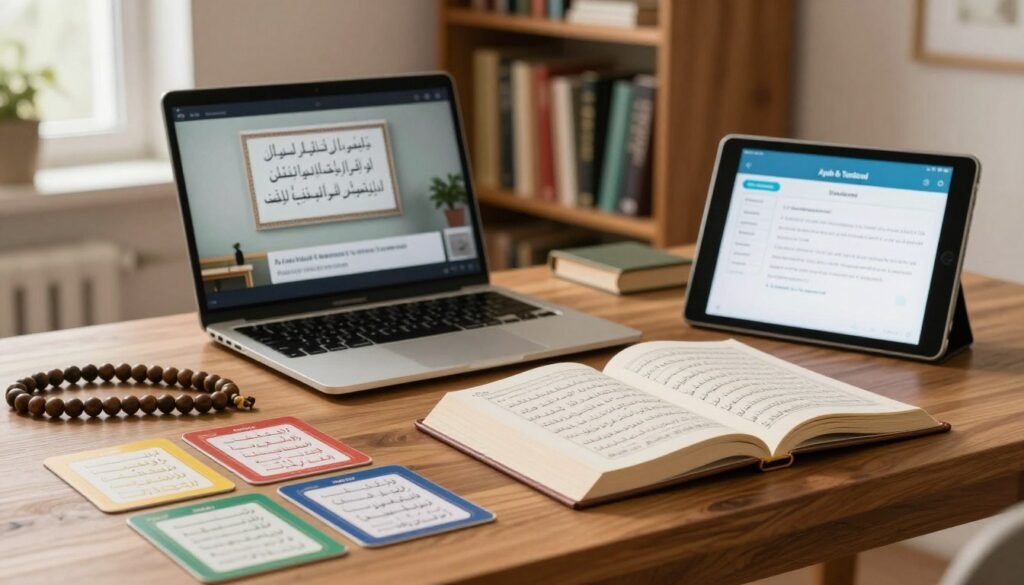
What if the smartphone in your pocket could transform from a source of distraction into a dedicated tutor for your child’s Quran journey? In our homes, screens often pull families apart. Yet, with intention, they can become the very thing that draws you closer to the Quran and to each other. The right memorization tools for Quran memorization don’t add to the noise. They create a focused, sacred space for learning.
We advocate for digital assistance, not passive consumption. A tool like our Ayah & Tardeed Juz Amma Mastery Package is designed with this precise balance in mind. It provides what even the most dedicated parent cannot always offer: infinite patience and instant, accurate phonetic feedback. This is the core of modern digital assistance.
These tools offer three critical advantages for busy families:
- Personalized Pacing: The AI adapts to your child’s unique speed, never rushing or holding them back.
- Instant Feedback: Your child knows immediately if their pronunciation (makharij) is correct, building confidence.
- Structured Progression: It removes the guesswork, providing a clear, step-by-step path forward.
The most important rule is this: the tool is an assistant, not a replacement. Its purpose is to amplify your role, not to take it over. The human connection—your encouragement, your explanation of the verse’s beautiful meaning, your shared smile—is irreplaceable.
Here is your actionable plan to make technology work for your family:
- Start Together: For the first 10 minutes of any digital learning session, sit with your child. Set the intention and explore the tool’s features side-by-side.
- Celebrate the Feedback: When the AI gives a “correct recitation” prompt, make it a moment of joy. A high-five or a “Masha’Allah!” reinforces positive achievement.
- Define the Roles: Let the digital tool handle the repetitive drill and practice. This frees you up to focus on the deeper relationship and spiritual connection.
This intentional approach performs a powerful shift. It turns isolated screen time into shared, productive, and bond-strengthening sacred time. The device becomes a portal to the Quran, not away from it.
Embrace memorization tools for Quran memorization as your supportive partner. They handle the consistent practice so you can provide the warmth and wisdom. In this partnership, faith and modern learning don’t just coexist—they thrive together.
Keeping the Flame Alive: Motivation for Parent and Child
In the sacred journey of hifz, the flame of enthusiasm can flicker—but with the right approach, we can keep it burning brightly for both parent and child. Motivation isn’t a single spark you light at the start; it’s a gentle fire that needs consistent, thoughtful fueling. For your child, this fuel comes from your genuine excitement and from seeing their own progress. For you, it comes from a subtle but powerful shift in how you define success.
Let’s start with your child’s motivation. Young minds thrive on tangible recognition and positive reinforcement. A visual progress chart isn’t just decorative; it’s a psychological tool that makes abstract achievement concrete. Celebrate completing a verse or mastering a difficult pronunciation with a special family dessert or a heartfelt, personalized dua. These moments create positive anchors in their memory, linking the joy of accomplishment directly to Quranic learning.
Your own motivation as a parent is equally crucial, and it requires a different kind of fuel. We must shift our measure of success from “verses memorized this week” to “connection fostered today.” Did your child engage with the Quran peacefully for ten focused minutes? That’s a win. Did they pause to ask a question about the meaning of a word in Surah An-Naba? That’s a monumental victory. Your sustained enthusiasm is the single greatest predictor of your child’s long-term engagement.
One of the most powerful ways to model this joy is to join the journey yourself. Consider reviewing Surah An-Naba alongside your child. Your authentic struggle and focus demonstrate that this is a lifelong pursuit of value. As one educator wisely noted:
“The child learns not from the parent’s perfect recitation, but from the parent’s patient return to the Quran, day after day.”
To make this dual-fuel approach practical, here is a clear comparison of strategies:
| Strategy Area | For Your Child (Actionable Tip) | For You, the Parent (Mindset Shift) |
|---|---|---|
| Celebrating Progress | Use a sticker chart for each verse; reward with a favorite activity or small privilege. | Find joy in the process—the quiet focus, the curious question—not just the outcome. |
| Handing Setbacks | Normalize mistakes. Say, “Let’s listen to the audio together and find that tricky part.” | View regression as part of the learning curve, not failure. Your calm patience is the lesson. |
| Daily Integration | Connect a memorized ayah to daily life. Discuss how “a resting place” (verse 3) relates to bedtime. | See memorization as weaving Quran into your family’s narrative, not an isolated academic task. |
Implement these actionable tips drawn from successful family experiences:
- Recite Yourself: Let your child hear you practicing, even imperfectly. It normalizes the effort.
- Celebrate Milestones Creatively: Beyond treats, create a “Quran accomplishment” page in a family scrapbook.
- Be Patient with Regression: Some days, just opening the mus’haf is the victory. Avoid pressure.
- Connect Surahs to Daily Life: Point out the signs of Allah mentioned in An-Naba during a walk in nature.
Ultimately, keeping the flame alive is about partnership. We are not just instructors; we are fellow travelers on a blessed path. When we model a consistent, joyful relationship with the Quran, our children don’t just memorize words—they internalize a love that can last a lifetime. Your steady, encouraging presence is the most sustainable motivation of all.
When Progress Stalls: Practical Troubleshooting Guide
Every memorization journey encounters moments where the path seems to level off. This is not a sign of failure but a natural part of the learning process. When your child’s progress with Surah An-Naba verses 3-5 slows, view it as valuable feedback. Our guide turns common hurdles into stepping stones.
Below is a practical table to diagnose and solve the most frequent challenges. Use it to quickly identify the issue and apply a targeted solution.
| Problem You See | Likely Root Cause | Actionable Solution |
|---|---|---|
| Resistance or Frustration | The session feels like pressure, not a positive connection. | Shorten immediately to 5 minutes of pure, joyful engagement. End with a favorite Islamic story or a quick game. Preserving love for the Quran is the primary goal. |
| Quick Forgetting | Neural pathways for the new verses are still fragile and need strengthening. | Dedicate 80% of your next 2-3 sessions to joyful review of old, mastered material. This reinforces memory more than pushing new content. |
| Poor Pronunciation (Tajweed) | Rushing through sounds without proper foundation. | Slow down dramatically. Isolate the difficult letter or rule. Use a phonics-based approach, repeating the single sound correctly before putting it back in the verse. |
| Inconsistent Schedule | Relying on willpower instead of a system. | Anchor memorization to an unshakeable daily habit. Practice right after Fajr or Maghrib prayer, or immediately after brushing teeth. Consistency in timing builds automaticity. |
Let’s delve into two key solutions. The 80% review rule is a game-changer. If your child is forgetting Surah An-Naba verse 4, don’t see it as a setback. It simply means their brain needs more exposure to that specific pattern. Spend the majority of your time reciting verses 3 and 4 together with confidence before introducing verse 5 again.
For inconsistency, the habit-anchoring method is powerful. By tying Quran time to an existing, non-negotiable part of your day—like a daily prayer—you remove the mental debate of “when.” The routine builds itself, creating a sacred rhythm for your family.
These moments of stalling are not roadblocks. They are your guide, showing you exactly what your child’s mind needs to solidify its connection to the Quran. Adjust with patience, and you’ll find your way back to smooth progress. This proactive approach is at the heart of effective quran memorization tips and provides the specific surah an naba verse 3-5 memorization help your family needs.
Conclusion
Memorizing Surah An-Naba verses 3-5 is a profound beginning. It is the first act of weaving the Quran’s divine thread into your child’s identity. This journey moves beyond simple recitation to build a living, loving relationship with the words of Allah.
We have explored the quiet struggles many families face. We looked at the cognitive science that makes visual learning so powerful for lasting memory. The clear path of Sequential Visual Memorization bridges your child’s faith with how their modern brain learns best.
This method is built for your reality. It honors the timeless goal of Quran memorization with a structured, compassionate approach fit for today’s world. You now have a practical action plan—from understanding meaning to active recall.
Our Ayah & Tardeed Juz Amma Mastery Package provides the specific tools and structure to support this journey. We are your partners, offering a proven system to make each step feel manageable and successful.
The next step is yours to take. Start their Quranic journey today. Gather your child, open their heart, and begin with one visualized verse. Build this sacred habit one peaceful, focused session at a time.
Do you prefer reading in Arabic? Continue reading our article on learning here.
How Kids Can Memorize Surah An-Naba Verses 1-3 Easily