
What if your child could hold onto the Quran’s wisdom not just through repetition, but through a method that paints vivid pictures in their mind? We understand that familiar tug-of-war. As parents in the diaspora, weaving Islamic learning into the busy rhythm of Western life often feels like a race against time—and a battle for lasting retention.
This guide is our partnership with you. Together, we will explore a gentle, yet profoundly effective, path to help your child internalise the powerful ayaat 19 to 21 from Surah An-Naba. It is crafted for the reality of modern family life, where moments are precious and meaningful connection is the ultimate goal.
We introduce ‘Sequential Visual Memorisation’—a step-by-step approach that moves beyond recitation. It builds a bridge between cherished Islamic tradition and the clear insights of modern cognitive science. Our method is designed to make these specific verses stick, transforming the task from a chore into a captivating journey of discovery for your young learner.
Key Takeaways
- Addresses the unique challenges of Quran memorisation for kids growing up in Western diaspora communities.
- Presents a structured, step-by-step framework for Surah An-Naba memorisation of verses 19-21.
- Employs the ‘Sequential Visual Memorisation’ method to enhance engagement and long-term retention.
- Harmonises time-tested Islamic learning principles with contemporary educational science.
- Offers a practical, time-conscious solution tailored for busy family schedules.
- Focuses on creating a deep, personal connection between the child and the meaning of the ayaat.
The Shared Challenge for UK Muslim Families: Quran Memorisation in Modern Life
The desire to nurture a deep, lasting connection with the Quran in our children is universal, but the practical challenges faced by diaspora families are uniquely demanding. We see the daily reality: a tapestry woven from school runs, work deadlines, and a genuine commitment to fostering a strong Islamic identity. This balancing act is a profound labour of love, yet it can leave little room for the consistent, quality time that effective Quran memorisation demands.
The hurdles are familiar to so many of us. Schedules are fragmented, pulled in different directions by homework, extracurricular clubs, and the essential need for family downtime. The intention to sit with our children and help them learn Surah An-Naba verses 19-21 is always there, but the window of focused opportunity often feels frustratingly narrow. It’s not merely about finding time; it’s about finding the right kind of time—when both parent and child are present, patient, and receptive.
Beneath the logistical struggle lies a deeper, more poignant concern: the fear that our efforts might lead to recitation without true retention. We worry that verses memorised today could be forgotten tomorrow, or that the process itself becomes a source of pressure rather than spiritual joy. This anxiety is valid. In a world of rapid information overload, creating lasting Islamic memory requires more than repetition; it needs a method that aligns with how our children’s minds naturally learn and retain.
“I want my child to love the Quran, not see it as another chore on the list.”
This search is at the heart of the challenge for modern Muslim parents in the UK. We seek an approach that honours our traditional values while respecting the realities of our children’s contemporary upbringing. It must be efficient, to fit into our lives, and engaging, to capture their hearts. The goal is not just to tick a box, but to plant seeds of faith that will grow and flourish.
We believe this shared challenge can be transformed. It can shift from being a source of overwhelm to becoming a manageable, even delightful, part of your family’s routine. The journey to help your kids learn and internalise the Quran is not a solitary burden, but a partnership. By understanding these common pressures, we can move forward with clarity and purpose, turning aspiration into achievable action.
Why Repetition Alone Isn’t Enough for Lasting Quranic Memory
While repetition forms the bedrock of memorisation, modern understanding reveals its limitations for long-term retention. For generations, we have relied on the powerful tool of tardeed—repetition—to commit the Quran to heart. Its value in establishing rhythm and familiarity is undeniable. However, cognitive science now shows us that for knowledge to become permanent, especially in a child’s developing mind, rote repetition can be an inefficient solo act.
The issue lies in how our brains store information. Rote practice primarily engages the auditory and short-term memory circuits. It’s like repeatedly writing a phone number on a scrap of paper you keep losing. Without a strong, associative ‘hook’, the information lacks a dedicated place in the long-term memory network. This is why a child might perfectly recite a verse after practice, but struggle to recall its sequence the next day or confuse it with another that has a similar sound.
When this happens, it’s crucial to understand it is not a sign of insufficient effort or a lack of piety. It is often simply the brain signalling that it hasn’t been given a robust enough framework to organise and retrieve the information. This insight is liberating for both parent and child. It shifts our focus from the pressure of ‘trying harder’ to the empowerment of ‘learning smarter‘.
So, what makes memory stick? Lasting recall is built through multi-sensory encoding. The brain prioritises information that is connected to vivid imagery, strong emotions, spatial awareness, or a clear narrative. This is where moving beyond pure repetition becomes essential. Effective tips for kids memorising Surah An-Naba verses 19-21 must therefore incorporate strategies that create these powerful mental hooks.
By embracing this scientific perspective, we free ourselves from guilt and open the door to more engaging, effective methods. We stop viewing memory lapses as failures and start seeing them as clues, guiding us to provide the right kind of cognitive support. The next step in our journey explores one of the most powerful of these supports: the science of visual learning.
The Cognitive Science Behind Effective Hifz: Visual Learning and Memory
At the heart of lasting Hifz lies a fundamental principle of neuroscience: our brains are built to remember what we see far better than what we merely hear. This isn’t a modern shortcut; it’s a divinely-wired feature of human cognition that we can harness to support our children’s sacred journey. When we align Quranic learning with how the mind naturally works, we move from strenuous effort to efficient, joyful mastery.
This approach is particularly transformative for the memorisation of Surah An-Naba verses 19-21 for kids. Rather than treating the verses as a string of abstract sounds, we help children construct a vivid, internal world where the Quran’s message comes alive. We bridge timeless faith with contemporary understanding, creating a learning path that is both deeply Islamic and brilliantly effective.
How the Brain Prioritises and Stores Visual Information
Cognitive scientists refer to the pictorial superiority effect. Simply put, our minds are incredible image processors. Information presented as a picture or a scene is encoded more deeply and recalled more accurately than words alone. Think of it as your brain having a dedicated, high-definition gallery for visuals.
When a child hears an Ayah, it primarily activates the auditory pathways. But when they link that Ayah to a specific mental image, they engage the visual cortex, the emotional centres, and the narrative-processing regions. This multi-sensory engagement weaves a far stronger ‘memory trace’. It’s the difference between writing in sand and etching in stone.
For parents, this means moving beyond auditory repetition. It’s about helping your child visualise the meaning and the story. The powerful imagery in Surah An-Naba—of skies opening and mountains moving—isn’t just profound theology; it’s a perfect canvas for this very science.
Sequential Visual Memorisation: A Definition for Islamic Learning
So, what is Sequential Visual Memorisation? We define it as the method of linking each Quranic phrase to a unique, memorable visual scene, where the order of the images mirrors the sequence of the verses. It transforms linear recitation into a flowing mental narrative.
This isn’t about artistic skill or physical drawing. It’s about coaching your child to build an internal, animated story. For Surah An-Naba verses 19-21 memorisation techniques for kids, this involves creating a three-part visual sequence:
- Scene 1 (Verse 19): A visual for “the sky being opened” as if it were doors.
- Scene 2 (Verse 20): An image of “the mountains being set in motion” and vanishing.
- Scene 3 (Verse 21): A compelling scene representing “an appointed meeting” that is certain.
Each scene acts as a mental bookmark. To recall the verse, the child simply ‘replays’ the next scene in their story. This method leverages the brain’s innate strength in episodic memory—remembering events in sequence—and applies it directly to Hifz. The Quranic narrative itself becomes the unforgettable anchor.
By adopting this core concept, we equip our children with a cognitive tool that makes the memorisation of Surah An-Naba verses 19-21 for kids not just achievable, but inherently logical and stable. It turns a potential challenge into an engaging act of imagination and faith.
Introducing the Ayah & Tardeed Package: A Structured Path to Juz Amma Mastery
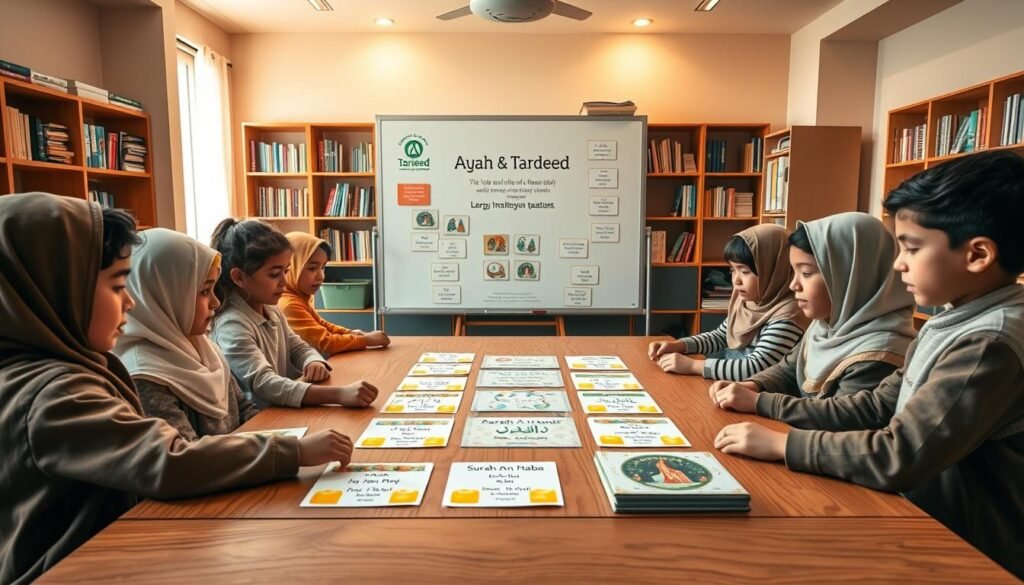
Translating theory into tangible results requires a dedicated framework, which is precisely what the Ayah & Tardeed Package provides. We have designed this system to address the specific challenges faced by UK Muslim families, offering a clear, step-by-step pathway that transforms the noble goal of juz amma memorization into an achievable, even enjoyable, daily practice.
Core Components of the Ayah & Tardeed Learning System
This isn’t just another set of audio files; it’s a holistic learning ecosystem. The Ayah & Tardeed system seamlessly integrates the Sequential Visual Memorisation method with disciplined, structured revision—the crucial ‘Tardeed’. It moves your child beyond passive listening to active, confident recall.
The system is built on three interconnected pillars:
- Step-by-Step Visual Story Guides: Each set of verses, including surah an-naba 78:19-21 memorisation for children, is broken down into memorable visual narratives. These guides act as cognitive anchors, making abstract concepts concrete and unforgettable.
- Crystal-Clear Audio Recitations: Professionally recorded tajweed-perfect audio provides the essential auditory foundation. Your child masters the correct pronunciation, melody, and rhythm from the very beginning.
- Interactive Practice Activities: We turn essential revision into engaging play. These activities reinforce the visual stories and audio, ensuring the memorisation moves from short-term to long-term memory.
Together, these components create a supportive loop: learn, visualise, practice, and retain. The following table outlines how each element contributes to your child’s mastery:
| Component | Description | Key Benefit for Memorisation |
|---|---|---|
| Visual Story Guides | Illustrated narratives that map directly onto the Arabic text and meaning. | Creates strong mental hooks for faster encoding and accurate sequence recall. |
| Structured Audio Tardeed | Organised audio tracks for daily and weekly revision sessions. | Builds auditory memory and ensures pronunciation accuracy over time. |
| Interactive Activities | Games and exercises based on the visual stories. | Transforms passive review into active recall, solidifying the memory pathway. |
The Benefit of Lifetime Access for a Growing Child’s Islamic Education
We understand that a child’s Islamic learning journey is not a short-term course but a lifelong relationship with the Quran. This conviction is why we offer lifetime access to the Ayah & Tardeed Package. It is an investment that grows and adapts alongside your child.
“The best of you are those who learn the Quran and teach it.” We believe access to transformative learning tools should be enduring, not temporary.
Consider this: the visual story that helps your seven-year-old effortlessly memorise a verse today will serve a different, deeper purpose in a few years. During their teen years, that same image can trigger profound reflection on the meaning (tafsir) and context. The resource evolves from a memorisation aid to a tool for spiritual connection.
This enduring access provides incredible value and flexibility. It supports your child’s evolving juz amma memorization goals, whether they are revisiting fundamentals or advancing to new surahs. It ensures that this supportive framework for surah an-naba 78:19-21 memorisation for children remains a constant, reliable companion throughout their formative years and beyond.
Preparing for Memorisation: Understanding the Meaning of Verses 19-21
Before your child can visualise the cosmic events of the Hereafter, they must first understand the profound scene being described. Memorising Arabic sounds is one step; anchoring those sounds to a powerful mental picture is what creates indelible memory. This is why our approach always begins with meaning. For parents wondering how to teach children Surah An-Naba verses 19-21, this foundational step transforms the task from rote learning into an engaging exploration of Allah’s signs.
Surah An-Naba, revealed in Makkah, focuses intensely on the reality of the Hereafter (Akhirah) and the Day of Resurrection. Verses 19-21 describe a pivotal, awe-inspiring moment on that Day, painting a picture of universal transformation that challenges everything we know about the stability of our world.
A Simple Explanation of the Powerful Imagery in These Ayaat
Let’s break down this divine imagery into concepts a child can grasp. The verses state: “The sky will be opened like gates, and the mountains will be set in motion, becoming like a mirage.”
First, consider the sky. We see it as a permanent, solid dome above us. Allah describes it being opened like gates. Explain to your child that this is like the vast sky splitting apart, with colossal sections swinging open like the doors of a mighty fortress. It signifies the end of the world as we know it and the beginning of a new, divine order.
Next, the mountains. They are the ultimate symbols of strength and permanence in our earthly life. On that Day, they will be set in motion, shaking and moving from their foundations. Even more strikingly, they will appear like a mirage—like the shimmering, insubstantial illusion of water you see on a hot road. This shows that everything we consider solid and eternal is entirely under Allah’s command and will be utterly transformed.
This imagery is not intended to frighten, but to inspire awe at Allah’s absolute power and to cement the certainty of the Akhirah in our hearts. When a child understands this, the words they are memorising carry weight, emotion, and a story they can connect with.
| Arabic Term (From the Ayah) | Simple Explanation for a Child | The Core Lesson |
|---|---|---|
| فُتِحَتِ (Futihat) | Opened wide, like giant doors swinging open. | Nothing in creation is locked or fixed against Allah’s will. |
| أَبْوَابًا (Abwaban) | Gates or doorways. | The sky itself will become an entrance to a new reality. |
| سُيِّرَتِ (Suyyirat) | Caused to move, set in motion. | Allah can move what we see as unmovable. |
| سَرَابًا (Sarabaan) | A mirage; a shimmering illusion. | The physical world’s solidity is temporary and an illusion compared to Allah’s eternal reality. |
Grounding your child’s memorisation in this clear understanding does more than aid memory—it nurtures iman (faith). The visual story they then build during memorisation practice is no longer imaginary; it’s a reflection of a profound Quranic truth. This is the essential first step in any effective strategy for how to teach children Surah An-Naba verses 19-21 with lasting impact.
Your Step-by-Step Guide to Memorise Surah An-Naba Verses 19-21 for Kids
For parents seeking a practical method to teach kids Quran step by step, this guide breaks down the memorisation of Surah An-Naba into manageable, engaging stages. We move from theory to action with a clear, three-phase process designed to build confidence and ensure lasting recall. This isn’t about rote repetition; it’s about creating a meaningful, cognitive connection with the verses.
Before we begin the first step, remember that consistency trumps duration. Short, focused sessions are far more effective than long, draining ones. Let’s explore each phase in detail.
Step 1: Cultivating the Right Mindset and Environment
Success begins before a single word is recited. This step is about setting the stage for focused, positive learning. Start by gently discussing the niyyah (intention) with your child – framing this as a special act of worship and learning, not a chore.
Practical Tip 1: Create a Dedicated ‘Hifz Corner’. Choose a quiet, consistent spot in your home, free from digital distractions like TVs and tablets. A simple prayer mat, good lighting, and perhaps a small shelf for the Mushaf can signal to your child’s brain that it’s time to focus.
Practical Tip 2: Use Empowering Language. Replace “You need to memorise this” with “Let’s discover these amazing verses together.” Celebrate effort, not just perfection. This builds a positive association with Quranic learning that lasts a lifetime.
Step 2: Auditory Foundation – Mastering the Sound and Melody
With the right atmosphere established, we lay the auditory groundwork. The goal here is for your child to become intimately familiar with the sound, rhythm, and correct pronunciation (tajweed) of the verses.
Practical Tip 3: Leverage Quality Recitation. Play a clear, beautiful recitation of verses 19-21 – such as the audio from the Ayah & Tardeed package. Have your child listen with closed eyes, focusing purely on the melody (maqam) and the flow of the words.
Practical Tip 4: The ‘Phrase-by-Phrase’ Echo. After listening, work on one short phrase at a time. You recite, then have your child echo it back, mimicking your tone and pace. This builds accurate auditory memory and makes the longer verse feel less daunting.
Step 3: Constructing the Unforgettable Visual Story
This is where cognitive science transforms memorisation. We translate the auditory sounds into a vivid, internal movie that the mind can easily retrieve. This technique is particularly powerful to memorise Surah An-Naba verses 19-21 for kids, as the verses are rich in imagery.
Practical Tip 5: Co-create the ‘Mental Movie’. Work together to visualise each phrase. For “The sky will be opened like gates,” imagine colossal, ornate gates in the heavens swinging wide. For “the mountains will be set in motion,” picture giant mountains wobbling and sliding as if they were made of soft clay. Make it dramatic and fun.
The key is to link each specific Arabic phrase directly to its corresponding image in your child’s mind. This collaborative storytelling turns passive listening into active, creative learning, cementing the verses in long-term memory.
By following these three steps in sequence – mindset, sound, and story – you provide a complete learning framework. Your child progresses from a willing participant to a confident memoriser, equipped with tools that go far beyond these three verses.
Five Advanced Techniques to Lock in the Memorisation
Securing these powerful ayaat in your child’s mind demands more than initial repetition; it calls for intelligent, multi-sensory reinforcement. The following advanced memorisation strategies for kids are designed to move knowledge from short-term recall to deep, lasting retention. Each technique addresses a different learning preference, ensuring every child can find a method that resonates.
1. The Gradual Uncovering Method for Precision
This technique combats a common issue: reciting from fuzzy memory rather than precise visual recall. Place an open Mushaf in front of your child. Use a plain card or a sheet of paper to cover the entire page.
Uncover only the single line of Surah An-Naba 78:19-21 they are currently reciting. As they correctly recite a word or phrase, slide the card down to reveal the next. This method trains the eyes and brain to associate the sound with the exact Arabic script.
It prevents guessing and builds confidence in their independent reading of the Quranic text. Precision becomes a habit.
2. Integrating Physical Movement for Kinetic Learners
Many children learn best when their whole body is engaged. For kinetic learners, associating a simple physical action with each part of the visual story creates a powerful memory anchor.
For verse 19, where the skies become doors, they could mimic opening a large gate with their arms. For the mountains moving in verse 20, a gentle swaying motion works well.
This embodied learning strengthens neural pathways. The movement itself becomes a cue that triggers the correct words and sequence, making the memorisation of Surah An-Naba 78:19-21 a dynamic, whole-body experience.
3. Designing an Effective Five-Minute Daily Tardeed Routine
Consistency is the cornerstone of Hifz. A short, focused daily review outperforms a long, infrequent session. We advocate for a dedicated five-minute tardeed (revision) ritual.
Here is a sample routine you can adapt:
- Minute 1-2: Recite the three verses from memory aloud, with Tajweed.
- Minute 3: Check the recitation against a recording or the Mushaf, noting any hesitations.
- Minute 4: Isolate and repeat the challenging phrase three times.
- Minute 5: Recite the entire passage fluently once more to finish on a high note.
This routine turns revision into a manageable, non-negotiable daily habit that fits seamlessly into busy family life.
4. Leveraging Digital Tools for Positive Reinforcement
Technology, used with intention, can be a remarkable ally in your child’s Islamic education. The goal is to create positive feedback loops that celebrate progress.
Use a simple voice recorder app on a phone or tablet. Let your child record their recitation and listen back; this develops self-correction skills. Alternatively, use a digital star chart or habit-tracking app to visually mark each successful daily tardeed session.
Small digital rewards or the simple act of seeing a streak build can provide immense motivation. It transforms a duty into an engaging challenge.
| Technique | Best For Learning Style | Daily Time Needed | Key Benefit |
|---|---|---|---|
| Gradual Uncovering | Visual & Meticulous Learners | 3-4 minutes | Eliminates guesswork; ensures script accuracy |
| Physical Movement | Kinetic & Active Learners | 2-3 minutes | Creates strong physical memory anchors |
| 5-Minute Tardeed Routine | All types, especially busy families | 5 minutes | Builds unbreakable consistency and habit |
| Digital Tools for Reinforcement | Tech-engaged children | 1-2 minutes | Provides instant positive feedback and motivation |
By mixing these methods, you create a robust framework for retention. One day might focus on precision with the uncovering method, the next on energy with physical movement. This variety keeps the process fresh and addresses all aspects of memory. Your child isn’t just memorising; they are mastering a sustainable system for lifelong Quranic connection.
Navigating Common Obstacles in Your Child’s Memorisation Path

Obstacles in memorisation are not signs of failure but opportunities for gentle guidance and renewed connection with the Quran. We understand that the journey of memorising Surah An-Naba 78:19-21 for children is a deeply personal one, where progress can sometimes stall. This is a normal part of the learning process. Our role is to navigate these moments with wisdom, turning potential frustrations into stepping stones for deeper understanding and commitment.
When Motivation Wanes: Re-engaging Your Child
A dip in enthusiasm is common. When it happens, shift the focus from pure output to the experience of learning itself. Revisit the vivid visual story you built together for the verses. Ask your child to describe the imagery of the mountains being set in motion or the sky being opened.
Sometimes, a fresh auditory perspective helps. Listen to a different Qari whose tone or tempo might rekindle interest. Connect the verses to the world around you; when you see a vast landscape, gently relate it to the Quranic description.
If a plateau persists, consider a structured break. Agree on a short pause—a day or two—with a specific date to return. This respects your child’s mental space while maintaining commitment. The goal is to preserve the love for the Quran above all.
Correcting Pronunciation and Sequence Errors Gently
Errors in Tajweed or the order of ayat are natural. The key is correction without criticism. If a mistake occurs, calmly replay the correct audio from your trusted source. Let the sound be the guide, not a verbal critique.
For sequence errors, prompt with a question about your visual story. Ask, “What does our picture show happening after the mountains move?” This cues memory through narrative, not rote recall.
Always frame corrections as collaborative problem-solving. Use phrases like, “Let’s help our memory get stronger together,” or “Our ears are training our tongues.” This approach maintains confidence and keeps the environment positive.
To summarise these strategies, the following table outlines common hurdles and practical, empathetic responses you can employ.
| Common Obstacle | Potential Root Cause | Practical Solution |
|---|---|---|
| Loss of interest or enthusiasm | Monotony or feeling of pressure | Shift to experiential learning; use a new recitation audio; connect verses to real-life observations. |
| Persistent pronunciation (Makharij) error | Habitual repetition of an incorrect sound | Pause and isolate the word; play the correct audio 3-5 times; have your child whisper it before speaking aloud. |
| Mixing up the sequence of verses | The logical link in the visual story is weak | Reconstruct the story together verbally; use flashcards to physically reorder the scenes. |
| Frustration leading to resistance | Perception of the task as too difficult | Break the session into tiny, 2-minute goals; celebrate micro-wins; ensure the environment is calm and free from distraction. |
Remember, your calm presence is the most powerful tool. By approaching each challenge as a supportive guide, you reinforce that this memorisation path is a shared journey of growth. Every obstacle overcome deepens your child’s connection to these precious verses.
Beyond An-Naba: Applying This Method to the Entire Juz Amma
The skills your child has developed through this structured method are not confined to a single surah; they form a transferable toolkit for Juz Amma memorisation. The mastery of An-Naba verses 19-21 provides a complete blueprint. The same core principles—Sequential Visual Memorisation and a disciplined Tardeed routine—can now be confidently applied to every surah in the Quran’s final section.
Each surah in the thirtieth Juz offers its own unique landscape for your child’s imagination to explore. From the profound, concise monotheism of Surah Al-Ikhlas to the vivid historical narrative of Surah Al-Fil, the rich imagery is a powerful ally. The method you’ve learned turns abstract text into memorable, visual stories. This adaptability is its greatest strength.
We encourage you to view this not as a single task completed, but as the acquisition of a lifelong Islamic skill. The Ayah & Tardeed Package is specifically designed to facilitate this seamless expansion. It provides a consistent, familiar framework that reduces the friction of starting new surahs. Your child won’t be learning a new system each time; they’ll be deepening their expertise in a method they already own.
Imagine the growing confidence and profound sense of accomplishment as your child builds, surah by surah, a personal, visualised library of the Quran. This journey through Juz Amma becomes a tangible record of their dedication and spiritual growth. The repetition of success breeds a positive, self-reinforcing cycle in their Islamic education.
Therefore, consider this milestone a launchpad. With this effective approach, the entire memorisation of Juz Amma transforms from a daunting prospect into an achievable, structured series of victories. You have equipped your child not just with a few verses, but with a reliable key to unlock the beauty of the entire thirtieth Juz.
Conclusion
Our shared journey from recognising the challenge of Quran memorisation for UK Muslim families to applying a structured, science-backed method is now complete. Memorising Surah An-Naba verses 19-21 is a profound first step in your child’s Islamic education. It plants a seed of divine connection using techniques that respect their God-given cognitive abilities.
The visual learning strategy and consistent Tardeed routine you have discovered transform this spiritual practice. They create deep, meaningful engagement with the Quran, moving far beyond simple repetition. This approach builds a foundation for lasting memory and love for Juz Amma.
We invite you to take that first, practical step today. Revisit the unique visual story you crafted during this guide. Faithfully implement the five-minute daily Tardeed routine to lock in the memorisation. For families seeking a comprehensive path, explore how the Ayah & Tardeed Package can support your mastery of the entire Juz Amma.
Your role in nurturing this Quranic journey is indispensable. Remember, you are not walking this path alone. We are your partners in nurturing a generation that carries the Quran with genuine understanding and love. Start this beautiful journey with your child with confidence.
Do you prefer reading in Arabic? Check out our article on visual learning here.
Start from the beginning and follow each lesson:
- Memorize Surah An-Naba verses 1–5
- Memorize Surah An-Naba verses 6–10
- Memorize Surah An-Naba verses 11–15
- 9-12 Memorize Surah An-Naba verses
- 12-15 Memorize Surah An-Naba verses
- Memorize Surah An-Naba verses 15–18
Many parents use the Ayah Tardeed method to help their kids memorize faster.
Start Your Child’s Quran Memorization Journey Today