
What if the secret to your child’s lasting Quranic connection isn’t more time, but a better method?
For dedicated parents across Canada and the wider Western diaspora, nurturing a deep bond with the Quran can feel like a race against the clock. We understand that quiet worry—wanting this profound connection for your child, yet feeling pressed for time and unsure if traditional repetition will truly stick.
This article is your partner in changing that narrative. We present a clear, step-by-step pathway for your child to memorize Surah An-Naba verses 12-15. This isn’t about adding pressure; it’s about unlocking a sustainable, joyful learning process rooted in modern cognitive science and Islamic tradition.
By the end, you’ll have a practical framework and the confidence to guide your child meaningfully.
Key Takeaways
- We directly address the common struggle of time-pressed diaspora parents wanting effective Islamic education.
- A structured, step-by-step method replaces anxiety with a clear path forward.
- The approach harmoniously blends evidence-based learning techniques with traditional Islamic values.
- Focus is on creating a joyful and sustainable process, not rote pressure.
- You will gain a practical toolkit to facilitate your child’s surah an-naba memorization for children.
- The goal is to build a profound and enduring connection with the Quranic verses.
- This guide is designed to work within the realities of modern Western family life.
The Unique Struggle of Quran Memorization in Western Diaspora Families
The desire to root our children in the Quran is profound, yet the path to memorization in a Western context is fraught with unique hurdles. We see you, striving to impart this sacred knowledge amidst the vibrant, fast-paced rhythm of Canadian life. Your struggle isn’t about a lack of devotion; it’s about navigating a reality where school schedules, hockey practice, and homework compete for every precious hour.
Where does dedicated Quran time fit in? This constant balancing act can make even the most well-intentioned quran memorization tips for kids feel theoretical. The challenge extends beyond the clock. In an environment saturated with interactive screens and visual storytelling, asking a child to memorize through silent repetition alone often leads to disengagement. The verses might be recited today but forgotten by next week, creating a cycle of frustration for both parent and child.
We recognize this dual tension: the deep wish for authentic Islamic grounding and the practical demands of modern parenting. Your goal in teaching surah an-naba to children isn’t merely to add another task to their list. It’s to foster a genuine, lasting connection. The traditional model of rote learning, while venerable, often clashes with how today’s children are wired to learn and retain information.
This isn’t a failure on your part. It’s a sign of the times. The problem we are solving together is clear: how to achieve effective, efficient, and engaging Quran memorization that fits seamlessly into your family’s reality. It’s about moving from a source of stress to a source of spiritual joy. We are partners in this journey, combining modern cognitive science with timeless Islamic values to create a method that respects your time and captivates your child’s mind.
The solution lies not in working harder, but in working smarter—with tools and a framework designed for your context. Let’s transform the struggle into a structured, successful pathway for your child to embrace the Quran.
Why Rote Repetition Alone Is Not Enough for Today’s Children
In an age of interactive apps and animated stories, asking a child to learn by repetition alone can feel like an uphill battle. We deeply respect the tradition of Tardeed—the disciplined repetition that has preserved the Quran for centuries. Its value is sacred and timeless. Yet, cognitive science now shows us that for the modern child’s brain, this powerful tool is most effective when it’s part of a richer, more engaging strategy.
Rote learning primarily exercises one type of memory: the auditory loop. A child hears, then repeats. While this builds initial familiarity, it can become a mechanical task. Without connection to meaning or imagery, the verses exist in a vacuum. This makes the memory fragile—easily recited today, but vulnerable to being forgotten tomorrow, especially amidst the constant sensory input of daily life.
True learning requires building multiple pathways to the same knowledge.
This is where we enhance the tradition with understanding. Sequential Visual Memorization is not a replacement for Tardeed; it’s its perfect partner. It moves beyond “how it sounds” to anchor “what it means” and “how it looks” in the child’s mind. By adding visual and contextual anchors, we engage more areas of the brain, creating a stronger, more resilient memory network.
For parents seeking easy ways to memorize Quran verses, this science-backed approach is transformative. It turns a duty into a discovery. When a child visualizes the “firm mountains” described in Surah An-Naba or understands the sequence of Allah’s creation, the verses stick. They become a story held in the mind, not just a sound on the tongue.
This method is particularly powerful for Surah An-Naba for young learners. The surah’s vivid descriptions of the universe are ideal for visual mapping. Supplementing repetition with this layer of understanding leads to the deeper, longer-lasting recall we all want for our children. It honors the timeless method while preparing them for a lifelong, connected relationship with the Quran.
Unlocking Memory: The Cognitive Science of Sequential Visual Learning
For a child facing the beautiful challenge of Quran memorization, the brain’s natural wiring can be their greatest ally. We often think of memory as a simple recording device, but modern cognitive science reveals it’s more like a dynamic storytelling studio. Our minds are built to remember narratives, vivid pictures, and information that follows a logical order—a clear beginning, middle, and end.
This is where the power of Sequential Visual Learning comes into play. It’s a memorization technique for kids that aligns perfectly with how their brains work best. Instead of treating a verse as a string of unfamiliar sounds, we break it into meaningful chunks. Each chunk is then paired with a strong mental image or a mini-story, a process known in Islamic pedagogy as Tasweer Al-Ma’na (visualizing the meaning).
Why does this work so well? Each image acts as a sturdy “hook” in the child’s mind. When they learn to place these image-hooks in the correct sequence, recalling the corresponding Arabic words becomes almost automatic. The abstract text transforms into a personal, internal movie they can replay at will.
Let’s demystify this with a practical example. Consider the phrase. A child might struggle to recall the Arabic sequence through sound alone. But if they visualize a bright, high lamp (a strong image for “intense heat”), followed by a cool, bubbling spring (for “cooling drink”), they create a storyboard. To remember the verse order, they just follow the story: first the heat, then the relief. This method turns memorization from a test of auditory recall into an engaging act of creation.
| Aspect | Traditional Rote Repetition | Sequitive Visual Learning |
|---|---|---|
| Core Strategy | Repeating sounds until they stick. | Building a connected story with images for each part. |
| How the Brain Engages | Primarily auditory processing; can lead to mental fatigue. | Multi-sensory engagement (visual, narrative, logical); creates more neural pathways. |
| Memory Hooks Created | One type: sound pattern. | Multiple types: image, story, sequence, and emotion. |
| Emotional Connection | Often neutral or associated with pressure. | Fosters curiosity and ownership; the narrative is theirs. |
| Long-Term Retention Potential | Fragile; easily disrupted by stress or time. | Robust; the story framework makes recall more resilient. |
Understanding this science is the first step in transforming your approach. It moves us from asking “how many times did you repeat it?” to “what story do you see?” This shift is at the core of effective Quran memorization resources for children. By leveraging sequential visual learning, we don’t just help children store words; we help them build a living, meaningful relationship with the divine message, one unforgettable image at a time.
Your Partner in Mastery: Introducing the Ayah & Tardeed Juz Amma Package
We understand that knowing the ‘why’ behind memorization is only half the battle; the ‘how’ demands practical, daily support. This is where we step in as your dedicated partner. We are thrilled to introduce the Ayah & Tardeed Juz Amma Package—a comprehensive resource crafted not as a mere product, but as your family’s guide to meaningful, lasting Quranic connection.
Designed with the unique realities of Canadian Muslim families in mind, this package transforms the theory of sequential visual learning into a tangible, engaging routine. It provides the exact structured framework we advocate, turning the challenge of surah an-naba 78:12-15 memorization for children into an achievable and joyful milestone.
What does this partnership include? It is built on three core pillars that address every aspect of effective learning:
| Learning Component | What It Is | How It Helps Your Child |
|---|---|---|
| Expert Tardeed Audio | Crystal-clear, paced recitations by qualified Quran teachers. | Ensures perfect pronunciation and rhythmic repetition from the very first listen, building a solid auditory foundation. |
| Visual Meaning Aids (Tasweer Al-Ma’na) | Beautiful, child-friendly illustrations that depict the core message of each ayah. | Locks the sequence of verses into long-term memory by linking sound to story, making abstract concepts concrete and memorable. |
| Sequenced Lesson Plan | A step-by-step roadmap that breaks down Juz Amma into daily, manageable sessions. | Eliminates guesswork and provides consistent progress, reducing frustration and building confidence with each small victory. |
| Lifetime Access & Growth Path | One-time access to the entire Juz Amma curriculum, forever. | Grows with your child. Master learn surah an-naba verses 12-15 today, and proceed through the entire Juz at their own pace, year after year. |
Imagine a resource that combines the authenticity of traditional tajweed with the engagement of modern educational design. The Ayah & Tardeed package does exactly that. It serves as your in-home Quranic learning centre, available on your schedule—after school, on weekends, or during family time.
The promise of lifetime access is particularly vital for diaspora families. It acknowledges that a child’s spiritual journey is not a sprint but a lifelong marathon. This resource adapts to different learning phases, ensuring the tools you invest in today remain relevant tomorrow.
This package is more than a memorization aid; it’s an investment in your child’s relationship with the Quran, designed to foster understanding alongside recitation.
For parents feeling the pressure of limited time and seeking effective Islamic education, this package is the bridge. It translates complex cognitive principles into simple, actionable steps. You are not just helping your child learn surah an-naba verses 12-15; you are equipping them with a method—a love for the Quran that is built on understanding, not just repetition.
Let the Ayah & Tardeed Juz Amma Package be the reliable partner that walks with you, turning the noble goal of Quran memorization from a daunting task into a shared, successful journey.
Exploring the Beauty: The Meaning and Context of Surah An-Naba Verses 12-15
These four verses from Surah An-Naba are not just words to recite; they are a vivid portrait of divine creation, painted with the Arabic language. Before we ask our children to memorize the sounds, we must first invite them to see the picture. This connection to meaning—the tafsir—transforms the task from simple repetition into a journey of wonder and understanding.
Verses 12 through 15 describe foundational acts of Allah’s power. They answer a profound question posed earlier in the Surah: “What are they asking about? About the great news.” The “great news” is the reality of the Day of Judgment, and these verses lay the groundwork by showcasing the Creator’s ability, making the resurrection entirely believable.
Let’s explore the narrative together, in a way designed to spark a child’s imagination:
In verse 12, Allah describes making the sky a “protected canopy.” We can explain this to our children as a vast, safe roof over our world. It’s not just empty space; it’s a shield, guarding the earth and its inhabitants. This imagery fosters a sense of security and awe at the same time.
Verse 13 speaks of the mountains as “firmly set stabilizers.” Think of the mighty Rockies or the Laurentians here in Canada. They are not merely beautiful scenery; they are like enormous pegs or anchors that steady the very crust of the earth, preventing it from shaking. This conveys strength, stability, and purposeful design.
Verse 14 introduces the concept of pairs: “And We created you in pairs.” This is a beautiful and accessible concept for kids. We see it everywhere—in animals, plants, and human families. It speaks to harmony, companionship, and the intricate balance woven into all of life.
Finally, verse 15 mentions sleep as a time of rest and the day as a time for seeking livelihood. This connects the cosmic scale of the previous verses to our daily human experience. It shows Allah’s mercy in the natural rhythms He established for our well-being.
Understanding this story is the essential first layer for effective Quran memorization for kids. It answers their “why.” They are not learning random sounds; they are learning the description of their world’s creation. This intellectual and spiritual foundation makes the subsequent memory work meaningful and much more engaging.
| Verse (Ayah) | Key Arabic Phrase (Transliteration) | Child-Friendly Core Meaning | Imagery & Theme |
|---|---|---|---|
| 12 | Wa ja’alnaa as-samaa’a sagfan mahfootha | We made the sky a safe, protecting roof. | Divine protection, a cosmic canopy. |
| 13 | Wa ja’alnal jibaala awtaada | We set the mountains like firm pegs. | Earth’s stabilizers, strength, and permanence. |
| 14 | Wa khalaqnaakum azwaaja | We created all of you in pairs. | Harmony, companionship, and balanced creation. |
| 15 | Wa ja’alnaa nawmakum subatan wa ja’alnal layla libasan | We made your sleep for rest and the night as a covering. | Divine mercy in daily rhythms of rest and activity. |
This table helps us break down the sequence. Notice how the description moves from the grand (sky) to the foundational (mountains) to the biological (pairs) to the personal (sleep). This logical flow is itself a memory aid. When a child visualizes this sequence—roof, pegs, pairs, rest—the verses begin to stick in the mind as a coherent story.
By investing time in this exploration, we do more than teach translation. We build a reservoir of positive association. The sounds of Surah An-Naba tajweed for children become linked to images of safety, strength, and beauty. This connection is what turns a short-term memorization task into the beginning of a lifelong, loving relationship with the Quran.
A Step-by-Step Framework to Memorize Surah An-Naba Verses 12-15 for Kids

This section provides your family’s actionable blueprint, built on the Sequential Visual Memorization method. We move from understanding why this approach works to the practical how. The following four steps create a supportive, effective pathway to help your child memorize Quran verses with confidence and connection.
Step 1: Cultivate a Positive and Sacred Learning Mindset
The foundation of successful memorization isn’t just repetition; it’s the emotional environment. Framing Quran time as a cherished privilege, not a daily chore, makes all the difference. This step is about setting a tone of calm reverence and joyful anticipation.
Practical tips for parents:
- Designate a consistent, quiet corner as your “Quran space,” free from digital distractions.
- Begin each session with a simple dua for understanding and ease, involving your child in the recitation.
- Use positive reinforcement. Celebrate the effort of focusing, not just perfect results.
- Keep initial sessions very short (5-10 minutes) to build a habit of success, not fatigue.
- Share your own love for the Quran’s sound and wisdom in casual conversation throughout the day.
Step 2: Master the Sound with Listen-and-Repeat (Tardeed)
Before eyes see the script, ears must capture the melody. Tardeed—focused listening and repeating—builds a pure auditory memory. This isolates the challenge of pronunciation (Makharij) and rhythm, creating a strong sonic template for the verses.
Practical tips for parents:
- Use a clear, slow recitation from a qualified Qari. Play a single verse (e.g., verse 12) on loop for 2-3 minutes.
- Encourage your child to repeat aloud, mimicking the tone and elongation, without worrying about the text.
- Make it a game: “Can you be the echo?” Record their attempt and play it back alongside the original for gentle comparison.
- Focus on one phrase at a time. Master the sound of “وَبَنَيْنَا فَوْقَكُمْ سَبْعًا شِدَادًا” before moving on.
- This step is purely about sound mastery; correct the pronunciation gently and move on.
Step 3: Visualize the Story of Each Ayah (Tasweer Al-Ma’na)
Here is the heart of the method. We anchor the sound to a mental picture. For each phrase, co-create a simple, vivid image based on its meaning. This transforms abstract words into a memorable storyboard in your child’s mind.
Practical tips for parents:
- For “And We placed firmly embedded mountains?” (verse 14), imagine giant, unmovable pegs holding the earth in place.
- For “And made for you therein ears and eyes?” (verse 15), picture the gifts of hearing birdsong and seeing colourful flowers.
- Ask your child, “What do you see?” Let them draw the scene or describe it. Their personal image is the most powerful.
- Connect the images in sequence: first the sky dome (v12), then the lamp (v13), then the mountains (v14), then the senses (v15).
- This visual story is the secret glue that makes memorizing Quran verses for kids stick.
Step 4: Chunk, Sequence, and Build the Verses
Finally, we assemble the masterpiece. Chunking breaks the task into manageable pieces. We master one visual-auditory chunk, then link it to the next, using the story sequence as our guide. It’s like building with linguistic blocks.
Practical tips for parents:
- Break verse 12 into two chunks: “وَبَنَيْنَا فَوْقَكُمْ” and “سَبْعًا شِدَادًا”. Master each separately with listening and visualization.
- Then, connect chunk one to chunk two. Repeat the process for verse 13.
- Once two verses are solid, link them: recite verse 12, then immediately verse 13, relying on the visual story flow.
- Gradually add verses 14 and 15 using the same chunk-and-link method. This is how to help kids memorize Quran without overwhelm.
- Regularly revisit the start. Always begin a new session by reciting what you’ve already built, reinforcing the sequence.
This four-step framework—mindset, sound, story, and structure—applies the power of Sequential Visual Memorization directly to your child’s journey with Surah An-Naba. It transforms a daunting task into an achievable, even enjoyable, series of small victories.
How the Ayah & Tardeed Package Seamlessly Integrates with This Framework
How does a structured approach to Quran memorization actually work in your living room? A brilliant framework is one thing; turning it into a smooth, daily routine is another. This is where theory meets tool. The Ayah & Tardeed package is engineered to be the precise, practical companion for each phase of the journey we outlined.
We designed it to eliminate guesswork and preparation time for you. For every step your child takes, the package provides the ready-made resource. Let’s map the direct synergy between our four-step framework and the tools in your hands.
For Step 1: Cultivating a Positive Mindset, the package provides more than just verses. It includes introductory materials that frame the act of hifz as a noble, achievable adventure. This sets a sacred and encouraging tone before a single word is recited.
For Step 2: Master the Sound with Tardeed, this is the package’s core strength. You receive crystal-clear, professional recitations of each ayah at perfect learning speeds. Your child listens and repeats with an impeccable model, mastering pronunciation and melody (tajweed) without you needing to be an expert. This is the essence of effective children quran memorization.
For Step 3: Visualize the Story (Tasweer Al-Ma’na), we move beyond sound to meaning. The package offers child-friendly visual aids and simple explanations for Surah An-Naba verses 12-15. These images and context turn abstract Arabic words into a memorable story about Allah’s creation, directly fueling the visualization technique.
For Step 4: Chunk, Sequence, and Build, the package delivers a structured plan. It breaks the four verses into logical segments, provides practice sequences, and offers built-in review points. This systematic build-up is what transforms isolated phrases into fluent, connected recall.
The right tool doesn’t just make the job easier—it makes the outcome better.
The result? A consistent, high-quality learning experience that comes directly into your home. You are freed from searching for correct audio, designing activities, or puzzling over the sequence. The Ayah & Tardeed package integrates these surah an-naba kids memorization techniques into a single, flowing process.
For parents in Canada’s busy diaspora life, this integration is invaluable. It transforms the noble goal of children quran memorization from a daunting project into a manageable, joyful daily connection. You are not just following steps; you are equipped with a complete system designed for mastery and connection.
Adapting the Steps for Your Child’s Age: 4-7 vs. 8-12 Year Olds
The cognitive and emotional landscape of a four-year-old differs vastly from that of a ten-year-old, necessitating distinct strategies in Islamic studies. We believe a rigid, one-size-fits-all approach often leads to frustration. By tailoring our framework to two key developmental stages, we transform memorization from a chore into a joyful, age-appropriate journey of discovery.
Your child’s brain is rapidly evolving. The methods that captivate a preschooler will likely bore a pre-teen. Our guidance helps you match your teaching to their growing abilities. This ensures the Quran resonates deeply at every step.
Ages 4-7: Emphasizing Play, Rhythm, and Sensory Engagement
For young children, the primary goal is to cultivate love and positive association with the Quran’s sound and presence. Their learning is driven by curiosity, play, and sensory experience. Sessions must be brief—often just five to ten minutes—and full of joy.
Step 2, the Tardeed (listen-and-repeat), becomes a melodic game. Think call-and-response with exaggerated tones or clapping to the rhythm of the ayah. The aim isn’t perfect recall, but familiarization and fun.
Step 3, visualizing the meaning (Tasweer Al-Ma’na), is entirely hands-on. Encourage your child to draw the “strong clouds” or “bursting seeds” from Surah An-Naba. Use props, act out the scenes, or build models with clay. This creates a tangible, multi-sensory memory hook.
The chunking in Step 4 is minimal. Focus on mastering one short phrase at a time through song-like repetition. Success is measured by their eager participation and the smile on their face, not by flawless output. This stage builds the emotional foundation for all future educational resources they will encounter.
Ages 8-12: Incorporating Meaning, Self-Testing, and Personal Goals
As children enter the middle years, their capacity for reasoning, abstract thought, and self-direction expands significantly. Our approach shifts to leverage these new abilities. The focus moves beyond exposure to building understanding and personal mastery.
In Step 3, visualization deepens into discussion. After introducing the tafsir (meaning) of an ayah, ask your child to describe the mental image it creates in their own words. Connect the verses to their broader knowledge of science or history. This cements the ayat contextually.
Step 4, chunking and sequencing, becomes a structured skill. Teach them self-testing techniques like covering part of the page and reciting, or recording themselves to play back. Encourage them to set a small, daily goal—such as perfectly connecting two lines. This fosters ownership and a tangible sense of accomplishment.
Their growing cognitive skills allow them to appreciate the wisdom within the verses. This transforms memorization from a rote task into an intellectually engaging part of their Islamic studies. We guide them to see themselves as active learners on a meaningful path.
By adapting our framework in these ways, you honor your child’s unique developmental stage. You provide the right challenge at the right time, turning Quranic learning into a source of confidence and connection. These tailored strategies are the core of effective, modern educational resources for Muslim families.
Five Common Pitfalls in Kids’ Quran Memorization and How to Sidestep Them
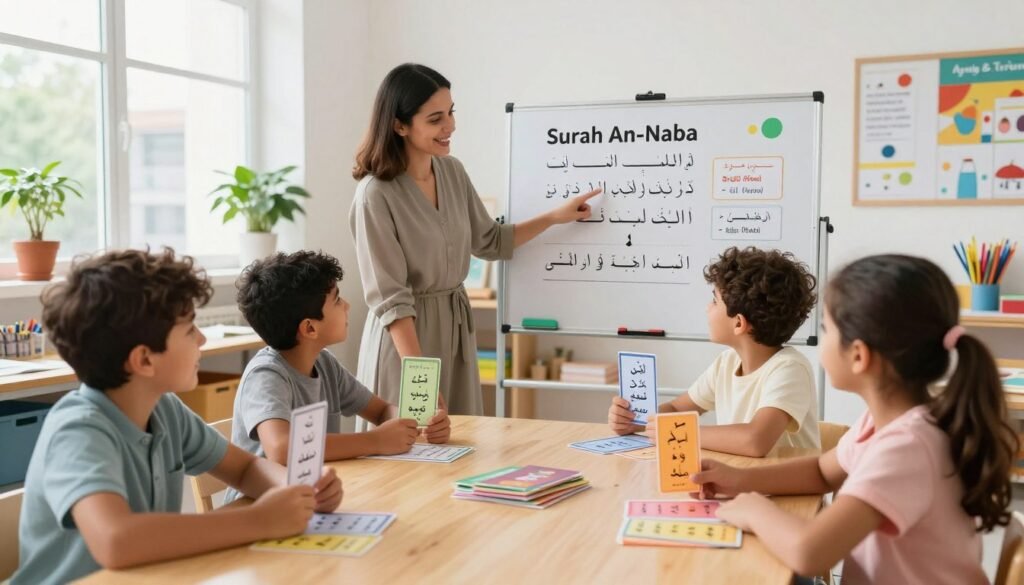
Let’s proactively identify the typical challenges families face so your child’s practice remains joyful and effective. Knowing these hurdles in advance allows us to transform them from sources of frustration into opportunities for growth. We combine practical memorization techniques with empathetic support to keep your journey on track.
In our work with families, we see patterns. A successful approach to surah an-naba lessons isn’t just about the method; it’s about navigating the human elements of learning. Below, we detail five common pitfalls and provide clear, actionable strategies to sidestep each one.
Pitfall 1: Inconsistent Timing
A sporadic schedule is the most common disruptor. When practice happens “whenever there’s time,” it never feels like a priority. The solution is to anchor it to a non-negotiable part of your daily routine.
Link five minutes of tardeed (listen-and-repeat) to an existing habit, like right after breakfast or before bedtime stories. This consistency builds neural pathways far more effectively than longer, irregular sessions.
Pitfall 2: Frustration with Mistakes
Children can become disheartened when they stumble over a word or forget a line. If the focus shifts to perfect recitation, the joy of connection is lost.
Celebrate the effort, not just the outcome. Praise their focus and perseverance. Say, “I love how you kept trying on that tough verse!” This builds resilience and separates their worth from their performance.
Pitfall 3: Rushing Ahead Before Mastery
The desire to check off verses can lead to a shaky foundation. This is where core memorization techniques like “chunking” are vital. Moving to the next ayah before the current one is solid creates cumulative confusion.
Employ the “three-in-a-row” rule. Your child should correctly recite a small chunk three times in a row, without help, before adding the next piece. This ensures deep, automatic recall.
Pitfall 4: Lack of Review
Without review, even well-memorized verses fade. This leads to discouragement as children feel they are constantly losing ground.
Integrate quick, fun revisions. Start each new session by effortlessly reciting two previous verses. Turn it into a game—you say one word, they say the next. This spaced reinforcement makes memory permanent.
Pitfall 5: Parental Pressure
Unintentional pressure, often from our own hopes, can make the Quran feel like a chore. A child’s motivation should be love, not fear of disappointment.
Adopt a supportive partnership model. Your role is that of a encouraging guide, not a strict examiner. Ask, “Can you teach me this verse?” instead of “Let me hear you.” This flips the dynamic and empowers them.
| Common Pitfall | Typical Result | Our Recommended Strategy |
|---|---|---|
| Inconsistent Timing | Practice feels optional; progress stalls. | Anchor practice to a daily habit (e.g., after breakfast). |
| Frustration with Mistakes | Child loses confidence and avoids practice. | Celebrate effort and perseverance, not just perfect recitation. |
| Rushing Ahead | Shaky foundation causes future verses to collapse. | Use the “three-in-a-row” mastery rule before adding new content. |
| Lack of Review | Previously memorized verses are forgotten. | Begin each session with a quick, game-like review of past material. |
| Parental Pressure | Learning is driven by anxiety, not love. | Shift from examiner to learning partner; let the child “teach” you. |
By anticipating these challenges, you move from reacting to problems to guiding a smooth process. The right memorization techniques are about psychology as much as pedagogy. Your awareness and calm guidance are the keys to a sustainable and spiritually rewarding journey for your child.
Building a Home Environment that Nurtures Lifelong Quranic Connection
Our shared vision isn’t just about perfect recall; it’s about building an environment where the Quran becomes a cherished companion throughout your child’s life. Memorizing verses is a magnificent start—a foundation. The true masterpiece, however, is a heart that naturally turns to the Quran for comfort, guidance, and a strong sense of identity.
This lifelong bond is forged not in the classroom alone, but within the daily rhythm of your home. For Muslim families in the Canadian diaspora, the home becomes the primary sanctuary of faith. It’s where we can intentionally weave the Quran into our family’s cultural and spiritual fabric.
A powerful, yet simple, strategy is to introduce ambient Quranic sound. Play a recitation of Juz ‘Amma softly in the background during quiet times—while drawing, during meals, or before bed. This isn’t about active listening for memorization techniques for kids, but about creating a familiar, peaceful soundscape. The melodic verses become a subconscious part of your child’s world, building comfort and affinity.
Move beyond audio into meaningful interaction. Share short, simple reflections on an ayah during family time. Ask, “What does this beautiful verse about the sky make you think of?” Model your own learning by listening to a tafsir podcast or setting a personal hifz goal. Your genuine engagement shows the Quran is a living guide for all ages.
Celebrate milestones with more than treats. Offer meaningful acknowledgement. Frame their certificate, let them lead a family prayer with their new verses, or dedicate a “Quranic hero” moment during storytime. This shifts the focus from task completion to honouring a spiritual achievement.
Ultimately, these practices transform your home. The Quran transitions from a subject to be studied into a presence to be lived. It becomes a source of stability and identity for your child navigating a multicultural world. This is our goal: to nurture not just a student of the Quran, but a heart forever connected to its divine light.
From Four Verses to Fluency: The Path Forward in Your Child’s Journey
We celebrate this success with you—a tangible proof that your child can master the Quran, one verse at a time. This accomplishment with Surah An-Naba is far more than four lines memorized; it is a living proof of concept for your entire family. It demonstrates that the Sequential Visual Memorization framework works within the rhythm of your modern Canadian life.
Now, we gently turn our gaze to the horizon. The same cognitive principles—chunking, visualization, and structured repetition—that brought this victory are your reusable toolkit. The path forward from here is not a daunting reset but a natural progression. You have a validated method and a child growing in confidence.
Think of the Ayah & Tardeed Juz Amma package as your companion for this ongoing journey. The very resources that guided you through these verses are designed to scale. The listen-and-repeat (Tardeed) tracks for the next surah await. The visual storyboards for new meanings are ready to engage your child’s imagination.
This is how fluency is built: not in a single, overwhelming leap, but through a series of connected, successful steps. Mastering Surah An-Naba 12-15 becomes the firm foundation for the next set of verses, then the next entire surah, and onwards through the accessible chapters of Juz Amma. Each success compounds, transforming apprehension into anticipation.
We frame this not as an academic burden, but as an exciting, shared exploration. The skills your child is honing—focus, auditory processing, visual memory—are lifelong assets. The connection they are forging with the Quran’s rhythm and message is the ultimate goal. You are not just teaching memorization; you are nurturing a relationship.
Let this moment be the spark. The confidence gained here is the key that unlocks a future of independent Islamic learning. From these four verses to fluency, the journey is a beautiful, intentional climb, and you now have a trusted map and the tools for the road ahead.
Conclusion
Our shared journey began with a recognition of your hope and the unique challenges of Quran memorization for kids in a modern context. We have explored the cognitive science behind sequential visual learning and provided a clear, step-by-step framework to memorize Surah An-Naba verses 12-15.
The core of this method lies in pairing sound mastery with visual meaning. This approach moves beyond simple repetition to create lasting memory. It adapts to your child’s age, whether they are four or twelve, and thrives in a home environment built for nurturing a lifelong Quranic connection.
The Ayah & Tardeed Juz Amma package is designed as your trusted companion on this path. It integrates seamlessly with the framework, offering the structured audio and visual tools to make each lesson engaging and effective.
The next step in this transformative journey is yours. We invite you to start your child’s Quranic journey today. Use the step-by-step guide outlined here and let the Ayah & Tardeed package support you as you build a beautiful, enduring bond between your child’s heart and the Quran.
What Is the Best Age for Kids to Start Memorizing the Quran?
Continue Memorizing Surah An-Naba
Do you prefer reading in Arabic? Check out our article on visual learning here.