
What if you could give your child a lasting connection to the Quran, even with your family’s packed schedule?
We understand that heartfelt desire. Many parents in our communities share the same reality. They want to root their children in Islamic teachings but face busy lives.
Time is scarce, and old ways of learning sometimes don’t stick. This article is our partnership to change that. We offer a proven, step-by-step pathway for your child to learn and connect with this Quranic passage.
Our approach respects your busy schedule and uses science-backed techniques. By the end, you’ll have a clear plan to make this journey effective, enjoyable, and lasting for your young one.
Key Takeaways
- Acknowledge the common challenge of time and retention faced by busy families.
- Discover a structured, empathetic approach designed for modern life.
- Learn science-backed methods that move beyond simple repetition.
- Gain a clear, step-by-step plan tailored for children’s learning.
- Foster a deep and lasting connection between your child and the Quran.
- Transform memorization from a chore into an engaging and meaningful activity.
- Equip yourself with practical strategies that respect your family’s schedule.
When Time is Short and Traditions Don’t Stick: A Parent’s Guide to Change
The gap between our Islamic traditions and our children’s learning today is a challenge. We want to connect them to the Quran. But, our weekly efforts often fall short.
You spend those precious minutes before bed with your child. They recite the Quran, and you listen. But soon, new songs or school projects take over. This cycle can be frustrating.
This isn’t a failure of intention. It’s often a mismatch of methods. The traditional way of reciting is beautiful but doesn’t match today’s learning.
Our children’s world is interactive and fast. Schools use games and stories to teach. Asking for quiet repetition can feel out of place.
To understand this better, let’s look at why some methods don’t work. The table below shows why and what children really need to learn.
| Learning Aspect | Traditional Repetition | The Modern Child’s Brain | Typical Result |
|---|---|---|---|
| Engagement Style | Auditory & Passive | Visual, Kinesthetic & Interactive | Mental drift, loss of focus |
| Information Processing | Linear, abstract words | Pattern-based, story-driven | Difficulty creating meaning from sounds |
| Memory Anchor | Sound pattern alone | Requires a visual or emotional hook | Short-term recall, quick forgetting |
| Feedback & Reward | Delayed (perfection goal) | Immediate, incremental progress | Lack of motivation, sees task as a chore |
We see you juggling work, school, and wanting to teach Islamic traditions. The guilt after a tough session is hard. But, it’s not helpful for change.
Understanding how your child learns is the first step. By matching our methods to their natural learning, we can make memorizing the Quran rewarding. The next sections will guide you on this journey.
The Brain Science Behind “Sequential Visual Memorization” for Kids
Ever wondered why kids remember movie details but not Quran verses? Neuroscience has the answer. Our brains, especially young ones, are not just recording devices. They are complex pattern-makers that love visual and story-based information. This is a key feature we can use for surah an-naba memorization techniques.
Cognitive science shows that our brains remember images better than text or sound. The visual cortex is a strong memory tool. When we link new information, like an Arabic ayah, with a vivid picture, it’s easier to remember. This is the heart of modern children’s quran memorization methods that work with young minds.
The “Sequential Visual Memorization” method uses this science. It has two main steps. First, we turn abstract Arabic words into clear, memorable pictures called “Visual Anchors.” For kids, a word becomes a vivid image they can easily remember.
Then, we connect these anchors in a story order. This uses the brain’s natural ability to remember events in order. It makes remembering verses a journey, not just a list.
The magic happens through dual-coding. When kids learn a verse by sound and link it with a unique image, it’s stored in two brain areas. This creates strong recall pathways. If one path fades, the other can help remember, making retention stronger.
Some might think this method is too new. But we see it as a way to enhance tradition. We’re not replacing the sacred oral tradition; we’re making it more engaging. The Quran is full of imagery and stories. This method uses that style in a way kids can easily grasp.
This scientific view empowers us as parents. It turns surah an-naba memorization techniques into a fun, cognitive exercise. We have a proven method that works with our child’s nature, not against it. Knowing the science behind it boosts our confidence and makes our efforts successful.
Your New Roadmap: The “Visual Anchor” Method for Lasting Recall
The Visual Anchor Method makes memorizing the Quran fun and creative. It helps your child create a personal map to remember verses. This method is a top choice for memorization techniques for kids, mixing science with Islamic values.
We offer a practical, three-step plan. It tackles common challenges parents face. It gives easy memorization tips that boost confidence and accuracy.
Our brains, especially young ones, love stories and pictures. The Visual Anchor Method uses this to your child’s advantage. It turns abstract Arabic text into mental images your child can relate to.
The method is simple yet effective. It has three stages that build on each other. Each stage lays a solid foundation for remembering verses.
| Phase | Core Action | Key Outcome for Your Child |
|---|---|---|
| 1. Masterful Listening | Focused, repeated listening to a perfect recitation. | Accurate auditory imprinting; the correct “sound pattern” is locked in. |
| 2. Creative Visualization | Co-creating a simple, strong mental image for a key phrase in each verse. | Each verse gains a personal “Visual Anchor” for easy retrieval. |
| 3. Story Sequencing | Linking the four visual anchors into a mini-narrative journey. | Verse order is memorized naturally through a logical story flow. |
Let’s look at why this sequence works. First, we make sure the ear learns correctly. This avoids pronunciation mistakes from the start. Then, we give the mind a visual anchor for each concept.
Finally, we connect those anchors in a sequence. This is like how kids remember stories. The result is a strong mental map of the passage.
This method helps overcome memorization anxiety. It offers a clear, step-by-step path. Your child gets a personal toolkit, moving from “I have to remember this” to “I know how to remember this.”
In the next sections, we’ll explore each phase together. We’ll apply this method to Surah An-Naba, verses 21 through 24. You’ll see how to turn Arabic words into vivid, memorable anchors.
This roadmap is more than easy memorization tips. It’s a new approach. We move from passive repetition to active, engaged creation. This builds lasting connection and recall, one visual anchor at a time.
Building Meaning First: Understanding Surah An-Naba (Verses 21-24) with Your Child

Before asking a child to recite, we must help them understand. This is the key to connecting with the Quran. Memorizing sounds is one thing. But understanding the message is what builds a lifelong bond with the Quran.
For verses 21 to 24 of Surah An-Naba, just memorizing can confuse kids. We need to build a strong foundation of meaning. This meaning should be clear, easy for kids to understand, and full of hope.
When we teach Surah An-Naba for children with understanding, it becomes more than just words. It becomes a lesson in faith and character. This understanding makes memorization meaningful and fun for young minds.
Verse by Verse: A Child-Friendly Translation and Theme
Let’s explore these four verses together. We’ll use simple translations and themes that kids can understand. This table helps you see the scene described in each verse:
| Verse (Ayah) | Child-Friendly Translation | Core Theme for Kids |
|---|---|---|
| 21 | Indeed, for those who denied the truth, there is a place of waiting. | Consequences have a place. Our choices matter. |
| 22 | They will be in a thick, dark smoke. | Feeling lost, confused, and separated from what’s good. |
| 23 | Which neither cools nor offers any refreshment. | Regret that doesn’t go away. A problem with no easy fix. |
| 24 | And before that, they lived in luxury and were steeped in sin. | Being distracted by fun and forgetting what’s truly important. |
Talk to your child about this scene. Ask them how they think someone feels waiting for a consequence. Or what it means to be “steeped in” something. Connect it to their life. The “dark smoke” is feeling far from Allah’s light and mercy because of our choices.
From Abstract to Concrete: Discussing the Day of Judgment with Kids
The concept of the Hereafter can seem hard to grasp. Our job is to make it real and relevant, not scary. We talk about the Day of Judgment in terms of ultimate justice and boundless mercy.
Start with what they already know. Explain that just like there are rules at home and school, the universe has a Creator who ensures justice. Every good deed is noticed, and every wrong will be accounted for. This is a comfort, not a threat.
Then, talk about hope. The Quran warns us out of mercy. It’s like a loving parent warning us about the stove to protect us. Allah tells us about this day to help us choose a better path now. Our good actions are because we believe in a loving God and a fair final destination.
When you learn Surah An-Naba for young ones with this view, the verses motivate us. They’re not about fear of punishment but about choosing light over darkness. This foundation makes memorization meaningful and personal for your child.
Setting the Stage: How to Create a Focused and Positive Memorization Environment
Creating the right atmosphere makes memorization a cherished ritual. Success comes from where and when we teach. A dedicated environment and a smart schedule help your child focus.
These steps are key tips for teaching Surah An-Naba to kids. They prepare the mind to learn and remember the divine words.
The Ideal “Quranic Learning Corner” in Your Home
Your child’s brain responds to cues. A special space signals it’s time for sacred learning. You don’t need a separate room. A consistent corner with a few elements can make a big difference.
Start with a clean prayer mat or rug to define the area. Place your child’s mus’haf and visual aids there. For Surah An-Naba, include a sun or river drawing.
This corner becomes a visual anchor. It tells your child, “Here, we connect with the Quran.” Keep it free from distractions. Consistency strengthens memory.
Think of this space as your main tool. Effective Surah An-Naba memorization tools are simple and personal. A basket for Quran materials, a mus’haf stand, and good lighting are all you need.
Scheduling Smart: Short, Daily Sessions vs. Weekly Marathons
Timing is as important as space. Neuroscience favors short, daily practice over long, sporadic cramming. This method, called spaced repetition, helps move information from short-term to long-term memory.
We recommend sessions of seven to ten minutes daily. This might seem short, but it’s very effective. A child’s attention span is limited; these short sessions maximize focus and minimize fatigue.
Weekly marathons of 45 minutes can be frustrating and lead to forgetting. The brain needs sleep and time to solidify connections.
To implement this, find realistic slots in your family’s routine. Consider these moments:
- Right after Fajr or before Maghrib prayers, when the home is calm.
- As a pre-bedtime wind-down activity, replacing a story.
- Immediately after returning from school, as a transitional ritual.
The goal is consistency, not duration. A daily ten-minute commitment is more powerful than a weekly hour-long plan. This approach makes memorization a manageable part of daily life.
How to Memorize Surah An-Naba for Kids Step by Step: The Visual Anchor Walkthrough
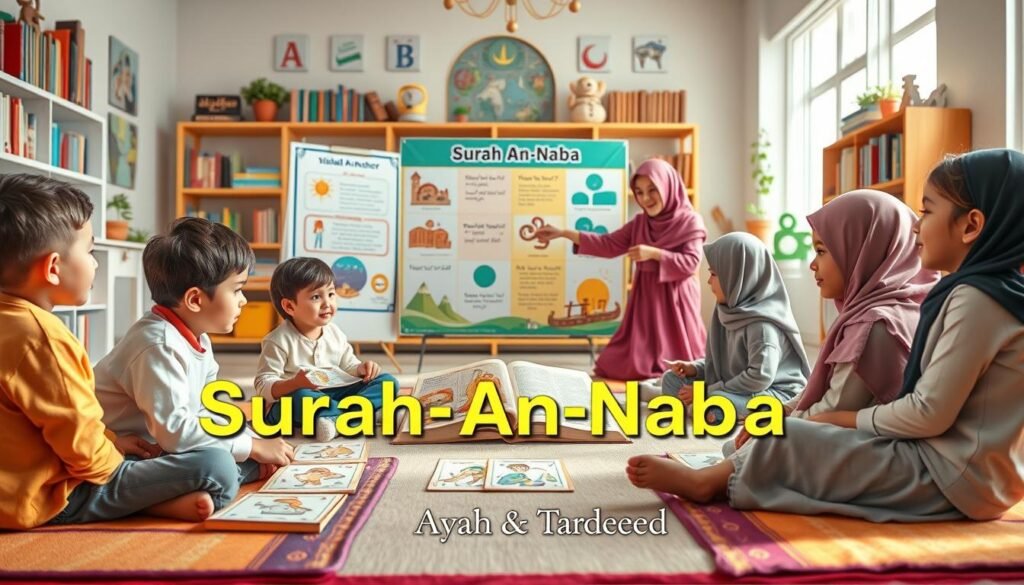
This section is your practical workshop. We’ll build your child’s memory of these four verses using vivid mental pictures. We move from understanding to action. Here, we apply the Visual Anchor Method directly to Surah An-Naba (21-24). You will get a clear, three-step blueprint.
Our goal is to create a strong, recall-ready mental model. This process turns abstract Arabic words into a concrete, unforgettable experience. Let’s begin this hands-on journey together.
Step 1: Masterful Listening – Imprinting the Correct Sound Pattern
All strong memorization starts with accurate input. Before your child attempts to recite, their ears must learn the melody. We use a perfect recitation as our master template.
Find a clear, slow (tarteel) audio of Surah An-Naba from a trusted Qari. Play verses 21-24 on repeat during calm moments. This passive listening builds familiarity with the rhythm, pronunciation, and flow.
The sound must be internalized first. This step lays the neural foundation for everything that follows.
Practice Drill: The “Pause and Repeat” Technique
Now, we move from passive to active listening. This drill builds accuracy and confidence.
- Play a Short Segment: Using your audio, play just the first phrase of verse 21 (e.g., “Inna jahannama kanat mirsada”).
- Pause the Audio: Hit pause immediately after the segment.
- Have Your Child Repeat: Ask your child to repeat the phrase exactly as they heard it, mimicking the tone and elongation.
- Assess and Correct Gently: If the pronunciation wavers, replay the segment. Model it yourself, then have them try again. Celebrate close attempts!
- Progress Gradually: Once mastered, move to the next phrase. Slowly chain phrases together until the entire verse is fluid.
This micro-learning approach prevents overwhelm. It makes mastery of each sound achievable.
Step 2: Creative Visualization – Turning Arabic Words into Mental Pictures
This is the heart of our method. We translate key Arabic phrases into simple, silly, or striking mental images called “Visual Anchors.” The brain recalls pictures far easier than raw text.
Work with your child to brainstorm images. There are no wrong answers if the image helps them remember. The anchor should be a single, snapshot image for the core idea of each verse.
Visual Anchor Examples for Verses 21, 22, 23, and 24
To spark your imagination, here are concrete examples. Use these as a starting point and customize them with your child.
| Verse | Key Arabic Phrase (Focus) | Child-Friendly Theme | Suggested Visual Anchor | |
|---|---|---|---|---|
| 21 | إِنَّ جَهَنَّمَ كَانَتْ مِرْصَادًا | (Inna jahannama kanat mirsada) | Hellfire is a waiting place, lying in ambush. | A giant, sleeping monster (named “Jahannam”) hiding behind a huge “WELCOME” sign, waiting to jump out. |
| 22 | لِّلطَّاغِينَ مَـَٔابًا | (Littagheena maaban) | A final return place for the defiant. | A boomerang with a grumpy face (“the defiant one”) flying back to a dark cave (the “return place”). |
| 23 | لَّابِثِينَ فِيهَآ أَحْقَابًا | (Labitheena feeha ahqaban) | Dwelling therein for long, long ages. | A person sitting in a giant, uncomfortable armchair labeled “Ages,” looking at a clock where the hands are stuck. |
| 24 | لَّا يَذُوقُونَ فِيهَا بَرْدًۭا وَلَا شَرَابًا | (La yathooqoona feeha bardan wala sharaban) | They taste no coolness and no drink there. | A person with a parched throat reaching for a glass of melting ice, but a big “X” blocks it. The ice is steaming hot. |
Draw these anchors, act them out, or describe them in detail. The more senses involved, the stronger the memory.
Step 3: Story Sequencing – Linking Your Four Anchors into One Journey
Separate images can get jumbled. The secret to flawless verse order is to weave your four anchors into a single, sequential story. This creates a “memory path” your child can walk through.
Guide your child to connect the images in the verse order. The story can be absurd—that makes it more memorable. The sequence itself reinforces the correct flow of the surah.
Example Storyline: “The Journey to the Waiting Place”
Let’s connect our four example anchors into a narrative. Narrate this to your child:
“First, we see the giant sleeping monster, Jahannam, hiding behind the WELCOME sign, waiting (Verse 21). Suddenly, a grumpy-faced boomerang flies through the air and gets caught by the monster—it has returned to him (Verse 22). The monster forces the boomerang to sit in a giant, uncomfortable ‘Ages’ armchair, where the clock is stuck (Verse 23). The boomerang gets so hot and thirsty in that chair. It sees a glass of ice, but a huge ‘X’ appears, and the ice starts steaming! It gets no coolness and no drink (Verse 24).”
Practice retelling this simple story together. Then, connect each part of the story back to its corresponding Arabic verse. This interactive surah an-naba memorization technique leverages the brain’s natural love for narrative.
With these three steps—listening, visualizing, and storytelling—you equip your child with a powerful cognitive toolkit. This approach transforms duty into discovery, making the words of the Quran stick for a lifetime.
Your Comprehensive Support System: The Ayah & Tardeed Juz Amma Mastery Package
While the step-by-step guide is a good start, true Quranic fluency needs a complete system. We created the Ayah & Tardeed Juz Amma Mastery Package for that. It’s a dedicated partner for your family’s Quran journey.
This package turns solo efforts into a fun, unified learning path. It gives busy parents the tools to guide their kids with ease.
What’s Inside: A Look at the Surah An-Naba Visual Memorization Module
Every surah, like An-Naba, has its own special module. It makes quran memorization for children an exciting journey. The module uses the Visual Anchor Method you’ve learned.
Here’s what you and your child will get:
- Professional Audio Recitations: Various styles to help your child learn the right sounds.
- Animated Visual Anchor Guides: Fun animations that make Arabic words easy to remember.
- Interactive Review Quizzes: Games that test your child’s memory and sequence skills.
- Printable Progress Trackers: Charts to track progress and celebrate achievements.
These tools are designed to keep your child engaged and save you time. You can focus on sharing learning moments instead of planning activities.
Breakdown of the Surah An-Naba Module Components
| Component | Primary Benefit | Engagement Style |
|---|---|---|
| Animated Anchor Guides | Turns abstract text into memorable pictures | Visual & Narrative |
| Interactive Quizzes | Reinforces sequence and pronunciation | Gamified & Auditory |
| Progress Trackers | Provides visual motivation and clarity | Kinesthetic & Rewarding |
| Professional Audio | Ensures correct Tajweed from the start | Auditory & Repetitive |
From One Surah to Mastery: How the Package Builds Long-Term Success
The Ayah & Tardeed package is truly powerful. Mastering Surah An-Naba sets the stage for the whole Juz Amma. The same visual system works for every surah.
This approach avoids feeling overwhelmed. It builds confidence step-by-step. It turns one achievement into a lifelong habit of learning.
With lifetime access, the package grows with your child. It helps a 7-year-old start and a 12-year-old deepen their understanding. It’s a lasting investment in their Islamic identity.
We see this as a partnership, not just a course. We offer the roadmap, tools, and method; you provide the love and guidance. Together, we create a lasting, heartfelt connection to the Quran.
5 Essential Habits for Parents to Foster Consistent Quranic Practice
The Visual Anchor method shows us how to start. But it’s the parents’ habits that make it a lasting part of life. Memorization grows in a daily routine, not just in sessions. We’re not just teachers; we’re guides who help our children enjoy learning.
Let’s look at five habits that make learning the Quran easy and meaningful.
Habit 1: Model the Joy of Learning Alongside Your Child
Children learn by watching us. They see what we value. Showing them you love learning is more powerful than any reward.
Let them see you listening to Quran or trying to understand a verse. This shows them learning is a lifelong journey. It turns memorizing into a fun family activity.
Practical tips for modeling:
- Set aside five minutes of your own “Quran time” visible to your child.
- Voice your process: “This ‘Ra’ sound is tricky for me too; let’s listen to it again together.”
- Share a simple reflection on a verse’s meaning after you both recite.
Habit 2: Implement the “Three-Time Perfect” Rule for Each Verse
Uncertainty can stop progress. The “Three-Time Perfect” rule sets clear goals. It helps your child feel confident by achieving small goals.
How to apply it effectively:
- After using the Visual Anchor steps, declare: “Now, let’s get your three perfect recitals!”
- Celebrate the third success with a high-five or sincere acknowledgment.
- If a mistake happens on the second try, gently reset the count to zero without criticism. This teaches resilience and precision.
Habit 3: Weave Review into Car Rides and Bedtime Routines
Reviewing in formal sessions can feel like a test. But stealth review in daily routines makes learning easy. Car rides and bedtime are perfect times to practice.
Examples of seamless integration:
- Car Ride Quiz: “Let’s recall our four pictures for Surah An-Naba before we get to the park.”
- Bedtime Whisper: Take turns whispering the verses in the dark. The change in environment boosts recall.
- Placemat Prompt: Write one verse on a whiteboard placemat for casual review during meals.
Use Specific, Sincere Praise for Effort, Not Just Outcome
Specific praise is a powerful habit. Instead of just saying “Good job!”, focus on the effort. Say “I saw how carefully you listened to that verse,” or “I admire your focus when you repeated it until you got it right.”
This kind of praise boosts their sincerity and effort. It shows them the value is in trying, not just succeeding.
By consistently practicing these habits, you’ll create a home where Quranic connection is valued and joyful.
Troubleshooting Guide: Solving Common Memorization Challenges
If your child is struggling with verse order or Arabic sounds, you’re not alone. We have solutions. These challenges are just signs to help us find better ways to learn. We’ll face them together, using surah an-naba memorization tips for kids and patience.
Challenge: My Child Keeps Mixing Up the Verse Order
When verses get mixed up, it’s because the story in their mind needs work. We need to make the story stronger. Start by going back to the Visual Anchor story you created together. Act it out together.
Try the “Anchor Chain” game:
- Write each verse’s key visual (e.g., “Mountain,” “Record Book”) on a separate card or sticky note.
- Lay them in order on the floor, creating a path.
- Have your child walk the path, saying the corresponding verse aloud at each stop.
- Scramble the cards and challenge them to rebuild the sequence from memory.
This activity makes the sequence real and memorable. Doing it for just five minutes can help more than just repeating verses.
Challenge: Pronunciation Hiccups with Specific Arabic Letters
Letters like Ḥā’ (ح) or Ṣād (ص) can be hard for beginners. We aim for small steps, not perfection right away. Focus on the sound alone.
Make correcting a game:
- Mouth Position Mirror Drill: Practice the letter in front of a mirror. For Ḥā’, show how it comes from the middle of the throat. Start by exaggerating the sound and shape.
- Single-Word Repetition: Find a simple word with the target letter (e.g., “ḥasan” for Ḥā’). Repeat it five times clearly before moving to the full verse.
- Slow-Motion Recitation: Recite the verse slowly, focusing on the tricky letter. Speed will come once you get the hang of it.
Patience and consistent practice are the keys to unlocking understanding.
This focused method will make your child’s surah an-naba recitation for children clearer and more confident. Every challenge they overcome is a victory in their Quranic journey.
Conclusion
We all face the same challenge: not enough time and wanting Islamic traditions to stick. We’ve discovered a new way, based on brain science, to make memorizing easier. Now, you have a simple, step-by-step plan: the Visual Anchor Method.
This method makes memorizing Surah An-Naba easy for kids. It turns a hard task into a fun one.
Memorizing verses 21 through 24 is now a clear goal for you and your child. It’s not just about four Ayahs. It’s about creating a strong, joyful bond with the Quran.
This bond will last a lifetime. The habits and techniques you start today will help your child connect deeply with the Quran.
Let’s take the first step together. Pick a technique from this children’s guide to Surah An-Naba memorization for your next Quran session. Start with creative visualization for one verse. See how your child enjoys turning Arabic words into pictures.
Your family’s Quranic journey begins with this step. We’re honored to be on this journey with you. Start using these easy ways to memorize Surah An-Naba and begin your child’s Quranic journey today.
Many parents use the Ayah Tardeed method to help their kids memorize faster.
Do you prefer reading in Arabic? Check out our article on visual learning here.
Memorize Surah An-Naba for Kids (Complete Guide)
Continue Memorizing Surah An-Naba
Help Your Child Memorize Quran Easily – Start Today