
What if nurturing your child’s connection to the Quran didn’t feel like another item on the endless to-do list?
We know that reality. As Muslim parents in the West, we carry a deep desire to root our children in faith. We want those bonds with the sacred text to be loving and lasting. Yet, this mission often collides with the daily whirlwind of school, activities, and screens. Time feels scarce, and worries about retention loom large.
This shared struggle is why we’re here. There is hope, and it’s more practical than you might think. This guide introduces a structured, science-backed approach to Quran memorization for kids. It’s designed to fit within the rhythm of modern life, turning brief, consistent moments into powerful learning.
We’ll focus specifically on the profound verses of Surah An-Naba (24-27), using a method that respects both your child’s development and your busy schedule. Let’s build that connection—together.
Key Takeaways
- Acknowledge the common challenge of balancing Islamic education with a busy Western lifestyle.
- Discover a memorization technique grounded in cognitive science, not just tradition.
- Learn how short, daily repetition sessions can be more effective than long, infrequent ones.
- Gain a practical framework specifically for teaching Surah An-Naba verses 24-27.
- Transform the learning process from a chore into a meaningful, shared journey.
- Equip yourself with a method that builds lasting memory, not just short-term recall.
The Modern Parent’s Dilemma: Nurturing Quran Love Amidst Chaos
Teaching our kids the Quran is a key part of Muslim parenting. But, the busy lives of Western families often make it hard. We have to balance work, school, and the digital world.
It’s tough to find time for meaningful Quran lessons. This goal can seem impossible in our chaotic lives.
Between School and Screens: Finding Time for Tajweed
Our kids’ days are packed with school, homework, and activities. They also spend a lot of time in front of screens. This makes finding time for Quran lessons a challenge.
We often try to fit in Quran lessons in short moments. This can be before bed or on weekends. It’s not because we don’t want to, but because our lives are so busy.
“They Just Keep Forgetting”: The Retention Struggle is Real
One of the toughest moments is when our kids forget what they learned. It feels like we’re starting over all the time. This can make both parents and kids feel frustrated.
Helping kids remember the Quran is a big challenge. Without a good system, they forget quickly. This makes learning the Quran feel like a never-ending battle.
We Need a Method That Works With Our Lives, Not Against It
The old way of learning the Quran doesn’t fit our busy lives. We don’t need more stress or things to do. We need a smarter way.
We need a method that fits into our lives. It should be easy, based on Islamic values, and backed by science. It should make learning the Quran fun and build our kids’ confidence.
The Brain Science Behind Effective Quran Memorization for Kids
Effective Quran memorization isn’t just about repeating words. It’s about doing it smartly, based on how our brains work. When we understand the science of memorization, we can help our kids learn better. This makes learning the Quran a fun and meaningful experience.
Memory is more than just storing information. It’s about creating strong connections in our brains. For kids, memorizing the Quran is a special way to keep Allah’s words alive. By using methods that match how our brains learn, we show respect for both the Quran and our children.
How Young Minds Cement Information: Spaced Repetition and Recall
Two key ideas help us remember things for a long time: spacing and recalling. Trying to learn too much at once can make us forget quickly. Instead, spaced repetition Quran techniques spread out learning over time.
Think of it like building muscle. Short, regular practice sessions work better than one long session. When a child reviews a verse after a short break, their brain has to work harder. This makes the memory stronger.
This approach helps with effective Quran memorization. It turns reviewing into a series of small wins. The table below shows how to avoid common mistakes and use brain-friendly strategies.
| Common Memorization Pitfall | Brain-Friendly Alternative | How It Supports Memory |
|---|---|---|
| Marathon sessions on weekends | Short, daily 10-minute reviews | Leverages the spacing effect to combat forgetting |
| Passively re-reading the same page | Closing the Mus’haf and reciting from memory | Forces active recall, creating stronger neural pathways |
| Moving on after one perfect recitation | Scheduled reviews at increasing intervals (1 day, 3 days, 1 week) | Transfers verses from short-term to long-term memory banks |
| Focusing on quantity over quality | Mastering a small “chunk” before adding more | Reduces cognitive load and builds a solid foundation |
Why Visual Sequencing Beats Rote Repetition
Rote repetition is boring and not very effective. Our brains love stories and patterns. They remember images and sequences better.
When a child learns a verse by linking it to a picture or story, they use more brain areas. This makes the memory stronger. The verse becomes a journey in their mind, not just words to repeat.
For example, learning Surah An-Naba’s description of Judgment Day becomes vivid. A child might imagine mountains moving and skies splitting. This method uses the brain’s love for stories to create lasting memories.
This approach respects how children’s minds work. It’s a natural, engaging way to learn. We’re not fighting their brains; we’re working with them. This is the heart of our Sequential Visual Memorization method, using Allah’s wisdom to preserve His words.
Surah An-Naba Verses 24-27: Understanding Before Memorizing
Memorizing without understanding is like building a house on sand. For Surah An-Naba verses 24-27, we start with understanding. We believe true connection to the Quran comes when a child understands the why behind the words. This step turns recitation into a meaningful dialogue with Allah’s message.
Our approach to Quranic studies for children always starts here. We make the profound accessible and relevant to young hearts and minds.
Thematic Overview: A Sobering Reminder with a Purpose
Surah An-Naba, “The Tidings,” talks about the Day of Judgment. Its themes are heavy—accountability, consequence, and ultimate truth. For a child, this might seem scary. Our role is to show it as a reminder of Allah’s perfect justice and mercy.
The purpose is guidance. These verses describe the reality for those who denied the truth. They serve as a clear signpost, helping us navigate our choices. When we introduce Surah An-Naba for kids, we focus on this purpose: to understand the consequences of our actions and to appreciate the clarity of Allah’s path.
Breaking Down the Four Verses for Child-Friendly Explanation
Let’s demystify these four verses together. We break down the complex Arabic into key concepts a child can grasp. This table provides a clear, visual roadmap for your explanation, turning each verse into a digestible lesson.
| Verse (Transliteration) | Key Arabic Word | Simple Meaning for Kids |
|---|---|---|
| 24. “Yawma yabluṣu l-kābirūna” | Yabluṣu | The day when the “big” or arrogant ones will be stunned and speechless. |
| 25. “Wa yugḍā ilayhim bi-ṣawābin” | Yuqḍā | A final decision is made about them, based on what they truly deserved. |
| 26. “ʿAlā ghulūbin shahīqatin” | Ghulūbin | Their arrogant and stubborn hearts will be in a state of painful regret. |
| 27. “Wa yud’khalu jahannama” | Yud’khalu | They will be entered into Hell, a place for those who knowingly chose wrong. |
Using this breakdown, you can move from unfamiliar words to clear ideas. This method is the bedrock of effective child-friendly Quran lessons. It replaces confusion with clarity.
Translating Profound Meanings into Simple, Relatable Lessons
The real magic happens when we translate these ideas into lessons that stick. Here’s how we can frame the core message of each verse for a young learner.
Verse 24 (The Stunning Reality): Talk about consequences. Just like there are rules in a game, life has rules from Allah. If we ignore them and act like we’re “too big” to listen, we’ll be surprised and lost when the game ends. This verse teaches humility.
Verse 25 (The Fair Decision): Emphasize Allah’s perfect justice. Explain that Allah is the fairest judge. He knows every good and bad deed, even the ones we hide. The “decision” isn’t random; it’s based on our own choices. This builds a sense of personal responsibility.
Verse 26 (The Regretful Heart): Discuss the feeling of regret. Ask your child if they’ve ever felt bad after doing something they knew was wrong. This verse describes that feeling as a deep, painful ache for those who stubbornly denied the truth. It teaches us to listen to our conscience.
Verse 27 (The Final Destination): Address the concept of Hell with wisdom. For children, frame it as a place for those who knew the truth but still chose to turn away. Contrast it with Jannah (Paradise) as the place for those who tried their best to follow Allah’s path. This reinforces the importance of making good choices.
By weaving these Quranic studies for children into relatable conversations, we do more than explain words. We build moral compasses. This foundational understanding is what makes memorization of Surah An-Naba for kids meaningful, durable, and spiritually enriching. The verses become signposts of wisdom, not just sounds to repeat.
The Sequential Visual Memorization Method: A Step-by-Step Guide
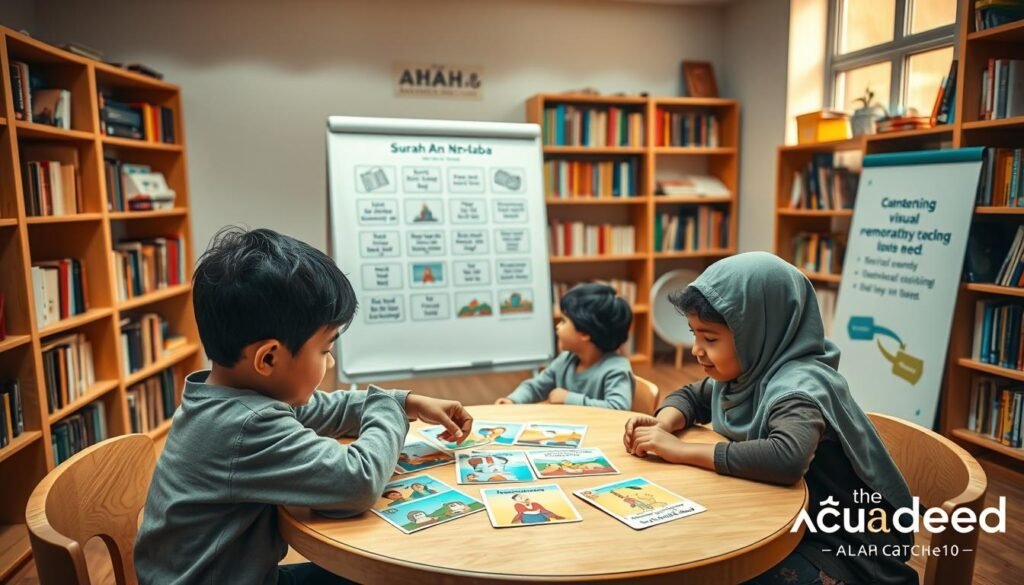
Forget endless drilling; a strategic, visual approach can make memorizing Surah An-Naba verses 24-27 an engaging and successful experience for your child. We’ve distilled modern cognitive science and traditional Islamic learning into a clear, four-step process. This method turns memorization from a daunting task into a manageable journey. It builds confidence and creates positive associations with the Quran.
Our guide provides a practical roadmap. You’ll move from setting the right environment to your child’s first confident, connected recitation. Each step is designed to work with your family’s rhythm, not against it.
Step 1: Preparation – Setting Up for Success
Success begins before the first verse is recited. Preparation is about creating a physical and mental space conducive to focus and reverence.
First, designate a consistent, quiet learning spot. This signals to your child’s brain that it’s time for Quran. It doesn’t need to be a whole room—a special corner with a prayer mat will do.
Second, set a clear, positive intention (niyyah) together. Briefly explain that you are learning Allah’s words to become closer to Him. This transforms the activity from a academic exercise into an act of worship.
Third, gather your tools: a mus’haf (Quran) with clear script, the specific audio recording of Surah An-Naba (verses 24-27), and perhaps blank paper for drawing. Having everything ready minimizes distractions and keeps the session flowing.
Step 2: Deep Listening and Visualization
This step is the heart of the visual memorization technique. Instead of jumping straight to reading, we start by immersing the ear and the mind’s eye.
Play the selected verses 5-7 times. Encourage your child to close their eyes and just listen. Ask: “What pictures come to your mind?” The verses describe a profound reality—the disbeliever’s regret and the reality of Hellfire.
Help them build a mental sequence. For “They will say, ‘Oh, woe to us!'” imagine a person with a shocked, regretful face. For “This is the Day of Judgement,” visualize a grand, solemn scene. This creates a “movie” in their mind that the Arabic words are attached to.
This linking of sound to image leverages how young brains store narrative information. It makes the Arabic words meaningful and memorable, not just foreign sounds.
Step 3: Chunked, Guided Repetition
Now, we break the memorization into digestible pieces. Our brains learn best in small, focused chunks, not by swallowing whole paragraphs.
Take the first phrase (e.g., “قَالُوا يَا وَيْلَنَا”). Read it aloud clearly three times, then have your child repeat it after you. Master that single phrase before moving to the next. Use the “gradual recall” method: once they know phrase one, learn phrase two, then recite one and two together.
This chunked repetition prevents overwhelm. It provides quick wins that boost motivation. Keep sessions short—10 to 15 minutes of focused repetition is far more effective than a frustrated hour.
A practical tip: Use a finger or a pointer to follow the words in the mus’haf as you recite. This adds a kinesthetic (movement) element, reinforcing memory through multiple senses.
Step 4: Recitation, Feedback, and Connection
The final step is where recall becomes confident recitation and the meaning takes root. Have your child recite the verses they’ve learned from memory.
Your feedback here is crucial. Focus first on what they got right. “Masha’Allah, your pronunciation of that heavy letter was perfect!” Then, gently correct errors by modeling the correct sound, not just pointing out the mistake.
Most importantly, connect the verses back to their meaning. Ask simple questions: “How do you think the people in the verse are feeling? Why?” This reinforces why we are learning this—not just for recitation, but for reflection and guidance.
Celebrate this accomplishment. This positive end creates a memory of success, making your child eager for the next session. This completes a full cycle of our step-by-step Quran memorization framework.
By following these four steps, you move from setup to mastery. You replace anxiety with structure and forgetfulness with a durable, visually-anchored memory. This method empowers your child to learn with understanding and builds a foundation for a lifelong relationship with the Quran.
Beyond DIY: The Structured Support of the Ayah & Tardeed Package
Every parent faces a time when DIY methods don’t work, especially for mastering Juz ‘Amma. We start with a plan, gather resources, and begin with enthusiasm. But keeping up the pace is hard.
Switching to a structured support system changes everything.
What is the Ayah & Tardeed Juz ‘Amma Mastery Program?
The Ayah & Tardeed program is a detailed online path for kids to learn Juz ‘Amma. It’s more than just an app or videos. It’s a complete tool and guide, built on science and ready to use.
“Our mission is to lift the planning burden from parents and replace it with the joy of shared learning. We provide the map, so you can focus on the journey.”
This program makes memorization practical and daily. It tackles challenges diaspora families face: time, teaching materials, and engaging methods for kids.
Think about the difference between doing it all yourself and having a professional guide:
| Parent’s DIY Challenge | Ayah & Tardeed Structured Solution |
|---|---|
| Spending hours making visual aids for each verse. | Instant, lifetime access to a full library of professionally designed visual memory cards and storyboards. |
| Worrying about correct Tajweed and engaging audio models. | Guided audio repetitions from qualified instructors, paced for optimal learning. |
| The mental load of planning each session and tracking progress. | A clear, sequential lesson plan that removes all guesswork—you just open and go. |
| Inconsistency leading to child’s frustration and forgetting. | A consistent, familiar routine that builds confidence and reinforces long-term retention. |
How It Works: Lifetime Access to Professional Resources
The heart of the Ayah & Tardeed experience is lifetime access. It’s not a monthly subscription or a course that expires. It’s a permanent resource for your family.
Here’s what this lifetime access unlocks:
- Visual Sequencing Guides: Custom images and diagrams that make abstract meanings concrete, directly applying the visualization technique.
- Chunked Audio Repetitions: Expertly recorded audio that breaks down verses into manageable phrases, perfect for listening during car rides or quiet time.
- Step-by-Step Lesson Plans: Daily and weekly schedules that tell you exactly what to do, eliminating the “what should we do today?” dilemma.
- Progress Trackers & Motivational Tools: Simple systems for your child to see their own advancement, building a sense of pride and accomplishment.
This model is a game-changer for Quran learning for diaspora families. It gives the structure and consistency needed, ensuring your child’s Quran connection grows steadily. We see it as a partnership, not just selling a product. We handle the design, and you provide the love. Together, we create a lasting Quranic legacy for your family.
Why Ayah & Tardeed is a Game-Changer for Diaspora Families

The Ayah & Tardeed program was made to turn parenting frustrations into meaningful moments. It helps you balance loving the Quran with a busy Western life. It’s not just a tool; it’s a diaspora family solution that tackles time, retention, and cultural integration.
Let’s look at the four key benefits of this program for families like yours.
Benefit 1: Eliminates Guesswork with a Science-Backed Roadmap
Ever felt unsure if you’re teaching the Quran right? Our program removes that doubt. It offers a clear, step-by-step path based on learning science.
With spaced repetition and visual aids, you can guide your child confidently. Each step is designed to move information from short-term to long-term memory. Say goodbye to guessing and hello to a proven method.
Benefit 2: Saves Precious Time on Lesson Planning and Sourcing
How many hours have you spent looking for the perfect Quran lesson? Time is precious for diaspora parents. Ayah & Tardeed gives you everything you need in one place.
Get professional audio, engaging visuals, and activity guides. This saves you hours each week. Now, you can spend more time connecting with your child over the Quran.
| Common Diaspora Parent Struggle | The Emotional Cost | Ayah & Tardeed’s Solution |
|---|---|---|
| Uncertainty about effective teaching methods | Stress and self-doubt | A science-backed, step-by-step memorization roadmap |
| Endless searching for quality resources | Time poverty and frustration | All professional materials provided in one central hub |
| Child’s lack of engagement or quick forgetting | Discouragement for parent and child | Methodology that builds confidence through independent mastery |
| Fear of Quranic learning feeling isolated from daily life | A disconnect from Islamic identity | Frameworks that weave memorization into family legacy building |
Benefit 3: Fosters Independent Learning and Builds Child’s Confidence
True mastery comes from owning your learning. This program’s format empowers your child to take charge of their Quran journey. They’ll feel a sense of control and accomplishment.
Seeing themselves recall verses boosts their immense confidence. This natural motivation is more powerful than any external pressure. It turns Quran time into a personal victory for your child.
Benefit 4: Creates a Tangible Family Legacy of Quranic Connection
In the diaspora, we build our family’s culture. Ayah & Tardeed helps you integrate Quranic fluency into your family’s culture. Memorizing Surahs together creates lasting, positive memories.
This isn’t just about memorizing words. It’s about building a living legacy of Quranic connection in your home. It gives your children a strong Islamic identity, rooted in joy and family pride. This is the ultimate solution for diaspora families.
Taking the First Step on Your Child’s Quranic Journey
Your child’s connection with the Quran is within reach. We’ve discussed the science of memory and a step-by-step method. Now, it’s time to take action. You, as a parent, will guide them on this blessed path.
Starting can seem daunting. The Sequential Visual Method makes it easy. You don’t need a perfect schedule or hours of free time. Just the willingness to try, together.
Applying the Method to Surah An-Naba Starting Today
Let’s start now. Take the four verses of Surah An-Naba (78:24-27) and apply the four steps from our guide.
First, prepare a quiet space for 15 minutes. Have the translation ready. Second, play a beautiful recitation of these verses. Ask your child to close their eyes and imagine the scenes.
Third, work on one verse at a time. Repeat it together slowly, linking the Arabic sounds to the mental picture. Finally, have your child recite it to you. Offer specific, positive feedback: “I loved how you pronounced that word clearly!”
This isn’t about perfection today. It’s about the experience. That first successful recall builds a child’s confidence more than any lecture. This hands-on practical application proves the method works and makes the goal of memorization feel genuinely attainable. You’ve just started their Quranic journey.
Exploring the Ayah & Tardeed Package for Comprehensive Guidance
For many families, that first successful session sparks a desire for more—a structured, long-term path. If you find yourself wanting to eliminate the weekly planning, searching for materials, or wondering “what’s next?”, the Ayah & Tardeed Juz ‘Amma Mastery Program is your logical next step.
Think of it as your family’s dedicated Quran curriculum. It provides the complete framework so you can focus on connection, not curation. The package offers:
- Professional video lessons for every surah in Juz ‘Amma, breaking down each verse visually.
- Printable guided repetition trackers and visual aids that turn practice into a engaging activity.
- Lifetime access, allowing siblings to benefit and your child to revisit lessons as they grow.
Exploring this package is a commitment to removing guesswork. It transforms the beautiful, sporadic moments of learning into a consistent and cumulative journey. It’s the tool that ensures your early efforts with Surah An-Naba blossom into a lifelong, confident relationship with the Quran.
The journey of a thousand verses begins with a single step. You have the method. You have the support available. The only question that remains is: will you take that step today? We invite you to begin. Start their Quranic journey today, and witness the profound growth that unfolds when faith meets a proven, loving approach.
Conclusion
Our journey started with a shared truth. The challenge of memorizing the Quran for kids in our busy lives is real. School schedules and digital distractions make it hard to remember.
We looked into the science behind memorizing. This knowledge shows us a practical way. The sequential visual method is easy for kids to follow. For more structure, the Ayah & Tardeed program is a complete guide.
This isn’t just about remembering verses. We aim to make the Quran a real part of their lives. We want these words to shape their character and faith. This builds a lasting family legacy.
You now have a simple method to start today and a detailed support system. We’re ready to make this goal a reality. Our goal is to create a strong bond between our children and the Quran’s message.
- Memorize Surah An-Naba verses 6–10
- Memorize Surah An-Naba verses 11–15
- 9-12 Memorize Surah An-Naba verses
- 12-15 Memorize Surah An-Naba verses
- Memorize Surah An-Naba verses 15–18
- Memorize Surah An-Naba verses 19–21
- Memorize Surah An-Naba verses 21–24
Join the Visual Memorization Generation
FAQ
How can we find consistent time for Quran memorization with our kids amidst school, activities, and screen time?
Why do children forget Quran verses so quickly, and how does your approach solve the retention problem?
What is Sequential Visual Memorization, and is it aligned with Islamic teaching methods?
What exactly is the Ayah & Tardeed Juz ‘Amma Mastery Program?
My child is just starting; is the Ayah & Tardeed program suitable for beginners?
How do we explain the deeper meanings of verses, like those in Surah An-Naba, to a young child?
What age group benefits most from the Ayah & Tardeed method and program?
How does the Ayah & Tardeed program actually save time for busy diaspora parents?
Can this method help my child learn more independently, building their confidence?
How does focusing on Juz ‘Amma create a lasting family legacy in the West?
An article related to the topic.https://ayahtardeed.com/how-kids-can-memorize-surah-an-naba-verses-15-18-repeat-after-me-method/