
What if the best age to start memorizing quran for kids isn’t “as early as possible”—but the age when your child can stay calm, repeat well, and keep coming back with love?
In the United States, many of us are juggling school drop-offs, homework, sports, and long workdays. Yet we still want the same thing: for our children to love the Book of Allah and carry it for life. That’s why when to start quran memorization can feel personal, not just practical.
We also need to say this with honesty: the ideal age for quran memorization is not about raising a prodigy or keeping up with another family. Quran memorization for children is doable—when it’s built on consistency, mercy, and patient teaching, because every child’s pace is different.
Allah reassures us in the Qur’an, “Indeed, it is We who have sent down the Qur’an, and indeed, We will be its guardian” (15:9). That promise steadies our hearts. It reminds us that when should kids start memorizing quran is not a panic question; it’s a hopeful one.
In this guide, we’ll walk through clear quran memorization age guidelines, including ages 4–7, 8–12, 13–18, and even later starts. We’ll also cover readiness signs, and a science-backed method we use—Sequential Visual Memorization—that supports Tajweed and steady Muraja’ah in real diaspora routines. If you’ve been asking when to start quran memorization, we’ll help you choose a plan that fits your child, your home, and your schedule.
We’ll also show a practical path many families can sustain: an Ayah & Tardeed routine that begins with Juz ‘Amma, uses small daily portions, and leans on strong revision and stable visual cues. Over time, this approach can make the best time to start learning quran feel less like a guessing game—and more like a wise next step.
Key Takeaways
- The best age to start memorizing quran for kids is often tied to readiness, not the earliest birthday.
- When to start quran memorization becomes easier when we plan for consistency, not speed.
- The ideal age for quran memorization varies—what matters most is a supportive home and steady routine.
- Clear quran memorization age guidelines can reduce stress and help us set realistic expectations.
- Quran memorization for children works best when Tajweed and Muraja’ah are part of the plan from day one.
- When should kids start memorizing quran is a family decision—one that should protect love, confidence, and long-term retention.
Understanding What “Quran Memorization for Children” Really Involves
When we talk about quran memorization for children, we are not talking about quick wins or perfect report cards. We are building a home routine where recitation, meaning, and manners grow together—so the Qur’an stays close in daily life.
For many families in the United States, structure matters as much as motivation. Clear memorizing quran for kids guidelines help children feel safe, supported, and steady, even on busy school weeks.
Hifz as a lifelong journey, not a race
Hifz works best when we treat it as a long path, not a sprint. The importance of memorizing quran as a child is real, yet starting “later” is not failure; consistency and sincere intention can carry a child far, at any age.
We can keep goals small and clear: a few lines, repeated well, with calm encouragement. Many effective methods for kids to memorize quran begin with short surahs, frequent repetition, and listening daily to a trusted qari to lock in rhythm and pronunciation.
The role of Tajweed accuracy alongside memorization
Memorization without Tajweed can build weak habits. If letter sounds drift, meaning can change—so we aim for correct articulation from day one, even if progress feels slower at first.
When a child needs reading support, a Noorani Qaida-style pathway can run alongside Hifz. In live sessions—whether in-person or online—immediate correction from a qualified Hafiz or Hafiza turns practice into clean, confident recitation.
Why consistent revision (Muraja’ah) matters as much as new memorization
Muraja’ah is the difference between “I knew it once” and “I still know it.” Forgetting is normal, especially for kids, so we plan revision time on purpose instead of hoping it happens.
One of the best quran memorization tips for children is to use memorized ayat in Salah, then review again the same day. Keeping one Mushaf also helps—children start to “see” the page and recall faster.
| Daily Focus | What it looks like at home | Why it helps long-term |
|---|---|---|
| New memorization (Sabq) | Small chunk—repeat out loud, then recite to a parent or teacher | Builds accuracy through spaced repetition instead of cramming |
| Recent review (Sabaqi/Manzil) | Review yesterday’s lines before adding anything new | Stops weak spots from becoming permanent gaps |
| Older review (Dour) | Rotate older surahs through the week; use them in Salah | Strengthens recall under real-life conditions, not just “practice mode” |
| Tajweed check | Fix 1–2 key sounds per session with immediate feedback | Keeps pronunciation clean while confidence stays high |
Why Western Muslim Families Ask: When to Start Quran Memorization
In many U.S. homes, the question isn’t whether our children should connect with the Qur’an—it’s how to do it with steady hearts and crowded calendars. Between school drop-offs, homework, sports, and late work meetings, we still feel that quiet pull to ask: when should kids start quran memorization, and what does a healthy start look like in real life?
Families also ask when to begin learning quran because “just reading” can feel too thin for a child’s long-term bond. We want recitation that sticks, manners that grow, and a home that sounds like Qur’an—not only on weekends, but on ordinary weekdays too.
Common diaspora challenges in the United States: time, school load, and retention
Time pressure is the headline problem. A full school day, tests, and activities can squeeze Qur’an into the last minutes of a child’s energy.
Then comes retention anxiety. Many parents watch a child memorize quickly, then forget after a break, and they wonder if starting quran memorization early actually helps—or if it backfires without routine.
In practice, a simple daily rhythm often calms that worry. Even 15–30 minutes with clear repetition can support age-appropriate quran memorization better than long, irregular sessions that feel heavy.
Here is a practical snapshot many U.S. families use while exploring the quran memorization age range:
| Weekday reality | Common challenge | What helps at home |
|---|---|---|
| After-school fatigue | Low focus; quick frustration | Short sessions; recite before screen time; end with a warm dua |
| Homework and test weeks | Missed days; broken momentum | Keep a “minimum plan” of a few lines plus Muraja’ah |
| Weekend overload | Long classes but weak carryover | Light daily review so weekend learning stays alive |
| Multiple siblings | Noise; split attention | Rotate quiet corners; headphones for listening; shared family recitation time |
Balancing love-based tarbiyah with structured learning
We can hold two truths at once: children need structure, and they also need mercy. A love-based tarbiyah approach keeps Qur’an tied to safety—listening together, gentle correction, and praise for effort, not only for speed.
Structure still matters, but it can be soft. A small goal, a consistent teacher, and a home that protects review time often make age-appropriate quran memorization feel doable instead of stressful.
Why “the right time” depends on readiness, not comparison to other kids
It’s easy to compare when we hear a child recite fluently at the masjid or during Ramadan. That moment can trigger a rush to decide when should kids start quran memorization, even if our child’s attention span or confidence is still forming.
Readiness looks different across the quran memorization age range. Some children thrive with starting quran memorization early, while others do better when to begin learning quran is paced slower, with more listening and smaller targets.
Our role is clearer than it seems. A teacher may have 30 minutes a day, but we shape the environment—reducing distractions, keeping Muraja’ah consistent, and celebrating steady steps without turning Qur’an into a competition.
Is There a Single Ideal Age for Quran Memorization?
Parents often ask for a clear number, but real learning rarely works that way. The ideal age to begin quran memorization can look different in each home, even when children share the same school schedule. In practice, quran memorization age is shaped by attention, routine, and the support we build around the child.
What scholars and educators commonly observe about early childhood advantages
Many teachers notice that younger children pick up rhythm and sound patterns fast. Their days also tend to have fewer competing demands, which can make repetition feel lighter. That is why some families see an optimal age for memorizing quran in the early years, especially when sessions stay short and calm.
Still, these are tendencies, not guarantees. Some kids need more time to settle, and some older students thrive once they have strong focus. This is where quran memorization age guidelines can help parents set expectations without turning the journey into a race.
Why sincerity (niyyah), consistency, and environment can outweigh age
We have seen that niyyah keeps a child steady when excitement fades—because the goal stays for Allah, not for applause. In many households, the biggest shift is not age; it is building a daily habit. A few lines with review, done most days, often beats long sessions that come and go.
Environment is part of the plan, too. A quiet corner, a predictable time, and a parent who listens in—even without Arabic—can make memorization feel normal. For families still asking when can children start memorizing quran, these home factors often matter more than the calendar.
How qualified teachers impact results across every age group
A qualified teacher acts like a guide and a safeguard. Tajweed correction happens early, small mistakes get caught before they harden, and the pace fits the student instead of the class. This support can change the experience at any quran memorization age, from early learners to busy teens.
| What a qualified teacher provides | How it helps the student | What parents often notice at home |
|---|---|---|
| Clear Tajweed feedback and listening drills | Cleaner pronunciation and stronger confidence in recitation | Fewer repeated errors during practice |
| A tailored pace for new memorization and review | Steady progress without overload or boredom | Less resistance at lesson time |
| Structured revision plan (muraja’ah) that stays consistent | Better retention and smoother recall in salah | More stability from week to week |
| Accountability, encouragement, and small milestones | Motivation that survives dips in mood or schedule changes | A more hopeful tone around learning |
best age to start memorizing quran for kids
Many parents in the U.S. ask the same thing: what is the best age to start memorizing quran for kids when school, screens, and sports fill the week. In practice, the quran memorization age range is wide, and each stage brings a different kind of strength.
Starting quran recitation for kids can begin before formal lessons—through listening, short du’as, and a calm home rhythm. This gentle lead-in often makes starting quran memorization early feel natural instead of forced.
Early childhood advantages and limitations: ages 4–7
Ages 4–7 are often prized for sound learning. Kids can copy pronunciation quickly, even before strong reading, which helps Tajweed later. Many families treat this as “pre-Hifz”: short surahs, surah names, and daily listening.
The limit is stamina. Attention can fade fast, and pressure can lead to tears or resistance. Short sessions and warm encouragement usually protect the child’s love for Quran.
School-age momentum and routine building: ages 8–12
Ages 8–12 can be a powerful window for steady progress. Children understand routines because school already trains that muscle. Their Arabic reading is often clearer too, which supports accurate memorization.
For many homes, this feels close to the ideal age for quran memorization because goals can be simple: a small daily portion, plus revision. Consistency tends to beat big weekend pushes.
Teen years and deeper reflection: ages 13–18
Teens bring a different gift: meaning. They can connect ayat to identity, choices, and purpose—so memorization can feel personal, not just assigned. With that comes a better ability to self-correct and plan.
The challenge is time. Sports, AP classes, and social life can crowd the week, so progress depends on a protected schedule and a mentor who keeps the tone respectful.
Why it’s still possible to begin later with the right plan and support
Beginning later is still valid, and many adults memorize with strong discipline and deep intention. The main obstacle is usually time, not the brain. A realistic plan—often 30–45 minutes most days—can keep momentum steady.
Across every stage of the quran memorization age range, age may shape ease, but it does not decide outcomes. Teacher quality, clear Tajweed, and steady muraja’ah often matter more than the calendar.
| Age window | What tends to work well | Common friction point | Parent-friendly focus |
|---|---|---|---|
| 4–7 | Sound imitation, quick recall, comfort with repetition | Short attention span; frustration if pushed | Listening, tiny targets, praise for effort while starting quran memorization early |
| 8–12 | Routine habits, stronger reading, steady daily pacing | Competing homework and activities | Fixed time slot, teacher feedback, balanced new memorization with muraja’ah |
| 13–18 | Deeper reflection, purpose-driven goals, self-monitoring | Busy schedules; burnout risk | Flexible weekly plan, supportive mentorship, meaning-based review alongside starting quran recitation for kids |
| 18+ | Consistency through discipline, strong intention, mature focus | Time scarcity and fatigue | Realistic session length, revision structure, steady pacing that still serves the ideal age for quran memorization goals |
Readiness Signs That Matter More Than Age Alone
Many parents in the U.S. ask, when should kids start memorizing quran, but birthdays rarely tell the full story. We get clearer answers by watching daily skills—focus, listening, and the child’s comfort with guidance. This is the heart of age-appropriate quran memorization in a busy Western routine.
Attention span benchmarks for structured sessions (about 15–20 minutes)
A practical sign is whether our child can stay with one task for about 15–20 minutes. That window supports steady repetition, fewer careless errors, and calmer correction. It also helps us apply quran memorization tips for children without turning the session into a struggle.
Ability to repeat sounds clearly before strong reading skills
Strong reading can come later; clear echoing often comes first. If our child can copy short phrases with a clean mouth shape and steady rhythm, the foundation is already there. Many effective methods for kids to memorize quran start with listening, repeating, then layering in simple word recognition over time.
Emotional readiness to accept gentle correction from a teacher
Memorization includes being corrected, sometimes many times in one sitting. A key readiness sign is whether our child can hear a gentle “try again” and keep going without shutting down. This is central to memorizing quran for kids guidelines because a safe tone protects motivation and helps the child stay open to Tajweed feedback.
Interest and curiosity as a predictor of long-term consistency
We also look for curiosity: the child leans in during recitation, asks what an ayah means, or imitates prayer recitation at home. Small moments like these often predict consistent practice more than strict rules do. In many families, this interest becomes the quiet signal for when should kids start memorizing quran—because the child is already reaching for it.
| Readiness sign | What we can notice at home | Why it supports progress | Simple next step |
|---|---|---|---|
| 15–20 minutes of focus | Stays seated, follows one routine, returns after a brief distraction | Builds stable sessions and cleaner review habits | Set a short timer and end while energy is still good |
| Clear sound repetition | Copies syllables and short ayat without rushing or mumbling | Strengthens listening-based memorization before fluent reading | Use slow recitation, then have the child repeat line by line |
| Comfort with correction | Accepts feedback, tries again, and does not spiral into shame | Keeps learning steady and prevents avoidance | Use one correction at a time, then praise effort and accuracy |
| Curiosity and initiative | Asks to recite, repeats words on their own, enjoys Qur’an time | Supports long-term consistency and healthier routines | Let the child choose a short surah to revisit for confidence |
When we put these signs together, we get a clearer picture than age alone can give. That’s how we keep age-appropriate quran memorization realistic—while still honoring the Qur’an with care, adab, and steady practice.
The Benefits of Learning Quran at a Young Age
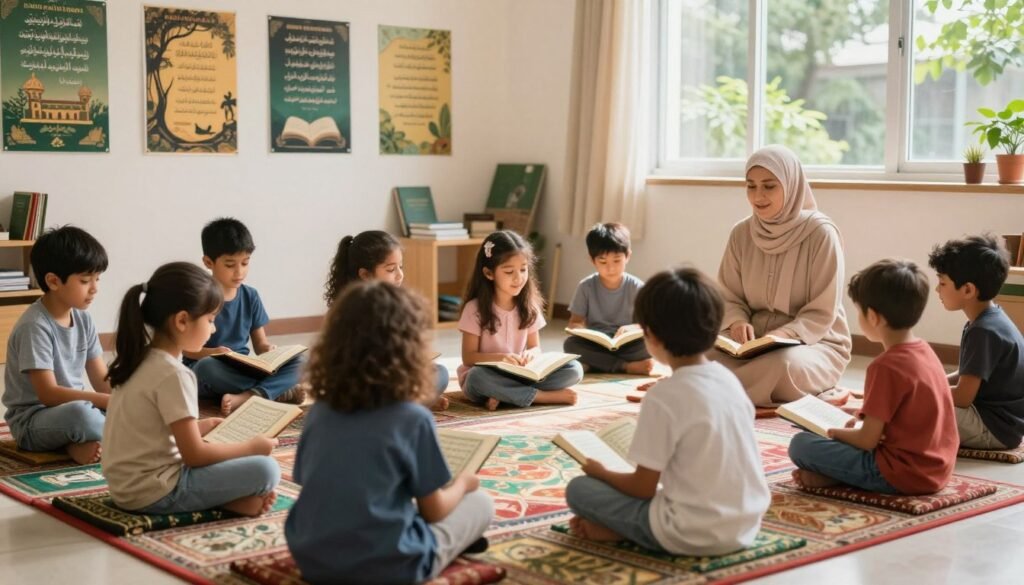
For many families in the United States, the benefits of learning quran at a young age show up in daily life, not just during recitation. When we treat Qur’an time as calm, steady practice—rather than a sprint—children build skills that help them at home and at school.
These benefits of early quran memorization often grow when routines are simple: a short lesson, clear goals, and gentle review. Over time, that rhythm shapes how a child approaches effort, mistakes, and progress.
Memory, focus, and discipline gains that often spill into school habits
With consistent repetition, many parents notice stronger recall, longer attention, and better self-control. The importance of memorizing quran as a child is not only spiritual; it can also support study habits like listening carefully, finishing tasks, and staying organized.
Because lessons are structured, children learn to sit, start, and complete a goal—even on busy weekdays. That kind of discipline can carry into reading time, homework, and classroom routines.
Stronger Arabic pronunciation through repeated listening and recitation
When teaching kids quran at a young age, repeated listening trains the ear before the tongue fully cooperates. Children absorb sound patterns, pauses, and rhythm; with patient correction, makharij and fluency become more natural over time.
This is one of the practical benefits of learning quran at a young age: pronunciation improves through exposure, not pressure. Later Arabic study can feel less intimidating because the sounds already feel familiar.
Confidence and character development through steady milestones
Finishing a short surah gives a child a real win. Small milestones turn “I can’t” into “I can,” which builds resilience and healthy motivation.
With steady Qur’an exposure, manners can also soften in quiet ways—more patience, more honesty, and kinder speech. The importance of memorizing quran as a child often includes this slow shaping of character, as reminders are heard and lived, not just memorized.
Family bonding when Quran becomes a shared home practice
Family life changes when revision happens together—listening in the car, reciting after Maghrib, or reviewing a few ayat before bed. These moments make faith feel present and warm, especially for children growing up between school culture and Islamic identity.
We also keep the Hereafter in view. In Sunan Abi Dawud, there is encouragement that parents of a child who recites and acts upon the Qur’an are honored with light—an aim that brings tenderness to the work and patience to the process.
| Benefit area | What families often notice at home | How it can show up at school | Simple way to support it |
|---|---|---|---|
| Memory and focus | Faster recall of lines; better listening during correction | More stamina for reading and instructions | Short daily sessions with the same start time |
| Discipline and routine | Less resistance to structured tasks; smoother transitions | Improved homework follow-through and planning | One clear target per day and quick review (muraja’ah) |
| Arabic pronunciation | Clearer letters through repetition; stronger rhythm in recitation | More confidence in language classes and presentations | Listen first, then repeat slowly with gentle feedback |
| Confidence and character | Pride after completing a surah; calmer response to mistakes | Willingness to try hard work and accept coaching | Celebrate small milestones and keep expectations realistic |
| Family bonding | Shared worship and calmer evenings; stronger connection to home values | Stable identity and less peer-pressure stress | One family recitation window, even if it is 10 minutes |
How Kids Memorize Best: Science-Backed Visual Learning and Retention
For many families in the U.S., the challenge is not motivation—it’s retention. When we use brain-friendly routines, Quran memorization for children becomes steadier, even with school and sports in the mix. These are effective methods for kids to memorize quran because they work with attention, repetition, and calm structure.
Why using the same Mushaf supports visual memory and recall
Keeping one Mushaf is more than tradition; it becomes a visual map. The page layout, line breaks, and even the spot where an ayah “lives” can cue recall when a child gets stuck.
This is the heart of sequential visual memorization: we move in order, and the same page becomes an anchor. For parents who are starting quran memorization early, this small choice often reduces stress and improves flow.
How listening + seeing + repeating strengthens long-term encoding
A strong loop uses three inputs: hearing, sight, and speech. The child listens to a trusted recitation, looks at the same lines, then repeats with gentle correction. This layered practice supports tajweed and memory at the same time.
As simple quran memorization tips for children, we can keep the steps consistent:
- Listen to a short passage (one ayah or 2–3 lines).
- See the ayat on the same Mushaf page while listening.
- Repeat out loud until the words feel smooth and stable.
Juz ‘Amma works well here because short surahs like Al-Ikhlas, Al-Falaq, and An-Nas allow quick repetition and clear wins without rushing.
Why “small chunks daily” beats occasional long sessions for the brain
Long weekly sessions can feel productive, but the brain learns better with spaced practice. A focused 15–30 minutes daily—sometimes even five strong minutes—builds stronger recall than a single long block.
When we pair small chunks with brief review, quran memorization for children fits real life. Many effective methods for kids to memorize quran use the same idea: consistent time, tiny portions, and steady revision so the child does not feel overwhelmed.
| Routine choice | What it feels like for a child | What it trains in memory | How to apply it at home |
|---|---|---|---|
| Same Mushaf every day | Familiar pages and fewer “blank moments” | Visual cues and faster retrieval | Keep one copy in the same spot; avoid switching print styles |
| Listen + see + repeat | Clear model, less guessing on pronunciation | Multi-sensory encoding and cleaner tajweed | Play one reciter, follow the line, then echo slowly |
| Micro-portions (1 ayah or 2–3 lines) | Manageable goals and quick confidence | Reduced cognitive load and better accuracy | Stop while it still feels “easy,” then review once more |
| Daily practice over weekly marathons | Less pressure, more rhythm | Stronger consolidation through repetition | Set a short daily slot after school or after Maghrib |
Proven Memorization Structures That Prevent Forgetting

In busy U.S. routines, quran memorization for children works best when the plan is simple and repeatable. We can honor quran memorization age guidelines without letting “age” run the schedule; the stronger driver is a steady rhythm that protects what was learned. The goal is calm progress—small wins that stay.
The Sabqi, Sabaqi/Manzil, and Dour model
Many teachers use a three-part structure because it matches how memory forms. This sits at the heart of memorizing quran for kids guidelines, whether your child learns at a local masjid or online with a qualified instructor.
- Sabqi: a short new portion each day, kept within your child’s focus window.
- Sabaqi/Manzil: a review of the last 7–10 days, so recent ayat don’t fade.
- Dour: older revision in larger blocks, so earlier pages stay fluent.
| Daily Block | Main Goal | What Parents Listen For | Common Time Range |
|---|---|---|---|
| Sabqi (new) | Accurate first imprint | Clear words, steady pace, clean stops | 10–20 minutes |
| Sabaqi/Manzil (recent) | Move new memorization into long-term recall | Fewer prompts each day; same page looks “familiar” | 15–30 minutes |
| Dour (old) | Keep earlier surahs from slipping | Strong flow across page breaks; quick recovery after a pause | 20–40 minutes |
Why many teachers recommend revising more than memorizing new lines
In real life, forgetting usually comes from light revision, not from “weak memory.” One of the most practical quran memorization tips for children is to give Muraja’ah more minutes than new lines, especially during school weeks. That’s one of the most reliable effective methods for kids to memorize quran without the stress of constant “catching up.”
We keep motivation stable by defining today’s win clearly: a few lines done well, plus revision done honestly. This keeps the load kind, and it protects confidence when homework, sports, and bedtime routines compete for attention.
Using memorized ayat in Salah as an effective retention tool
We can turn retention into worship by using memorized ayat in daily Salah. This adds spaced repetition in a natural way—quiet, consistent, and Sunnah-aligned—so memorization is not just a study task. For many families, this fits quran memorization age guidelines because it adapts to any stage: younger kids start with short surahs, and older kids rotate longer passages with care.
When Salah becomes part of the revision plan, the home routine supports quran memorization for children even on hectic days. It also makes memorizing quran for kids guidelines feel lived and meaningful, not just tracked.
Tips for Teaching Quran to Kids at Home Without Pressure
Home can be the safest place for steady growth in Qur’an—especially when we keep the tone calm and the goals clear. The best tips for teaching quran to kids start with connection: a gentle voice, a short plan, and a lot of encouragement.
For many families in the United States, teaching kids quran at a young age works best when it feels like part of daily life, not a high-stakes test. We can keep progress simple, trackable, and kind.
Build love before workload: environment of mercy, not performance
If we want starting quran recitation for kids to last, we build love before we count pages. Keep sessions short, avoid comparisons, and notice effort out loud.
One practical rhythm is: we recite clearly, the child repeats several times, then listens again later in the day. This is one of the most reliable tips for teaching kids quran memorization because the ear learns before the tongue feels confident.
Start small with Juz ‘Amma and celebrate completion of short surahs
Begin with Juz ‘Amma selections like Al-Ikhlas, Al-Falaq, and An-Nas. Short surahs give quick wins, and those wins protect motivation.
Celebrate completion in a simple way—call a grandparent, share the moment at dinner, or plan a small family treat. These are quran memorization tips for children that turn effort into a warm memory they want to repeat.
Set a fixed daily time and protect it like any essential appointment
Choose one daily slot and guard it: after breakfast, after school, or before bed. A steady routine beats weekend cram sessions for both retention and mood.
When life gets busy, we can shrink the session instead of skipping it. Even 10 focused minutes keeps starting quran recitation for kids on track without turning it into a battle.
Prioritize Tajweed from day one instead of “fixing later”
Tajweed is not “extra”; it is part of the Qur’an’s amanah. Correcting letters early protects confidence, so kids don’t feel they must unlearn habits later.
If pronunciation needs structure, a Noorani Qaida-style foundation helps secure makharij, then memorization becomes smoother. This approach supports teaching kids quran at a young age with clarity and respect for sound.
| Home focus | What we do in 10–15 minutes | Why it helps | Gentle parent role |
|---|---|---|---|
| Mercy-first tone | Open with one du’a, then 2–4 lines of repeat-after-me | Reduces stress; increases willingness to try again tomorrow | Praise effort, not “being smart” |
| Juz ‘Amma start | Memorize 1–3 ayat; end by reciting the full short surah | Fast progress; clear milestones for kids | Celebrate completion with family attention |
| Fixed daily time | Same time daily; quick review before adding anything new | Builds habit loops; improves long-term retention | Protect the time like homework or bedtime |
| Tajweed from day one | Correct one sound at a time; repeat it in a short phrase | Prevents fossilized errors; improves fluency | Stay present during revision even without perfect Arabic |
Conclusion
Many parents ask about the best age to start memorizing quran for kids, hoping there is one perfect window. In real homes, there isn’t a single magic number. The ideal age for quran memorization is the age when your child is ready—able to focus for short sessions, accept gentle correction, and return each day with a willing heart.
If you’re still weighing when to start quran memorization, look beyond age and focus on the basics that protect progress. Strong niyyah, steady practice, accurate Tajweed with a qualified teacher, and a clear Muraja’ah plan matter more than speed. This is what makes quran memorization for children stick, even with U.S. school schedules and busy weeks.
We also want to reassure families who feel they “missed it.” Teens—and even adults—can begin too, because time is usually the real obstacle, not ability. With a realistic routine, the best time to start learning quran is when your home can sustain daily effort—small, consistent steps that build confidence and calm.
That’s why we recommend Sequential Visual Memorization as a practical bridge between science and adab: the same Mushaf, small daily “Ayah & Tardeed” portions, and structured revision that prevents forgetting. If you’re ready to start, begin with a Juz ‘Amma mastery pathway and steady support—so the Qur’an grows as a lifelong companion, not a short-term project.
Do you prefer reading in Arabic? Check out our article on visual learning here.
Continue Memorizing Surah An-Naba
How Kids Can Memorize Surah An-Naba Verses 3-5 Step by Step