
What if the very effort we pour into our children’s Islamic education is setting them up to forget what they’ve learned? This heartbreaking question haunts many Muslim parents in the West who witness their children’s diligent memorization journey fade over time.
We know this silent struggle well. The initial pride as our child completes a juz, followed by the slow, frustrating erosion of those precious verses. It’s particularly acute for diaspora families balancing school, activities, and limited time for revision.
Consider Fahmid, who memorized several surahs during Ramadan but could barely recall them by Eid. Or Halima, whose daughter’s once-strong recitation became hesitant after just a few months without practice. This pattern of children forgetting quran they worked so hard to learn isn’t about lack of effort—it’s about how memory works in our modern context.
The common reasons are often invisible: insufficient revision cycles, learning without deep understanding, and the overwhelming distractions of daily life. Traditional methods, while noble, sometimes clash with the realities of Western upbringing.
This article addresses the core issue of quran memorization retention. We’re here to partner with you, combining Islamic values with cognitive science. Together, we’ll explore why retention fails and build a practical, sustainable system to transform your child’s relationship with the Quran from temporary achievement to lifelong bond.
Key Takeaways
- Forgetting memorized Quran is a common, painful experience for many Muslim families in the West, often related to time constraints and modern distractions.
- Real-life stories like Fahmid’s and Halima’s daughter show this isn’t about a child’s ability or dedication.
- The problem usually stems from how memory consolidation works and gaps in traditional revision methods.
- Effective retention requires understanding both Islamic learning principles and cognitive science.
- Parents and educators can work together to create a sustainable system that fits modern lifestyles.
- The goal isn’t just memorization but building a deep, lasting connection with the Quran.
- Practical solutions exist that respect both religious values and scientific understanding of memory.
The Heartbreaking Reality for Muslim Parents in the West
Many of us in the diaspora share a silent worry: will our children’s Quran memorization stick, or will it fade away?
We pour our hopes, time, and sincere intention into their Islamic education. Yet, we often confront the quiet heartache of seeing hard-earned verses slip from their memory. The story of Fahmid—a dedicated 17-year-old who memorized sections of Juz Amma only to find them elusive later—resonates deeply. It echoes the experience of parents like Halima, who describes feeling overwhelmed by the dual role of parent and Quran teacher amidst life’s other demands.
Our context in the United Kingdom and similar Western societies creates a uniquely complex landscape for teaching Quran to children. We are balancing:
- Packed schedules filled with school, homework, and extracurricular activities.
- A secular cultural environment that provides little daily reinforcement for Islamic learning.
- An intense inner desire to anchor our children’s identities in the timeless words of the Quran.
The pattern is painfully familiar. A child masters a surah for a deadline or a test, succeeds momentarily, but then fails to maintain consistent review. This “cram and drop” cycle breeds discouragement on both sides. The child feels a sense of personal failure, while the parent questions the return on their invested effort and emotion.
This situation is not a reflection of poor commitment. Frequently, it stems from a critical disconnect. The traditional approaches to Quran hifz challenges, though valued, were not designed for the cognitive realities and environmental pressures our children face today. Their minds are wired by a different world, one of rapid information and competing priorities.
We intimately understand this struggle. Our deepest concern extends beyond forgotten ayahs. We fear that this noble pursuit could transform into a stressful chore, overshadowing the spiritual joy and lifelong bond with the Quran we so desperately wish for them. The vision of our children carrying this divine guidance in their hearts can feel frustratingly fragile.
Understanding the Core Issue: Why Kids Forget Quran After Memorizing
Unpacking the core reasons behind Quran memorization loss in children reveals a combination of brain science and environment. It’s a challenge many families face, and feeling frustrated is completely normal. The good news is that by understanding these factors causing Quran forgetting in kids, we can move from guesswork to a clear, effective strategy.
Forgetting isn’t a personal failing. It’s a neurological process. When we see it this way, we stop blaming our children—or ourselves—and start building a smarter system for success.
The Forgetting Curve: Why Review Alone Isn’t Enough
Neuroscience shows us that memory fades rapidly without reinforcement. This is known as the “Forgetting Curve.” Imagine learning a new Ayah. Within hours, you might remember most of it. But after a day or two, without review, a significant portion slips away.
Traditional, sporadic muraja’ah (review) often falls into this trap. A weekly test or a monthly revision session is simply not enough to combat this natural decay. The brain needs deliberate, spaced repetition to move information from short-term to long-term storage.
Think of it like building a muscle. One intense workout doesn’t make you strong. Consistent, scheduled practice does. The same principle applies to memorizing the Quran.
Environmental & Psychological Factors
Our children’s surroundings and emotional state play a huge role. In the West, the learning environment is often fragmented. School, extracurriculars, and digital distractions compete for mental space, leaving little cognitive “room” for Quranic retention.
More critically, psychological pressure is a major factor causing Quran forgetting in kids. When a child feels intense performance anxiety—fear of making a mistake in front of a teacher or parent—their brain can enter a “survival mode.”
In this state, the prefrontal cortex, responsible for recall and reasoning, literally gets hijacked. The result? They know the Ayah at home but blank out in class. This creates a vicious cycle: pressure leads to mistakes, mistakes lead to shame, and shame leads to disengagement.
The “Cram and Drop” Cycle of Short-Term Success
Many of us have seen this pattern. A child works intensely to memorize a new surah for a deadline or a test. They succeed! There’s celebration. But then, attention shifts to the next surah, and the previous one is left without a structured review plan.
This is the “Cram and Drop” cycle. It relies on short-term memory for a quick win but neglects the long-term architecture needed for durable recall. Weeks later, that once-mastered surah is now a confusing mix of strong and weak spots.
The child feels overwhelmed trying to patch it all back together. This cycle is a primary driver of Quran memorization loss in children, leading to a frustrating sense of starting over repeatedly instead of building a permanent foundation.
Recognizing this cycle is the first step toward breaking it. It shows us that the goal isn’t just to memorize—it’s to integrate. True mastery means the Quran becomes a permanent, accessible part of your child’s mind and heart.
The Science of Memory: How a Child’s Brain Best Retains Information
To engineer lasting Quranic memory in our children, we must first understand the brain’s natural wiring for learning. Modern cognitive science gives us a powerful blueprint. It moves us from hoping for retention to actively building it. A child’s mind is not a simple recording device. It is a dynamic, connection-hungry network that thrives on specific types of input.
By aligning our teaching methods with these innate processes, we unlock far more effective and joyful hifz retention techniques. Let’s explore the three core principles that transform how information sticks.
Visual Learning and the Picture Superiority Effect
The brain processes images an astonishing 60,000 times faster than text. This is known as the Picture Superiority Effect. Information paired with a relevant visual is far more likely to be stored and recalled later.
Think about how easily a child remembers a scene from a favourite storybook. The same principle applies to Quranic verses. When an ayah is linked to a mental picture—the towering elephant in Surah Al-Fil, the vast night sky in Surah Ash-Shams—it ceases to be a string of unfamiliar sounds. It becomes a memorable scene etched into the mind.
This is a foundational strategy for improving Quran memorization longevity in children. We must move beyond auditory-only repetition and help their minds see the meaning.
The Role of Sequential Processing and Storytelling
Our brains are wired for narrative and sequence. We remember things better when they are part of a story or follow a logical order. This is why children love bedtime stories and can recount them in perfect sequence.
Traditional hifz can sometimes treat each verse as an isolated unit. But when we connect verses to the story of their revelation—the asbab an-nuzul—or to the flowing narrative within the Surah itself, we give the brain what it craves. The verses transform from abstract phonetic patterns into meaningful episodes in a larger story.
Context is the glue of memory. Telling the story of the Year of the Elephant doesn’t just teach history; it makes the verses of Surah Al-Fil unforgettable.
Leveraging this natural love for sequence is one of the most powerful strategies to strengthen Quran memorization in children. It builds a coherent mental map, making retrieval intuitive.
Active Recall vs. Passive Review: Building Durable Memory
This distinction is perhaps the most critical for lifelong retention. Most review is passive: re-reading or re-listening to a verse while looking at the Mushaf. The brain is on autopilot.
Active recall, however, is the deliberate effort to retrieve information from memory without any cues. It’s the mental equivalent of closing the book and trying to recite. This effortful practice strengthens the neural pathway, making the memory far more durable.
Consider the difference:
- Passive Review: Listening to a recording while following along in the text. Feels easier, but leads to shallow, fleeting memory.
- Active Recall: Closing the Mushaf and attempting to recite from heart. Feels challenging, but forges deep, long-term mastery.
Integrating regular active recall practice is the ultimate technique for improving Quran memorization longevity. It turns fragile short-term memory into unshakeable, long-term knowledge. By combining visual hooks, sequential storytelling, and this “mental strength training,” we provide our children’s brains with the optimal conditions for success.
Where Traditional Quran Memorization Methods Often Fall Short
Respecting tradition does not mean ignoring its practical shortcomings, especially when it comes to helping our children build a durable connection to the Quran. With deep reverence for the classical Hifz system, we must honestly evaluate its application in our modern homes. The goal isn’t to discard time-tested wisdom, but to identify where adjustments can turn struggle into sustainable success for our kids.
The Over-Reliance on Auditory Repetition (Tikrar)
The method of tikrar—repetitive recitation—is the bedrock of memorization. Its power is undeniable. However, when it becomes the only tool in the box, especially for children who don’t yet understand Arabic, a critical gap emerges.
This creates what experts call a “Comprehension Gap.” Verses are stored as sequences of sound, not units of meaning. For a young mind, this makes the memory incredibly fragile—like a beautiful but delicate string of beads with no thread holding them together. The slightest distraction or similar-sounding verse can cause the chain to break.
Focus on Quantity Over Mastery
A common, well-intentioned pitfall is measuring progress by volume alone. The drive to “finish a juz” can inadvertently overshadow the deeper, essential work of consolidation. This rush leaves knowledge wide open to confusion.
This approach directly leads to the challenge of Mutashabihat—the many similar verses in the Quran. Without dedicated time for mastery and differentiation, children easily mix them up. The consequences of this “cram and drop” cycle are clear:
- Fragile Retention: New verses push out poorly anchored old ones.
- Growing Frustration: Constant confusion erodes a child’s confidence.
- The “Hard Way”: As noted by educators, this creates unnecessary friction and demotivation, making memorizing the quran for children feel like an uphill battle.
The Missing Link: Contextual Understanding for Children
Perhaps the most significant shortfall is the separation of words from their world. When memorization is purely phonetic, it risks becoming a mechanical task—a checklist to complete, not a message to internalize.
Children are natural meaning-makers. They learn through story, connection, and relevance. Without linking verses to the powerful narratives of the prophets, the lessons for daily life, or the beauty of their message, we miss a profound opportunity. This missing context is the bridge between recitation and spiritual engagement. Filling this gap is key to solving the core quran memorization challenges we face and transforming duty into a lasting, heartfelt connection for our children.
Introducing a Better Way: The Power of Sequential Visual Memorization
What if memorizing the Quran for kids could feel less like a chore and more like solving an intriguing visual puzzle? For many families, the traditional cycle of listen-and-repeat has led to frustration and fading memory. We believe there is a better path—one that honors the sacred text while respecting how your child’s brain learns best. This path is built on a powerful, science-backed methodology known as Sequential Visual Memorization.
This approach moves beyond mere auditory repetition. It synthesizes timeless Islamic learning principles with modern cognitive science to create a system that is engaging, effective, and sustainable. It directly tackles the core reasons children forget, transforming revision from a daunting task into an active and rewarding journey.
What is Sequential Visual Memorization?
At its heart, Sequential Visual Memorization is a structured system that breaks down Quranic verses into manageable, meaningful segments—often called “chunks.” Each chunk is then paired with a unique visual cue or icon. Imagine a child learning a verse not as a string of unfamiliar sounds, but as a sequence of memorable images that tell a story.
This method leverages the cognitive principle of chunking, where the brain groups information into smaller units to improve recall. For example, a longer ayah might be divided into three conceptual parts, each represented by a simple, evocative image. The child learns to associate the Arabic text with these visual anchors.
The system is particularly powerful for navigating Mutashabihat (similar verses). Traditional methods often stumble here, but visual markers act as distinct notes in the memory’s melody, helping children instantly spot the subtle differences. The abstract becomes concrete; the complex becomes clear.
Why This Method is a Game-Changer for Western Children
This isn’t just another theoretical idea. For Muslim families in the West, it addresses specific environmental and psychological challenges head-on. The method is a game-changer for several compelling reasons:
- It Closes the Comprehension Gap: Many children recite without deep understanding. Visual cues attach immediate, intuitive meaning to the text, building a bridge between sound and significance.
- It Makes Practice Engaging: Review sessions become an active process of reconstructing a visual sequence. This feels more like a puzzle or a story than rote repetition, dramatically increasing a child’s willingness to participate.
- It Reduces Mental Friction: By providing a clear, step-by-step visual roadmap, the method lowers anxiety and cognitive load. This is crucial for building a daily habit that feels achievable, not overwhelming.
- It Aligns with Modern Learning: Children today are immersed in visual media. This method speaks their language, turning a potential distraction into a powerful tool for enhancing Quran memorization.
Ultimately, Sequential Visual Memorization shifts the goal from short-term recall to lifelong, durable mastery. It equips your child with a cognitive toolkit that makes the Quran a living, accessible part of their daily life. We see it not merely as one of many Quran memorization techniques, but as a foundational shift in approach—one designed for the reality of raising confident, connected Muslim children today.
How the Ayah & Tardeed Package Turns Theory into Lifelong Mastery
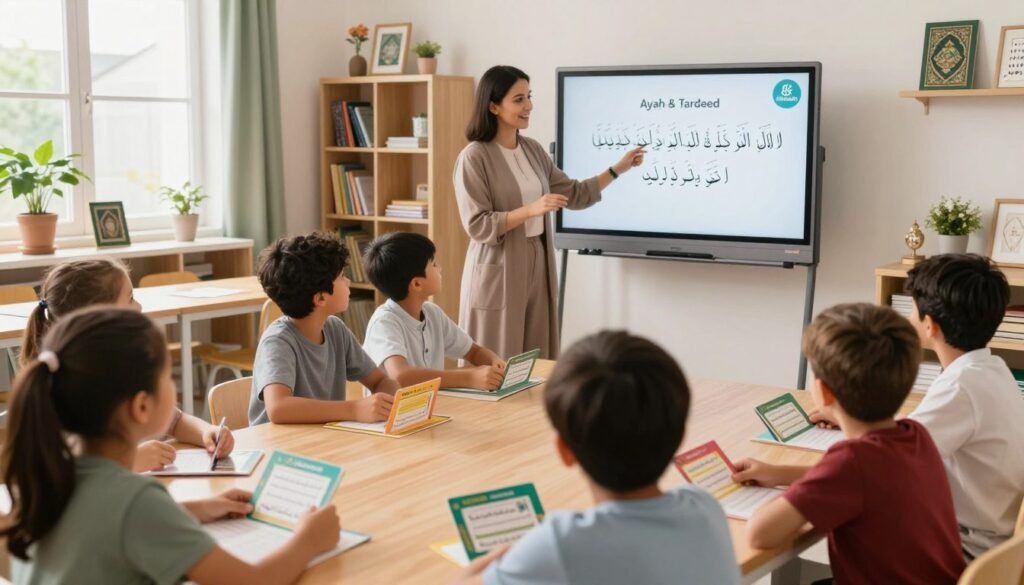
Practical application is key, and the Ayah & Tardeed package embodies this by turning Sequential Visual Memorization into an actionable family routine. We understand that knowing why a method works is only half the battle; the real victory comes from having the how seamlessly integrated into your daily life. This comprehensive package is the engineered solution, transforming cognitive science into a faithful companion for your child’s Quranic journey.
Structured for Success: The Two-Phase System
Lasting retention doesn’t happen by accident. It requires a deliberate structure that guides the brain from initial learning to deep, automatic recall. Our system is built on a proven two-phase cycle:
| Phase | Primary Focus | Core Method | Key Outcome |
|---|---|---|---|
| Ayah (Memorization) | Initial Encoding & Visual Mapping | Uses color-coded visual flashcards to link Arabic text with meaning and imagery, leveraging the Picture Superiority Effect. | Creates a strong, multi-sensory memory trace that is easier to retrieve. |
| Tardeed (Revision) | Spaced Repetition & Active Recall | Structured review schedules and prompts that force the brain to retrieve information without cues, combating the Forgetting Curve. | Transfers knowledge from short-term to long-term memory, ensuring mastery. |
| System Synergy | Lifelong Habit Formation | The seamless transition between Ayah and Tardeed phases creates a sustainable learning loop. | Builds the neural “muscle memory” for how to learn and retain the Quran independently. |
This isn’t just memorization and review; it’s a complete cognitive training system. The Ayah phase builds the foundation, and the Tardeed phase reinforces it with scientific precision, offering one of the most effective ways to prevent Quran forgetting in children.
Key Features Designed for Family Success
We designed every element with the realities of modern family life in mind. The package includes tools that work together, minimizing parental stress and maximizing child engagement.
- Visually-Coded Flashcards: Each card uses strategic colors and simple icons to create mental hooks, making complex verses digestible and memorable.
- Professional Audio Tracks: Perfect for “dead time” commutes or quiet moments, these recitations reinforce pronunciation and melody, deepening auditory memory.
- The Parent’s Guide: More than just instructions, this is a coaching manual. It helps you shift from an enforcer to a supportive partner, explaining the method and offering practical tips for encouragement.
- Lifetime Digital Access: This is a permanent family resource. As your child grows, the materials remain available for ongoing revision, adapting to new goals and longer surahs.
Starting with Juz Amma: The Foundation for a Lifetime
Confidence is the fuel for any long-term journey. That’s why we strongly advocate beginning with Juz Amma. These shorter, familiar surahs are the ideal training ground.
Mastering this Juz with our visual and active recall method does more than add pages to their memory. It provides a series of quick, tangible wins that build a child’s belief in their own ability. They aren’t just learning Surahs; they are learning how to learn the Quran successfully. This established competence and positive habit become the unshakeable foundation upon which all future memorization is built, effectively preventing Quran memorization loss in kids from the very start.
By starting with achievable mastery, we turn anxiety into accomplishment and lay the groundwork for a lifelong, loving connection with the Quran.
Building a Strong Foundation: 5 Daily Habits for Unshakeable Quranic Retention
Beyond any structured program, the true secret to unshakeable Quranic retention lies in the powerful daily rituals you establish at home. The most effective tips to help kids retain Quran are not complex secrets, but consistent, simple actions that build durable memory pathways day after day. We can move from hoping our children remember to knowing they will.
This shift requires us to rethink practice. It’s about embedding the Quran into the rhythm of daily life, not isolating it as a separate academic task. The following four habits, supported by a fifth foundational principle, provide a practical blueprint for this transformation.
1. The 15-Minute “Quality over Quantity” Rule
Replace long, draining sessions with short, focused bursts of high-quality engagement. Neuroscience shows our brains learn best in concentrated chunks. A dedicated 15-minute daily practice is far more powerful than a stressful hour once a week.
This method directly combats the “Forgetting Curve” by providing consistent, spaced repetition. The key is full engagement during those minutes. Sit with your child, free from distractions, and focus on mastery of a small segment—perhaps two or three new ayahs, or a thorough review of a known page.
Action for parents: Set a timer for 15 minutes. During this time, the goal is attentive recitation and correction. This consistency builds a reliable routine that children can anticipate without dread, turning practice into a predictable and peaceful part of the day.
2. Active Recall Practice: The “Close the Book” Method
This is the single most powerful technique for strengthening memory. Passive review—simply reading or listening—is weak. Active recall forces the brain to retrieve information without prompts, cementing it deeply.
Implement the “Close the Book” method. After your child has studied a section, gently close the Mus’haf and ask them to recite it from memory. Start with a single line and build up. It’s okay if they struggle; the struggle itself is where learning happens.
This practice transforms memory from fragile to robust. It moves knowledge from short-term recognition to long-term ownership. Make this a regular checkpoint in your daily 15-minute session.
3. Connecting Verses to Daily Life and Stories
Memory thrives on meaning. When a verse is connected to a story, a tangible example, or a personal experience, it stops being a sequence of sounds and becomes a living idea. This is one of the most engaging ways to remember Quran verses for children.
When reviewing Surah Al-Fil, talk about the power of small creatures overcoming giants. Link verses about gratitude to the food on your table. Use simple Tafsir resources for children to explain the context behind the revelation.
This contextual understanding creates a “hook” for the memory. The child remembers not just the words, but the story and feeling attached to them, making recall natural and meaningful.
4. Utilizing “Dead Time” for Audio Review
Learning doesn’t only happen during focused study. Our environments are powerful teachers. “Dead time”—car journeys, quiet playtime, or before bed—is a golden opportunity for passive reinforcement.
Play high-quality recordings of the surahs your child is learning. The familiar voice of a favorite Qari, playing softly in the background, normalizes the sound of the Quran and provides subconscious reinforcement of pronunciation, melody, and sequence.
This habit supports active learning without extra effort. It turns your home and car into a continuous learning environment, seamlessly blending sacred knowledge with daily life.
Transforming Daily Practice: From Ineffective to Effective
| Common Challenge | Inefficient Approach | Effective Daily Habit | Key Benefit |
|---|---|---|---|
| Limited time & child fatigue | Long, irregular weekend sessions | The 15-Minute Daily Rule | Fights the Forgetting Curve with consistent, low-stress exposure. |
| Superficial memorization | Only reading with the book open | Active “Close the Book” Recall | Builds durable, long-term memory by strengthening neural retrieval paths. |
| Lack of connection to the text | Pure phonetic repetition without discussion | Linking Verses to Stories & Life | Anchors memory through meaning and emotional relevance, a core principle for effective tips for Quran memorization. |
| Missed opportunities for reinforcement | Quran time confined to a study table | Using Audio in “Dead Time” | Creates a Quran-rich environment for effortless, passive learning throughout the day. |
These four habits create a holistic ecosystem for retention. They address the cognitive, contextual, and environmental factors that influence memory. By weaving them into your routine, you stop hoping your child retains the Quran and start building the daily conditions that guarantee it. The journey to lifelong connection is built one consistent, meaningful day at a time.
Creating a Supportive Environment: The Parent’s Role in Long-Term Success

While methods and materials are crucial, the atmosphere you cultivate at home is the invisible scaffold that supports your child’s lifelong Quranic connection. The most advanced learning system cannot thrive in a vacuum. True mastery is built within a nurturing ecosystem where emotional safety, shared values, and positive reinforcement are the bedrock. Your role evolves from a scheduler or overseer to a foundational pillar of support.
Modeling the Value: Let Them See You Recite
Children are exceptional observers but poor interpreters of lectures. Your actions speak volumes more than your instructions. Let them witness you finding solace, joy, and guidance in the Quran. This isn’t about perfect Tajweed; it’s about authenticity.
When you dedicate time for your own revision or listen to a recitation during daily chores, you silently communicate its irreplaceable worth. This modeling transforms Quranic practice from a child’s chore into a family value. It answers the “why” before the “how,” making the journey a shared family identity rather than an isolated task.
Reducing Performance Anxiety: Creating a Safe Learning Space
One of the most significant challenges in Quran retention for kids is the fear of making mistakes. Performance anxiety can shut down a child’s willingness to try, creating a mental block where verses simply won’t stick. Our role is to dismantle this pressure.
Celebrate the courage to recite more than the flawless output. Use phrases like, “I love how you tried that difficult word,” or “Your focus today was amazing.” Frame errors as stepping stones: “That mistake just showed us exactly what to work on next!” This approach creates a psychologically safe space where learning is prioritized over performance, directly improving Quran retention for kids by removing the fear of failure.
Partnering, Not Policing: Shifting Your Role from Enforcer to Coach
Move away from the “did you do your revision?” checklist dynamic. Instead, adopt the language of a coach. Ask collaborative questions: “Which part of Surah Al-Ikhlas feels strongest to you today?” or “Should we tackle the new verse together or would you like to try it solo first?”
This shift—from policing to partnering—makes you an ally in their journey. You’re working with them towards a shared goal. It empowers the child with ownership and turns practice sessions into collaborative problem-solving, rather than a top-down command. This partnership is key for sustaining motivation over the long years of memorization.
Connecting with Community: The Power of Peer Motivation
Isolation is a common catalyst for stagnation. Learning in a community, as seen in many successful stories, provides a powerful boost. Peer motivation makes practice social and fun. Look for local Quran circles at the mosque, consider forming a small study group with other families, or explore reputable online platforms where children can share progress in a supervised setting.
When a child sees a friend mastering a verse, it creates healthy, positive competition. Group recitations and shared goals build accountability and a sense of belonging. This community connection reinforces the habit, proving that the journey is not theirs alone to bear. It transforms a personal duty into a joyful, collective achievement.
Conclusion: Begin Your Child’s Journey to Lifelong Quranic Connection Today
The path from forgetting to lifelong Quranic mastery is now clear. It is built on informed strategy and consistent, loving support. We have explored the science and laid out a compassionate alternative for your family.
Effective quran memorization strategies blend understanding with modern technique. Sequential Visual Memorization, supported by structured systems, directly addresses core challenges. Your role in teaching quran to children evolves from enforcer to coaching partner. This shift is fundamental for success in a Western context.
The goal transcends simple recall. It fosters an unshakeable, personal connection with the Divine message. This gift of lasting fluency is a legacy you build together.
Take that first, decisive step now. Explore the resources designed for your family’s unique journey. Begin implementing these quran memorization strategies and transform your approach to teaching quran to children. Start building a foundation for a lifetime of connection today.
You can read the article “How to help your child memorize Juz Amma without forgetting it
Do you prefer reading Arabic? Check out our article on visual learning here.